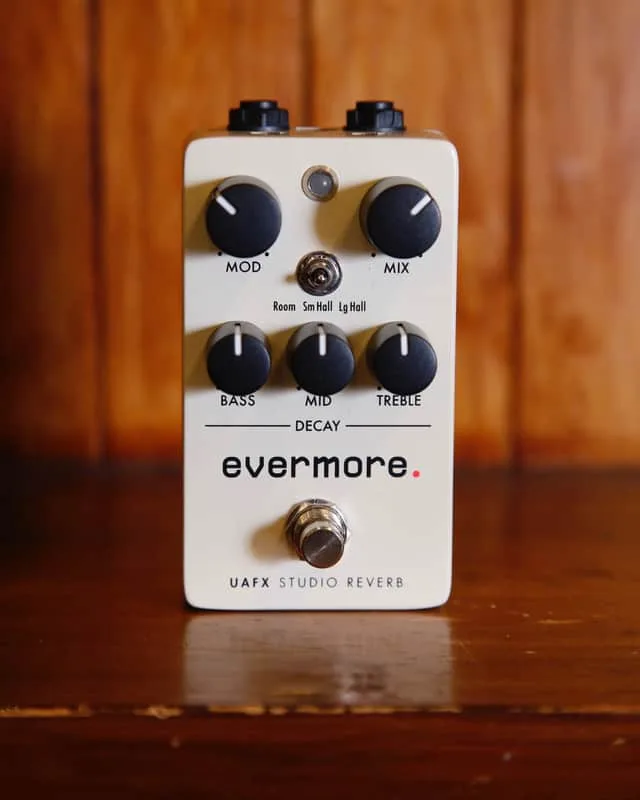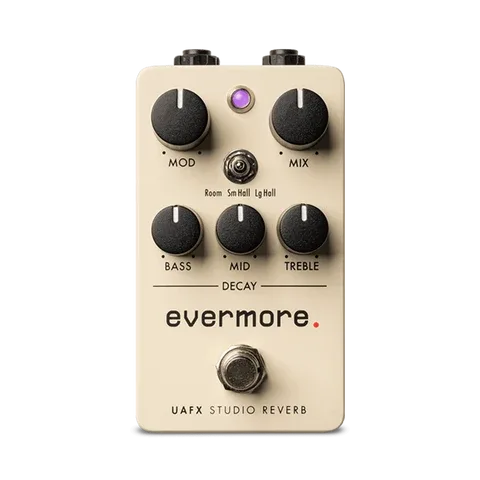


The Evermore Studio Reverb is a compact reverb pedal from Universal Audio that puts an authentic emulation of a vintage digital studio hardware unit into a small stompbox1. Universal Audio describes it as giving players "the grainy ambient tails and mesmerizing modulations of the iconic late-'70s early-digital device, in a compact, elegantly crafted stompbox"1.
Universal Audio describes the result as "the grainy ambient tails and mesmerizing modulations of the iconic late-'70s early-digital device, in a compact, elegantly crafted stompbox"1. In practical terms, that means digital reverb modeled on the hardware era when studio reverbs first went digital, complete with the modulation character those early units were known for.
Hall 224 reverb in a compact pedal
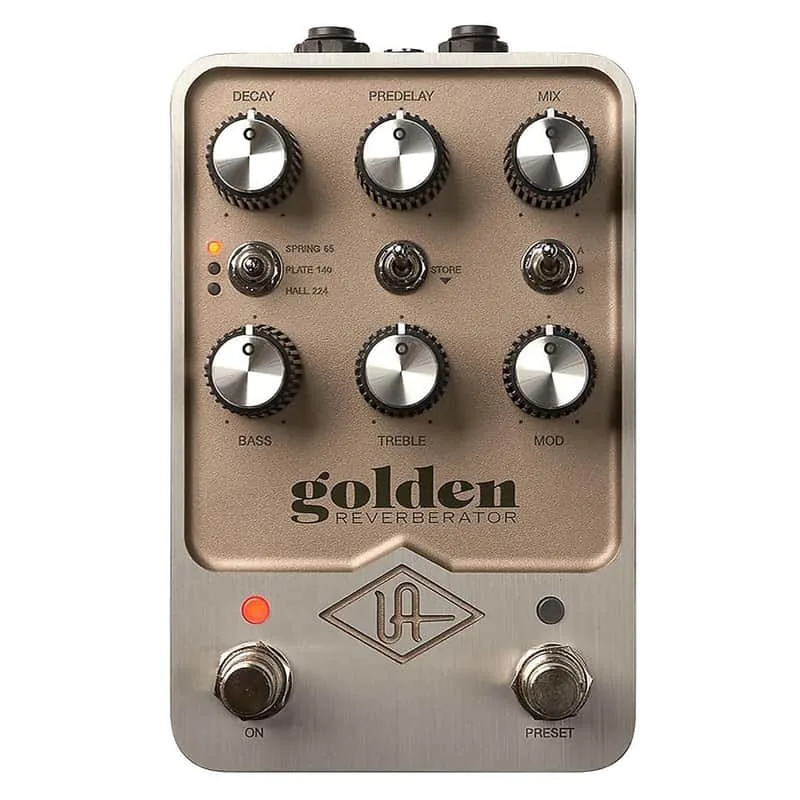
The Evermore's three programs, Room, Small Hall and Large Hall, are what Universal Audio calls "bit-for-bit emulations" of the original algorithms4. Gearnews' Stefan Wyeth identifies the source of those algorithms as the Lexicon 224, the late-'70s digital studio reverb, and notes the Evermore gives you "three different settings modelled on the famous Lexicon 224"51. The same Hall 224 algorithms appear in Universal Audio's full-size Golden Reverberator, so the Evermore is effectively a single-engine, smaller-format route to that pedal's hall sounds1.
Delicious Audio's Paolo De Gregorio framed the Evermore at launch as "at its core a Room reverb pedal" unveiled as one of four effects in the Compacts series2. For a player, the distinction from the bigger UAFX reverbs is scope: the Golden Reverberator bundles spring, plate and hall engines, while the Evermore is halls and room only, in a smaller box at a lower price than the full-size UAFX line2.
The controls
The control set splits between knobs for shaping the reverb and switches for choosing its character.
| Control | What it does |
|---|---|
| Mix | Blends the wet reverb signal with your dry sound2 |
| Bass, Mid, Treble decay lines | Vintage-correct three-band EQ for sculpting how the reverb tail decays across the frequency range1 |
| Mod | Adjusts reverb tail modulation, for what Universal Audio calls lush, grainy "early-digital" textures1 |
| Mode toggle | Selects Room, Small Hall or Large Hall2 |
| Pre-delay switch | Short or long pre-delay, placing the reverb behind your dry note1 |
| Footswitch | Reverb on/off3 |
The three decay lines work as a three-way EQ on the reflections rather than on your whole tone, letting you roll off bass so the tail stays clear, or shape the mids and treble of the decay12. The Mod knob is the character control: Guitar World noted at launch that it is "responsible for 'lush, grainy early-digital textures'"6, and GuitarPlayer's Art Thompson describes it simply as "a mod knob that adjusts reverb tail modulation"3. Pre-delay, selectable short or long, sets how quickly the reverb begins after your note, which keeps fast playing articulate under long hall decays1.
Power and connections
The Evermore requires an isolated 9V DC, center-negative supply delivering at least 250 mA1. Universal Audio specifies that compact single-footswitch UAFX pedals draw 250 mA, which rules out a battery and makes a proper isolated output, not a shared daisy chain, the safe choice. The power input is a 2.1 x 5.5 mm barrel connector, the same size as standard Boss connectors1.
Connections are 1/4" unbalanced TS jacks1. Input impedance is 1 Megohm, output impedance 500 Ohms, maximum input level 12.2 dBu, and frequency response is 20 Hz to 20 kHz, ±1 dB1. A USB Type-C port handles registration and firmware updates from a computer1.
Bluetooth is not on this pedal: Universal Audio's page states that dual footswitch UAFX pedals have Bluetooth, and the Evermore is a single-footswitch compact1. To update firmware, connect the pedal with a USB-C cable to a compatible computer and run the UA Connect application; registration can be done through the UA Connect desktop app or the UAFX Control mobile app1.
What reviewers said
GuitarPlayer's Art Thompson reviewed the Evermore among Universal Audio's compact stompboxes and found the reverbs held up in a real amp rig, writing3:
"Evermore's sounds are beautifully spacious and so inspiring"3
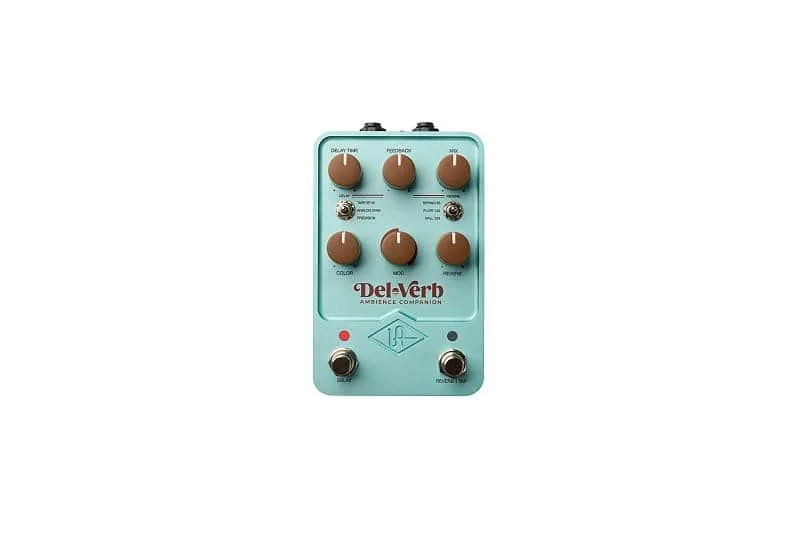
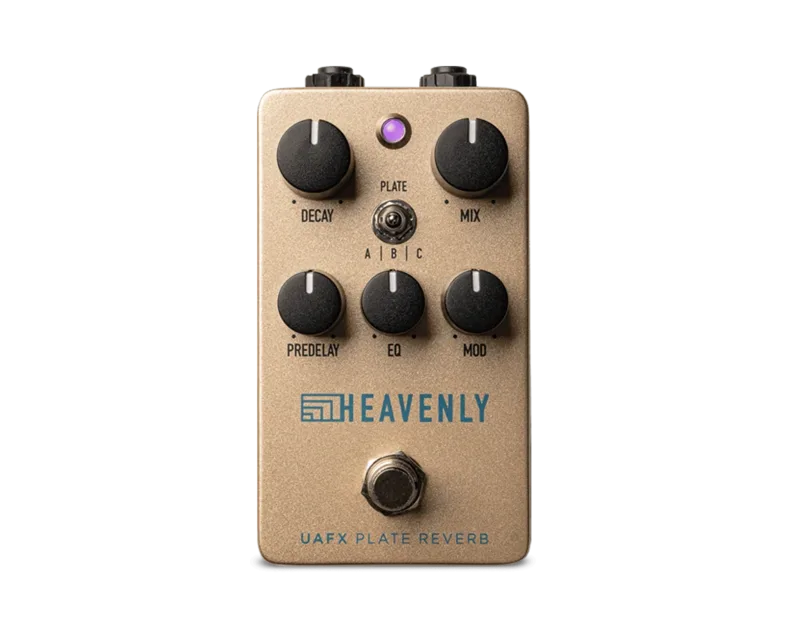
Thompson reported using the Room and Small Hall settings most, through a non-reverb Fender '48 Dual Pro, and that the reverbs sound good through an amp3. Gearnews' review of the compact UAFX quartet took a more measured view, praising the 1176 and Orion while finding the Heavenly and Evermore inferior to the full-size Del-Verb Ambience Companion2. Gearnews' budget reverb roundup nonetheless included the Evermore among its picks for home studio use, citing its Lexicon 224-modeled algorithms, modulation control, two pre-delay settings and three-band EQ5.
Videos
Sweetwater
Universal Audio
Corey Congilio
Questions
What reverb unit is the UAFX Evermore based on?
Universal Audio built the Evermore on the Hall 224 algorithms from its flagship Golden Reverberator pedal. Those algorithms model the late-'70s early-digital studio hardware associated with the Lexicon 224, and the Evermore offers three programs: Room, Small Hall and Large Hall.
Does the Evermore Studio Reverb have trails bypass?
Yes. The bypass is selectable between true bypass and trails bypass, so you can choose whether the reverb tail cuts off abruptly when you switch the pedal off or rings out naturally. A short/long Pre-delay switch is selectable in the same way.
Does the UAFX Evermore have Bluetooth?
No. Universal Audio's product page says Bluetooth is a feature of the dual footswitch UAFX pedals, and the Evermore is a compact single-footswitch model. Registration and firmware updates on the Evermore are done over USB-C instead.
How do I update the firmware on the Evermore Studio Reverb?
Connect the pedal to a compatible computer with a USB-C cable and run the UA Connect application to update the firmware. You can also register the pedal through the UA Connect desktop app or the UAFX Control mobile app.
Is the Evermore stereo?
The Evermore's connections are 1/4 inch unbalanced TS jacks, the same type used for a standard mono pedalboard setup. Universal Audio lists a single TS input and TS output for this compact model rather than the stereo connections of its larger UAFX reverbs.
Sources (6)
- Evermore Studio Reverb Pedal, Universal Audio
- UAFX Evermore Studio Reverb, Delicious Audio, 2023-09-25
- ''Creating dreamy sounds that were once only possible in world-class recording studios…'' The new award-winning range of stompboxes from Universal Audio will blow your mind, GuitarPlayer (www.guitarplayer.com), 2023-11-17
- New UAFX Pedals, Premier Guitar, 2023-08-22
- The Best Budget Reverb Pedals for your Home Studio, www.gearnews.com, 2026-01-19
- Universal Audio's latest UAFX pedals trim the size and the price, but still seek to recreate more “timeless” historic effects, Guitar World, 2023-08-24