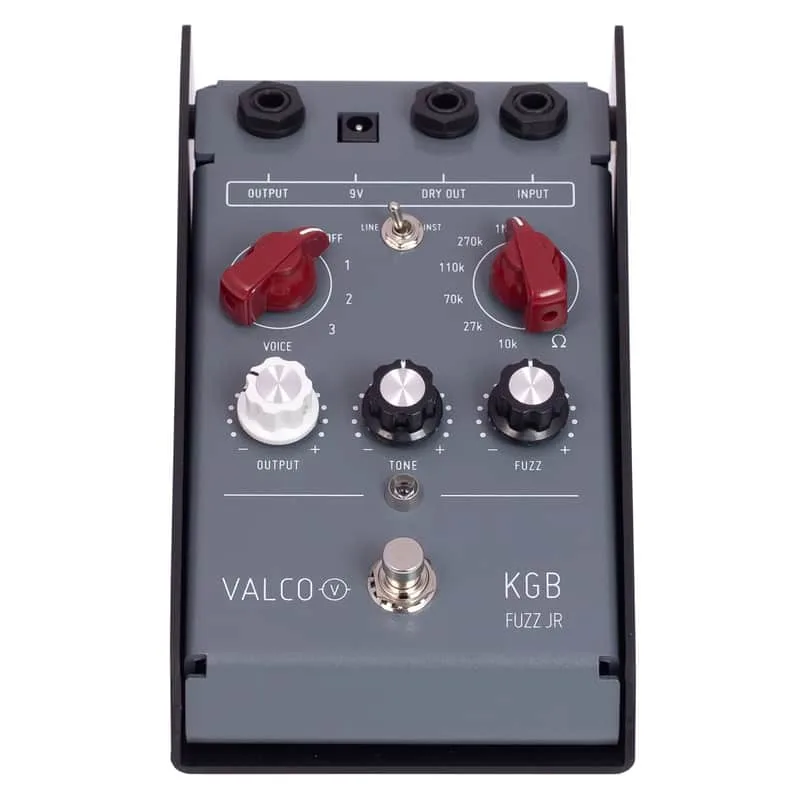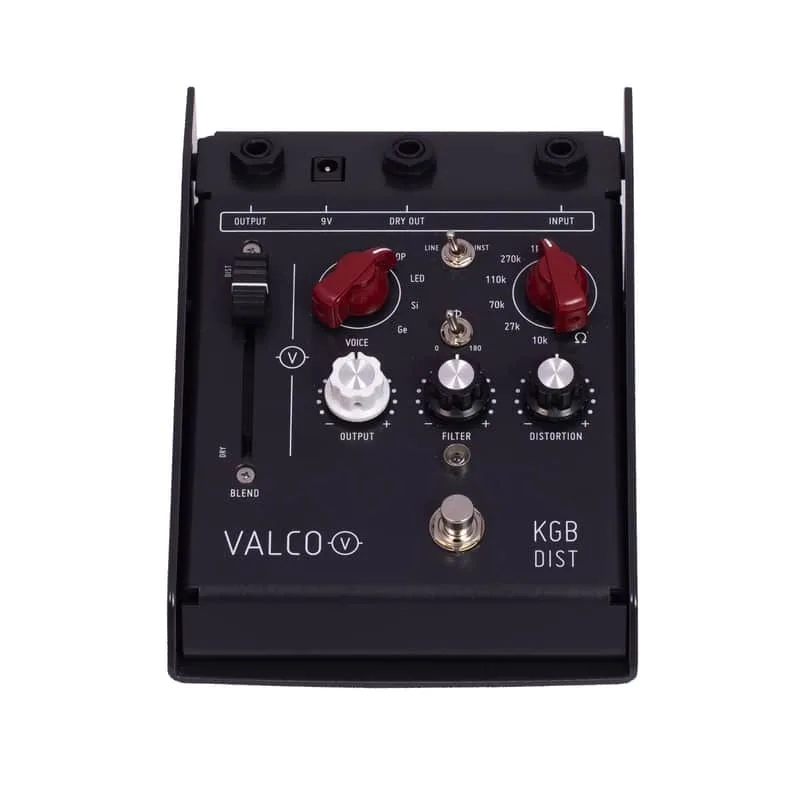


The Valco KGB Dist is a four-mode distortion pedal from Valco, a Canadian maker and subsidiary of Eastwood Guitars whose pedal line is designed and built in Canada1. The name spells out its intended range: KGB stands for keyboard, guitar and bass, hinting at the unit's broad function1. Delicious Audio described it as "a multi-function / tone-sculpting distortion machine, designed to work within a sound creation chain or as a regular standalone distortion pedal"2.
What sets it apart from most distortion boxes is the big red Impedance knob on the top right, labeled with the Greek letter Omega. It varies the circuit's impedance, which changes the signal's color and dynamics even with the distortion turned off2. It is the second release in Valco's KGB series, following the KGB Fuzz, and it mostly keeps that pedal's control layout while adding a polarity reverse switch2.
The four voices and the impedance knob
The heart of the pedal is the voice switch, which offers four flavors of distortion generation: op-amp (Op), LED diode clipping (LED), silicon diode clipping (Si) or germanium diode clipping (Ge)1. Delicious Audio breaks down how each one clips:
| Voice | How the distortion is generated |
|---|---|
| OP | Op-amp circuit where the LM308 itself enters clipping, the same chip found on some RAT pedals23 |
| LED | Unique "soft-clipping" generated using back-to-back LEDs2 |
| Si | Silicon diode circuit using back-to-back silicon diodes3 |
| Ge | Germanium diode circuit using back-to-back Schottky diodes3 |
The Impedance knob works independently of the drive. According to Delicious Audio, lower settings yield softer dynamics and transients with a notable "rounded / vintage" feel and tone, while higher settings give a sharper high-frequency response with a more direct, aggressive transient feel and more perceived gain3. Because it shapes the signal before the distortion circuit, it changes the character of whatever guitar, bass or keyboard is plugged in, even with the distortion knob rolled back2.
The controls
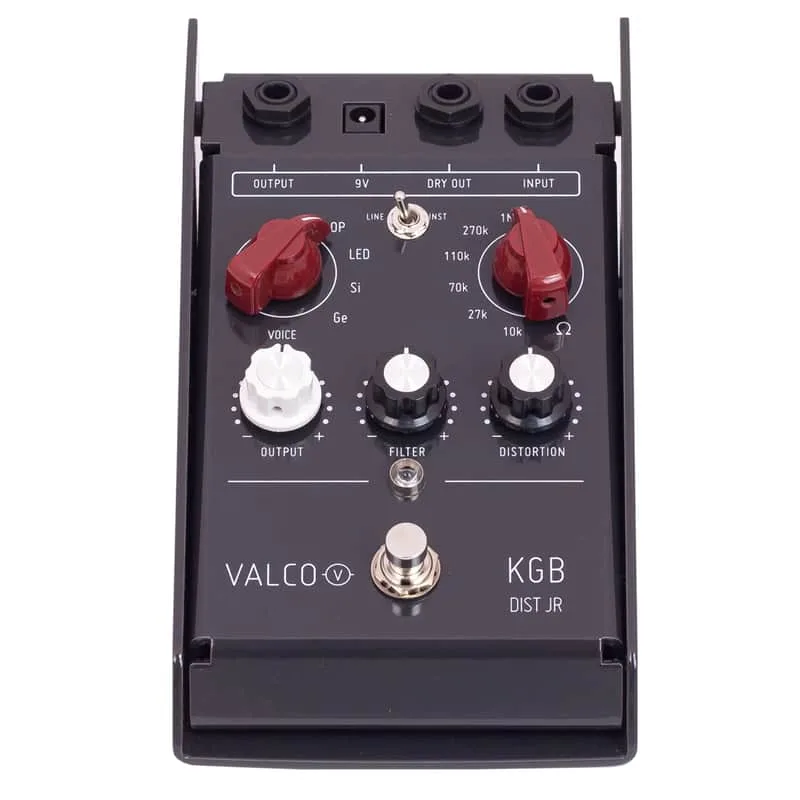
GuitarPlayer's review lists the full control set: Distortion, Filter, Output, Blend, Voice and input impedance, plus mini-toggles for polarity and line/Inst, and an on/off stomp-switch1. The shared controls with the compact JR version, as detailed by Delicious Audio, are:
| Control | What it does |
|---|---|
| DIST | Controls the amount of distortion3 |
| FILTER | A 1-pole low-pass filter; lower settings are brighter, higher settings roll off high frequencies3 |
| OUTPUT | Overall output volume of the distortion circuit, with increased headroom3 |
| VOICE | Selects the distortion voice3 |
| Impedance | Varies circuit impedance, shaping color and dynamics2 |
| Blend | Mixes dry and distorted signal; found on the full-size pedal only3 |
The Blend fader is the one control the KGB Dist JR leaves out3.
Inputs, outputs and power
The pedal's connections are an input, a dry out and an output, plus a 9V DC adaptor input, with the adapter not included1. The Dry Out is a permanent "thru" for the dry signal, taken before the impedance selector, so it can feed a second chain or recorder while the main output carries the processed sound2. There is no battery option on the full-size pedal; the JR, by contrast, runs on a standard 9V center-negative AC adapter or a 9V battery3.
The KGB Dist needs its own 9V DC adapter, which is not included, and has no battery compartment. Only the smaller JR version takes a battery.
The line/Inst mini-toggle is what makes the pedal friendly to more than guitars. It was designed to work with both instrument and line inputs, and Delicious Audio notes it works well with synths and audio interfaces2. The JR carries the same idea in a switch that makes the input compatible with line instruments like synths3.
What reviewers said
GuitarPlayer's Dave Hunter tested the KGB Dist with a Fender Telecaster and a Gibson 1959 Les Paul Reissue, into a Friedman Dirty Shirley Mini head and 2x12 cab and a tweed Deluxe-style 1x12 combo1. His verdict on the sound:
"there's an enjoyable range of mostly vintage-voiced distortion tones to be had, from a light thickening to an all-out, fuzz-like sizzle"1
Dave Hunter, GuitarPlayer1
He summed it up as "a well-made and good-sounding distortion pedal"1, while noting the practical cost of the enclosure: "Housed in a wedge-shaped, folded-steel box, the KBG DIST demands some real estate on your pedalboard"1. Delicious Audio's earlier look concluded it "looks and sound like another device worthy of attention"2.
Videos
Oscillator Sink
Bonedo Synthesizers
Demos In The Dark
Questions
What are the four clipping modes on the Valco KGB Dist?
The voice switch selects four ways of generating distortion: Op, where the LM308 op-amp chip itself clips; LED, a soft clip produced by back-to-back LEDs; Si, back-to-back silicon diodes; and Ge, a germanium diode circuit using back-to-back Schottky diodes. Each voice has its own clipping character, from the op-amp's RAT-style grind to the softer LED and diode voices.
Does the Valco KGB Dist come with a power supply?
No. The full-size KGB Dist runs from a 9V DC adaptor input and the adapter is not included. The compact KGB Dist JR can be powered by a standard 9V center-negative AC adapter or a 9V battery, so battery power is only an option on the smaller version.
What does the KGB in Valco KGB stand for?
KGB stands for keyboard, guitar and bass, a name that hints at the pedal's broad intended use. Valco designed it to work with both instrument and line inputs, so it handles synthesizers and audio interfaces as well as guitars and basses.
What does the Valco KGB Dist JR leave out?
The JR is a more compact version of the four-mode KGB Dist, and the main difference is that it drops the Blend fader. It keeps the four voice modes, the impedance control, the filter and the output level, and adds a switch that makes the input compatible with line instruments like synths.
Can the Valco KGB Dist be used with a synth or line-level source?
Yes. The pedal was designed to work with both instrument and line inputs, and Delicious Audio notes it works well with synths and audio interfaces. A line/Inst mini-toggle on the full-size pedal sets the input for the source you are feeding it.
Where is the Valco KGB Dist made?
Valco is a subsidiary of Eastwood Guitars, and its pedal line is designed and built in Canada. GuitarPlayer's review lists the KGB Dist's build origin as Canada.
Sources (3)
- Valco KGB DIST Distortion Pedal Review, GuitarPlayer, 2022-09-13
- Valco KGB DIST Distortion, Delicious Audio, 2022-08-17
- New Pedal: Valco KGB Dist JR, Delicious Audio, 2022-11-16