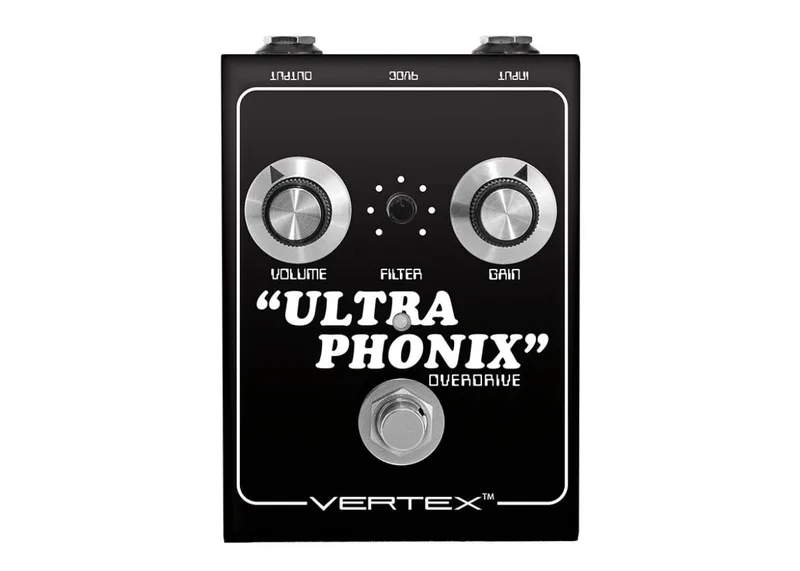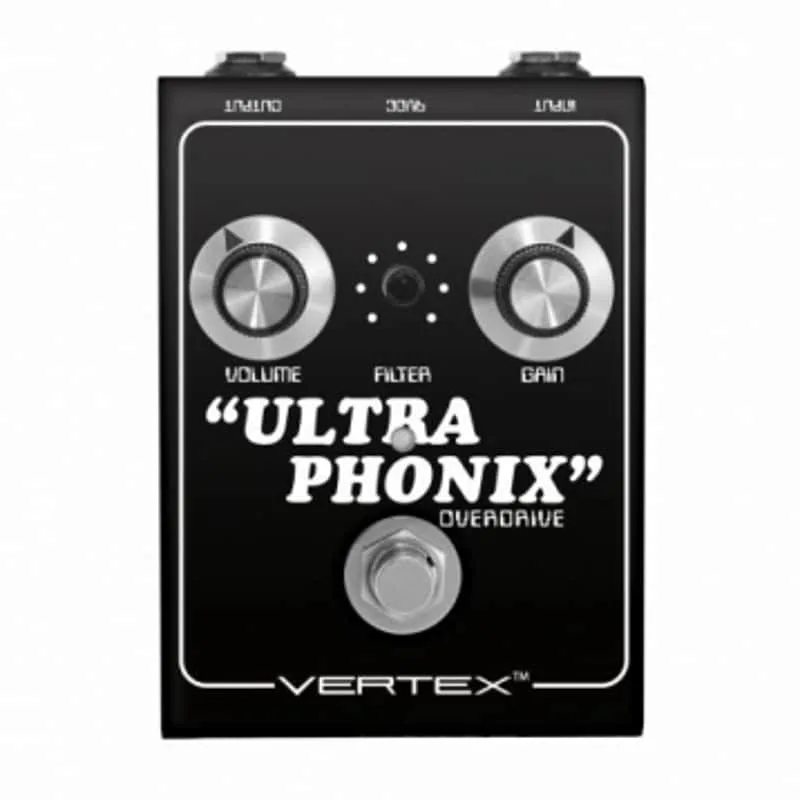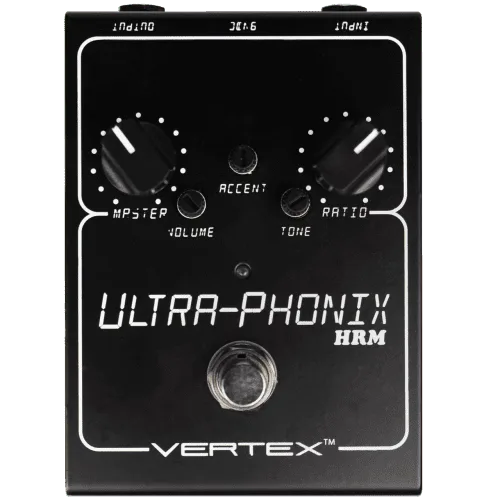


The Vertex Ultra-Phonix HRM is an overdrive pedal from Vertex Effects that takes a specific, rare branch of Dumble amplification and puts it on a pedalboard. Where most Dumble-style pedals chase the standard Overdrive Special, this one is a sonic re-creation of Dumble ODS #0214, an amp carrying the HRM modification: a tube mod, performed on only a limited number of Overdrive Specials, that shifted the midrange toward a British-style tone stack1. Vertex calls it an EL-34 British voiced Dumble-style overdrive, and the circuit is fully analog1.
The name carries two readings. In Vertex's Sweetwater demo, company owner Mason Marangella explains that "the hrm stands for hot rodded marshall"2, while Delicious Audio expands the same letters as Hot Rubber Monkey, the name of the tube modification itself3. Both point to the same idea: a Dumble preamp voiced with the midrange character of a British amp.
A Dumble HRM mod in a pedal
The Dumble Overdrive Special was built in small numbers, and among those amps an even smaller handful were armed with EL-34 power amp tubes rather than the 6L6 tubes found in most ODS amps3. That tube swap, combined with the HRM modification to the tone stack, is what the Ultra-Phonix HRM emulates: Delicious Audio describes the result as an expansive midrange and a burning-hot British-style tone stack3.
The pedal came about after one of Vertex's customers made an HRM edition Dumble Overdrive Special available to the company. Marangella says that amp sounded different enough from the standard design that it needed its own model, so Vertex "came out with a second version separately from the ultraphonics which really has no overlap sonically"2. In other words, the HRM is not the original Ultra-Phonix with a new paint job; it is a separate circuit built from a different reference amp.
Delicious Audio added the pedal to its list of Best Dumble-Style Overdrives in March 20213.
The controls
Vertex gives the HRM five voicing controls for overdrive tone1, and the layout rewards a player who likes to shape gain and EQ in stages rather than with one knob. Two of the controls are gain-related, and two are volume-related, which is unusual for a compact overdrive.
| Control | What it does |
|---|---|
| Volume | Adjusts how hard the pedal's preamp is working, giving more control over the amount of gain coming from the preamp1 |
| Master | Determines the total output of the pedal1 |
| Tone | Accentuates different upper-mid frequencies, ranging from 800 to 1.6k Hz1 |
| Accent | Increases presence and slowly introduces more saturation into the signal1 |
| Ratio | A second gain control adjusting the output gain2 |
The split between Volume and Master is the heart of the design. In the Sweetwater demo, Marangella describes the pedal as having "two different volume controls one is a pre gain one is a post gain"4, with a pre-gain that "allows you to voice how much saturation you want on the input stage"2 and a standard master volume control2. Setting the preamp hard and the master low, or the reverse, gives two very different feels from the same box.
The Accent control is the fine-tuning tool for the top end. Marangella describes it as "really voicing in that presence that top end," letting a player place the brightness in relation to the tone control2. Because the tone control works in the upper mids, around 800 to 1.6k Hz on the maker's page1, the Accent knob gives the high frequencies their own adjustment rather than dragging the whole EQ along.
How it differs from the original Ultra-Phonix
Vertex positions the HRM as having a quintessentially British voicing and EQ shift compared to the original version1. The practical difference, as Marangella puts it in the demo, is flexibility:
"if i were to have a very neutral amp i would choose the hrm over the ultraphonics because it's so much more dialable in"
He frames the HRM as the better choice for voicing the top end and midrange, especially with high gain sounds, when the amp itself is not adding character2. A player running a clean, neutral platform and shaping the drive entirely at the pedal has more to work with here; a player whose amp already has a strong voice may find either model fits.
In use
Sweetwater's demo of the pedal, presented by Marangella with guitarist Dani Rabin of the band Marbin, runs the HRM through a Fender Stratocaster into a Fender Hot Rod Deluxe2. An earlier Sweetwater demo from December 2019 covers the same ground, noting the tone control's reach of about 1.6 to 1.8 K4.
Vertex backs the pedal with a lifetime warranty and a 30-day money back guarantee return policy, and sells it through Sweetwater1.
Videos
Sweetwater
Vertex Effects
Questions
What does HRM stand for on the Vertex Ultra-Phonix?
Vertex's Mason Marangella says HRM stands for hot rodded Marshall, referring to the British-style tone stack the mod gave a small number of Dumble Overdrive Special amps. Delicious Audio also expands the abbreviation as Hot Rubber Monkey, the name of the tube modification performed on Dumble amplifier #0214.
What is the difference between the Ultra-Phonix and the Ultra-Phonix HRM?
The HRM is a separate design, not a modified Ultra-Phonix. Marangella says the two have no sonic overlap: the HRM has a quintessentially British voicing and EQ shift, and he describes it as more dialable for voicing top end and midrange, especially with high gain sounds into a neutral amp.
Is the Vertex Ultra-Phonix HRM analog?
Yes. Vertex lists the pedal as a 100% analog circuit. It is a sonic re-creation of Dumble ODS #0214, specifically the HRM version of the Overdrive Special, and is designed in North Hollywood, California.
Sources (4)
- Vertex Ultraphonix HRM, Vertex Effects (vertexeffects.com)
- Vertex Effects Ultra-Phonix HRM Overdrive Pedal Demo, Sweetwater (YouTube), 2021-03-19
- Vertex Ultra-Phonix HRM Overdrive/Distortion, Delicious Audio, 2021-03-22
- Vertex Effects Ultra-Phonix HRM Demo, Sweetwater, 2019-12-18