

The Vertex Ultraphonix is an analog overdrive pedal from Vertex Effects designed to re-create the overdrive produced by a Dumble Overdrive Special amplifier1. Dumble amplifiers are ultra-rare, American-built boutique amps that players have coveted for decades, and Vertex's pitch for the Ultraphonix is that it delivers that D-style overdrive in front of any clean amp platform12. The pedal can also be stacked with another overdrive pedal or used in front of an amp that is already breaking up1.
The original Ultraphonix launched in 2018, listing at $199.993. Vertex's own comparison page framed it against a Dumble valued at $100,000, with estimated shipping in Spring 20184. Research and development took over four years, from 2012 to 2016, and used five reference amplifiers2. Mason Marangella is named as co-designer2.
What it does: Dumble-style overdrive in a pedal
The Ultraphonix is engineered to recreate the sound of the Dumble Overdrive Special, an amp associated with players such as Carlos Santana, Robben Ford and Kenny Wayne Shepherd63. Rather than copying one specific amplifier, Vertex voiced and calibrated the pedal alongside four Overdrive Specials, each built between 1970 and 1990, to distill what those amps shared16. In the Sweetwater demo of the MkII, Mason Marangella explained the reasoning:
"when we made our original ultraphonics mark 1 we actually used four different dumbbell overdrive specials from different generations to really distill the x factor between those amps and we've carried that through to our mark ii"
Vertex describes the MkII's character as "blooming midrange and screaming overdrive" with "an articulate attack and smooth sustain" reminiscent of players like Robben Ford and Larry Carlton2. Gearnews reported Vertex's claim that the company had "shrunk a Dumble ODS" into the MkII5.
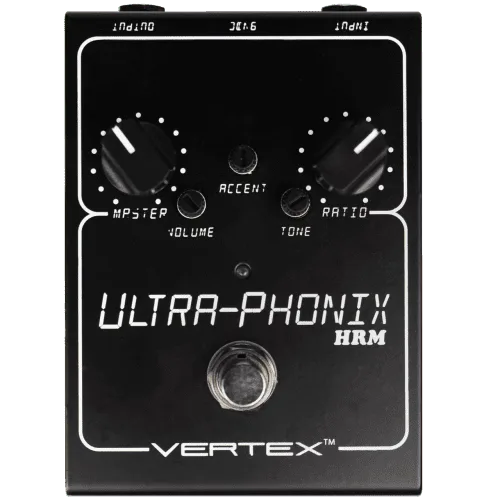
The family also includes a second version, the Ultra-Phonix HRM, which is a sonic re-creation of Dumble ODS #0214, an HRM (hot rodded Marshall) variant of the Overdrive Special89. According to Marangella, the HRM was created separately from the standard Ultraphonix and has no sonic overlap with it9. Vertex gives the HRM a "quintessentially British voicing and EQ shift compared to the original version"8. A third-party take on the original pedal's reputation comes from GUPtech, whose Lab Series #22 Ultraphonix Overdrive is based on the Vertex circuit and notes it is known to "simulate" the classic Dumble sound210.
The controls
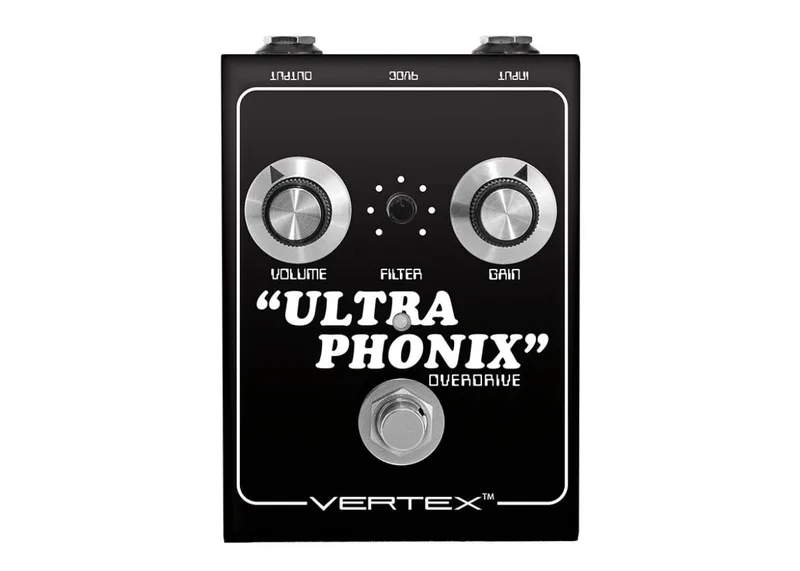
The original MkI keeps things straightforward with three controls: Volume, Filter and Gain311. The MkII adds gain-shaping controls beyond the MkI: Master Volume, input gain "Level", and a Distortion/Saturation "Ratio" control2.
| Control | Version | What it does |
|---|---|---|
| Volume / Gain | MkI | Core drive and level controls on the three-knob original3 |
| Level | MkII | Input gain with up to 8 dB of level compensation, to match pickup outputs or add input saturation27 |
| Ratio | MkII | Distortion/saturation control, described in the Sweetwater demo as the more typical gain control on a pedal27 |
| Master | MkII | Sets the final output level after all signal and distortion processing27 |
| Filter | MkII | Sculpts the upper-mids from 800 Hz to 1.6 kHz, adding presence and harmonic saturation2 |
On the Level knob, Marangella explained in the MkII demo that rolling it all the way off gives the stock MkI tone, while dialing it up adds up to 8 dB of extra input gain, useful for adding compression or compensating between humbucking guitars like a Les Paul or 335 and single coils like a Strat or Telecaster7. Delicious Audio notes the same knob can be used to more precisely match the input of the devices following in the chain6.
The HRM version has its own control set: Master (volume), Volume (gain), Accent (presence), Tone, and Ratio (clean blend)8. Its Tone knob accentuates upper-mid frequencies ranging from 800 to 1.6k Hz, the Accent control increases presence and slowly introduces more saturation, and the Master determines total output8.
MkI versus MkII
The MkII, announced in 2021, is an update to the first version launched in 20185. The differences:
- Size: The MkII is one third (33%) smaller than the original, with all top-mounted jacks, which Marangella described as making it very pedalboard friendly267.
- Level knob: New to the MkII, adding up to 8 dB of volume; the original MkI level is set with the knob fully anti-clockwise116.
- More control: Vertex says the MkII offers more control over overdrive tone, EQ and saturation than before2, with improvements based on player feedback from the Mark One7.
Both versions share 100% analog circuitry, mechanical true bypass switching, California assembly and 9V DC center-negative power operation with the adapter not included26.
What reviewers said
Published coverage of the Ultraphonix line has been largely descriptive. Guitar.com covered the 2018 launch, noting the three simple controls and that "you won't have to tinker about too much to get that rich D-style tone," and calling it a rugged unit with the same font stylings as the iconic amplifier3. Gearnews, covering the MkII in 2021, wrote that "the YouTube official demo video below doesn't sound that far off what you might expect from a Dumble-flavoured overdrive tone, so it could be a neat solution for anyone looking to cop that boutique American amp tone"5.
In the Sweetwater MkII demo, player Tim Marco described the pedal as "super dynamic so you have like a big bottom end with the with the low strings but then depending on how hard you pick um you can get more gain or less gain"7. Marangella's takeaway from the same video was about versatility: "you can get a variety of tones just to kind of depending on how you adjust and where you get the gain from"7.
The earlier Sweetwater HRM demo featured Dani Rabin of Marbin, a longtime Ultraphonix user who said "I used ultra phonics as my main lead sound"12. In that video Marangella said that with a very neutral amp he would choose the HRM over the standard Ultra-Phonix because of how much more dialable it is for voicing the top end and midrange, especially with high gain sounds9.
Delicious Audio added the Ultra-Phonix HRM to its list of Best Dumble-Style Overdrives in 202113, and its MkII coverage lists the pedal's features as "Quintessential D*style tone, note bloom, & harmonic overtones" alongside the analog circuitry and true bypass6.
The MkII runs on 9V DC center-negative power only, and the adapter is not included2. There is no battery option in the listed power specification, so plan on a dedicated power supply or pedalboard power source.
Videos
Andertons Music Co
Vertex Effects
News
Questions
Is the Vertex Ultraphonix true bypass?
Yes. Both the original Ultraphonix Overdrive and the Ultraphonix Special Overdrive MKII use mechanical true bypass switching, so with the pedal off your signal passes through without active circuitry in the path. The MKII also runs on 9V DC center-negative power, with the adapter sold separately.
What is the difference between the Ultraphonix MkI and MkII?
The MkII is one third smaller than the original, with top-mounted jacks for pedalboard space savings, and it adds a Level knob providing up to 8 dB of extra input gain. Rolling the Level knob fully anti-clockwise gives the original MkI level, so the MkII can reproduce the MkI's stock setting while adding more gain-shaping range.
What amp is the Ultraphonix based on?
It is based on the Dumble Overdrive Special. Vertex voiced and calibrated the pedal alongside four Overdrive Special amplifiers built between 1970 and 1990, aiming to distill what those amps shared into one pedal. The separate Ultra-Phonix HRM version recreates a specific amp, Dumble ODS #0214, an HRM (hot rodded Marshall) variant.
Where is the Vertex Ultraphonix made?
The Ultraphonix and the MKII are assembled in California, and the Ultra-Phonix HRM was designed in North Hollywood, California. Mason Marangella is named as co-designer of the Ultraphonix, and the research and development period ran from roughly 2012 to 2016 using five reference amplifiers.
What does the Level knob do on the Ultraphonix MkII?
The Level knob is an input gain control with up to 8 dB of level compensation. It lets you match the pedal's reaction to different pickup outputs, for example between single coils and humbuckers, or to add saturation and compression at the input. With the knob all the way anti-clockwise you get the original MkI level.
Is the Vertex Ultraphonix MKII true bypass?
Yes. Vertex lists mechanical true bypass switching on the Ultraphonix Special Overdrive MKII product page, and both Gearnews and Delicious Audio report the same. The MKII is a 100 percent analog circuit powered by 9V DC center-negative, with the power adapter not included.
Sources (13)
- Ultraphonix Overdrive, 100% Analog Dumble™ ODS emulator, www.vertexeffects.com
- Ultraphonix Special Overdrive MKII, www.vertexeffects.com
- Vertex Effects launches Ultraphonix OD, Guitar.com, 2018-07-19
- $199 Ultraphonix V.S. $100,00 Dumble, www.vertexeffects.com
- Vertex Effects Ultraphonix MkII: The legendary Dumble ODS in a pedal?, gearnews.com, 2021-08-03
- Vertex Ultraphonix MkII Special Overdrive, Delicious Audio, 2021-12-06
- Mason Marangella Demos the New Vertex Effects Ultraphonix MKII, Sweetwater (youtube.com), 2021-07-26
- Vertex Ultraphonix HRM, Vertex Effects (vertexeffects.com)
- Vertex Effects Ultra-Phonix HRM Overdrive Pedal Demo, Sweetwater (YouTube), 2021-03-19
- Lab Series #22, GUPtech (guptech.ca)
- Best Dumble-Style Pedals For Your Needs & Budget, Delicious Audio, 2024-09-25
- Vertex Effects Ultra-Phonix HRM Demo, Sweetwater, 2019-12-18
- Vertex Ultra-Phonix HRM Overdrive/Distortion, Delicious Audio, 2021-03-22