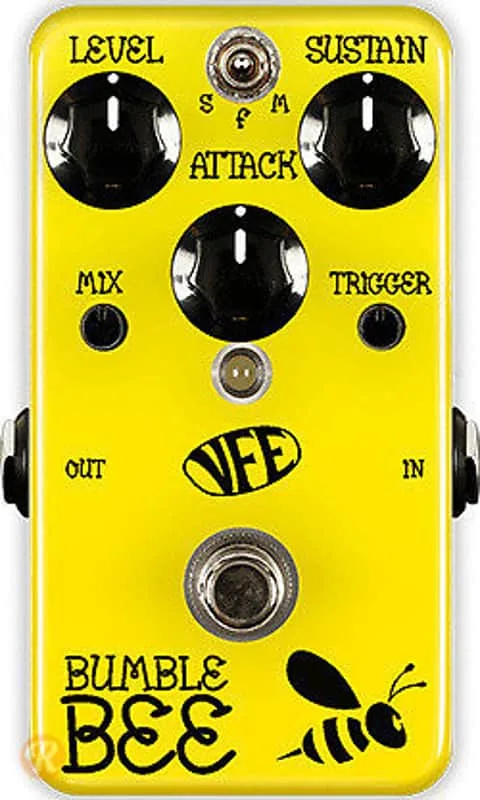

The VFE Bumblebee is a combination swell and compressor pedal from VFE designer Peter. VFE describes it as a pedal for creating ambient textures and unique effects: a wide attack range yields bowed guitar, reverse delay, and slow, synth pad-style sounds. It is also documented as working with bass, which makes it usable on either instrument1.
As a swell pedal, the Bumblebee sits in the same family of effects as the Boss SG-1 Slow Gear, the circuit it grew out of. As a compressor, it belongs to the broader world of compressor pedals, though its optical design and swell function set it apart from ordinary squashing compressors12.
From a Boss SG-1 Slow Gear clone to an original design
The Bumblebee's family tree starts with the Boss SG-1 Slow Gear, a swell pedal Boss first released in 1979 and made in Japan34. TONEHOME notes that the SG-1 was made using the exact same circuit as Boss's NF-1, but working in the completely opposite way3.
The Bumblebee's designer has described the path from there in his own words:
"The very first pedal I built was a clone of the Boss SG-1 Slow Gear. It barely worked. After countless hours of finding..."1
The account continues: the clone was modified to swell longer than the original, and then evolved into an original design rather than a straight copy1. One detail carried over from the Slow Gear is a capacitor value: the 0.47uF cap used in place of a 0.68uF is, according to the build documentation, the default value used in the Slow Gear, and it worked out fine1.
How the circuit works
The Bumblebee is an optical compressor, using an NSL32-R3 optocoupler/LDR rather than the VTL5C9 type. The build documentation is explicit on this point: "Use NSL32-R3, not the VTL5C9"1. In an optical compressor, an light-dependent resistor paired with a light source sets the amount of gain reduction, which is what gives the pedal its swell behavior.
The documented component list includes:
- IC1: OPA2134a
- IC2: 4558
- Q1, Q3: 2N5088
- Q2: 2N5457
- Q4 to Q7: 2N3904
- NSL32-R3 optocoupler
- 6.2V Zener and 1N914 diodes1
Controls
| Control | What it does |
|---|---|
| LEVEL | Sets the amount of gain in the output section. As a swell pedal, a master volume/boost is critical to creating the perfect swell and avoiding volume drops.1 |
| MODE | On/Off/On SPDT switch for the swell mode range1 |
The LEVEL control matters more on a swell pedal than on an ordinary compressor: because the swell effect can pull the volume down, the output gain is what keeps the swells at full strength1.
Building a Bumblebee
The Bumblebee is documented as a DIY project through Madbean Pedals, which published the build documentation in 20191. The designer's own notes appear in that document, including the admission that "There are a few deviations I made from the build and Peter's recommendations"1.
A few points matter to anyone considering a build:
- Enclosure: a 1590B1
- Power: a 9.42V One Spot DC supply, drawing 36mA1
- Optocoupler: the NSL32-R3, specifically not the VTL5C91
- Support: technical assistance for builds is available via the madbeanpedals forum rather than email1
The licensing terms are specific: purchased VFE Bumblebee circuit boards may be used for both DIY and small commercial operations, but the boards may not be resold or offered as part of a commercial kit. Peer-to-peer resale is fine1.
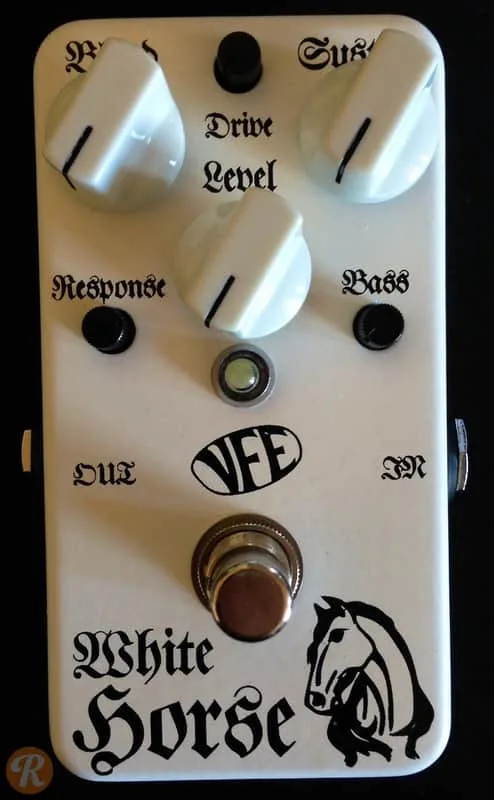
VFE also offers its design files through a product called The Motherload, which lists the Bumblebee as "Bumblebee comp/swell" among its contents2. For players more interested in VFE's other designs, the VFE White Horse is another circuit from the same designer documented as a DIY project.
Videos
L.F
Questions
Does the VFE Bumblebee work with bass?
Yes. The build documentation for the Bumblebee states plainly that the pedal loves bass, so bass players looking for slow, bowed or pad-style swell textures can use it on bass as well as guitar. Because it is a combination swell and compressor, the attack range can be set wide enough to create slow, synth pad-style effects on either instrument.
What power supply does the VFE Bumblebee need?
The build documentation lists a 9.42V One Spot DC supply for the Bumblebee, with a current draw of 36mA. A standard 9V DC center-negative supply is the usual choice for a pedal of this type, but the documented current draw means it should be powered from a supply rated to deliver at least that much.
What is the Bumblebee based on?
The Bumblebee's designer has said the very first pedal he built was a clone of the Boss SG-1 Slow Gear, and that the Bumblebee design descends from that circuit. It was modified to swell longer than the original, and then evolved into an original design of its own rather than a straight copy.
What size enclosure does the Bumblebee use?
The build documentation specifies a 1590B enclosure for the Bumblebee, which is a common Hammond-style aluminum box used in many compact DIY pedal builds. Builders sourcing parts for the project will need a 1590B along with the documented component list.
Can I build a Bumblebee from a VFE circuit board?
Yes. Purchased VFE Bumblebee circuit boards may be used for both DIY and small commercial operations. The boards may not be resold or offered as part of a commercial kit, though peer-to-peer resale is fine. Technical assistance for builds is available through the Madbean Pedals forum rather than by email.
Sources (4)
- VFE_Bumblebee.pdf, Madbean Pedals, 2019
- The Motherload, VFE Pedals
- TONEHOME, TONEHOME, 1979
- Onyx Volume Swell / BOSS® SG-1 Slow Gear, Aion FX, 2023-09-08