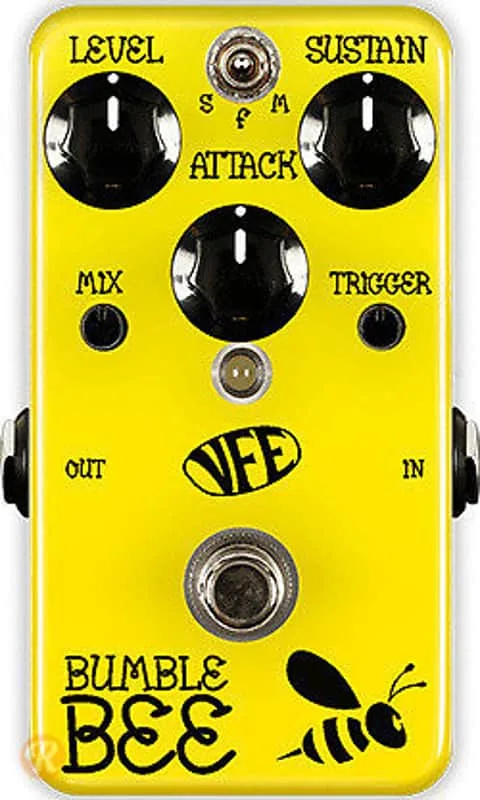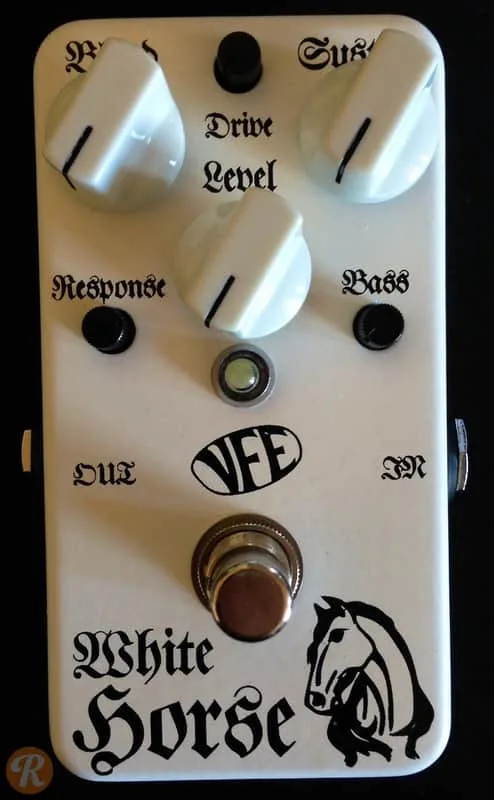


The VFE White Horse is an optical compressor pedal, and in the maker's words "a whole lot more": it pairs the compression stage with a blend control for longer, sustained notes and a drive section that responds to picking intensity1. It was sold under the VFE pedal line, which Madbean Pedals describes as recently discontinued as of its March 2020 documentation; the PCBs sold through Madbean are the actual boards used to build those pedals, so the White Horse now survives chiefly as a DIY project1. It sits in the wider family of compressor pedals, alongside other VFE designs such as the VFE Bumblebee.
The controls
The White Horse carries six knobs, each with a distinct job. The Blend and Level controls shape the mix and output, while Sustain, Pre-Gain, Speed and Drive shape the compression and the added gain stages1.
| Control | What it does |
|---|---|
| BLEND | Blends between the dry (uncompressed) and compressed signals1 |
| SUSTAIN | Adds gain/sustain to the compression stage1 |
| SPEED (labeled "Response" on schematic) | Sets the pre-gain bass cut; crank it to the max for a flat bass response1 |
| PRE-GAIN | Turn it up for more squish and sustain, or pull it back for high input sources like active bass guitars1 |
| DRIVE | Balances the gain section between the clean compression and a saturated mosfet drive section1 |
| LEVEL | Sets the output volume of the White Horse1 |
The Drive control is what separates the White Horse from a straightforward compressor: rather than only squashing the signal, it mixes in a saturated mosfet drive section, so the pedal can lean toward overdrive territory or stay clean depending on where the knob sits1.
Versions: from two BS170 transistors to four 1N914 diodes
The Drive section's clipping arrangement changed between versions. In ver.4.2, two BS170 transistors were set up for body-mode clipping, and the bill of materials called for four BS170s in total1. The March 2020 update made four 1n914 diodes the default instead, replacing Q1 and Q2, arranged in a way the manual says those familiar with the Timmy will recognize1.
Ver.5 is the current version offered as of March 2020. Wiring is the same for ver.5 as before the update, and electrolytic caps became a default alongside the 1n914 clipping change1.
Power and the LED that matters
The circuit uses a split-rail power supply, so anyone building the pedal needs to construct the Switching Board with the charge pump1. The opamp specified is a TLE20741.
One detail the manual stresses is the bypass LED. It is designed so that the compressor turns on gradually when the effect is activated, over a few milliseconds, and that behavior requires a high voltage drop LED. The manual puts the warning plainly1:
"If you want to try an experiment, use a red diffused instead and listen as your compression magically disappear."
In other words, the LED is not just an indicator: swapping in the wrong type removes the compression entirely, so builders should treat the LED choice as part of the circuit, not a cosmetic decision1.
Videos
JetCityMusic
Mike Hermans
Sam Vilo
Sources (1)
- Microsoft Word, Madbean Pedals, 2020-03