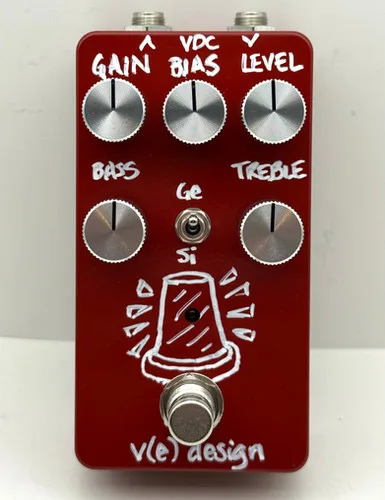


The VFE Fuzz Duo is a hybrid fuzz pedal that lets you switch between low-gain germanium and high-gain silicon transistors on the front end of a Fuzz Face circuit, or use a combination of both to create your own signature fuzz tone1. Four knobs (Level, Fuzz, Bias, Treble) and a Ge/Si toggle sit on the outside, with two trimpots inside for feedback and LED brightness.
The pedal is currently listed as Out of Stock on the VFE Pedals site at a sale price of $129.00, down from a regular price of $179.002. A DIY build thread has described the Fuzz Duo as "soon to be discontinued"3.
The controls
Four external controls shape the fuzz, plus the Ge/Si toggle for voicing.
| Control | What it does |
|---|---|
| LEVEL | Controls the output of the pedal2 |
| FUZZ | Sets the gain of the fuzz2 |
| BIAS | Sets the voltage fed to the second transistor stage; extreme low/high settings reduce output volume2 |
| TREBLE | Clockwise gives a flatter treble response in the gain stage2 |
| Ge/Si toggle | Switches between low-gain germanium and high-gain silicon transistors, or combines both21 |
The Bias control deserves a note for anyone building or modding the pedal. In the Fuzz Duo it is placed in series with the 1k resistor, which means it changes the bias setting as well as adds a lot of extra volume1. That is why the extremes of the knob cut output: the useful bias range sits between them.
The very first prototype worked differently from the production pedal. It had a 3-way rotary switch to toggle between germanium, silicon, and hybrid fuzz tones1; the finished pedal uses the simpler two-way Ge/Si toggle with a combined option.
The internal trimpots
Inside the pedal there are two trimpots, and they do very different jobs2.
- Main board trimpot (FDBK, 200k): affects the amount of feedback and voltage bias of the fuzz circuit. More feedback means less gain21.
- Lower trimpot: controls the brightness of the LED2.
For builders, the manual also records measured transistor voltages for a working unit, which gives a reference point when biasing your own build: Q1 (Si) collector 1.35, base 81mV, emitter 6mV; Q2 (Ge) collector 168mV, base 84mV, emitter 7mV; Q3 (Si) collector 0.75, base 1.34, emitter 0.69; Q4 (Ge) collector 7.65, base 168mV, emitter 118mV1.
Transistors and voicing
The Fuzz Duo runs two germanium and two silicon transistors. VFE's Peter often used BC108 for the silicon positions, listing hFE between 450 and 600 with a combined total between 1000 and 1200, the lower-gain one going in the Q1 position. For germanium he listed OC139 or OC140 with hFE between 70 and 130 and a combined total of 180 to 220, again with the lower-gain one first1.
The madbean manual's author built his own version with NPN AC127 germanium transistors (hFE about 140 each) and SE4002 silicon transistors, and reported both worked out fine1. A TO-5 style socket will fit the germanium positions if you want to socket them for swapping1.
Power
The pedal accepts the industry standard 9 to 18 VDC, negative-tip power supply2, with a current draw of about 11mA1. The 9 to 18V range means it will run on a standard 9V supply but can also take higher voltage from a suitable source.
DIY builds and layouts
Two routes exist for building one yourself.
Madbean Pedals PCB: Madbean Pedals offers a PCB version, though it is not a VFE PCB but rather an approximation of one; the circuit is 100% original to VFE1. Technical assistance for builds is available via the madbeanpedals forum1.
The filter control on the original units works as a sweep: fully counterclockwise lets the full bass range through the input stage, turning clockwise to 12:00 cuts bass and tightens the low end, and from 12:00 to fully clockwise it cuts treble in the gain stage and smooths the top end3.
Videos
Guitariste.com
JJ Tanis
TheGigRig
Questions
Is the VFE Fuzz Duo discontinued?
Yes. The VFE Pedals product page lists the Fuzz Duo as Out of Stock, and a DIY blog described it as soon to be discontinued as far back as 2016. VFE Pedals has also stated it will close down at the end of 2026, while continuing to offer repair service indefinitely. The page still shows a sale price of $129.00, down from a regular $179.00.
What transistors does the VFE Fuzz Duo use?
It uses two germanium and two silicon transistors in a Fuzz Face style front end. VFE's Peter often used BC108 for the silicon positions, with hFE between 450 and 600, and OC139 or OC140 for germanium, with hFE between 70 and 130. The toggle switches between low-gain germanium and high-gain silicon, or combines both.
Is there a DIY layout for the VFE Fuzz Duo?
Yes. Tagboardeffects published a layout in 2016, tagged Difficult, and updated and verified it on 01/07/2018 after input and filter section errors were fixed. Madbean Pedals also sells a PCB version, though it is an approximation of the original VFE board rather than an exact copy. Build support is available on the madbeanpedals forum.
What does the Bias knob do on the Fuzz Duo?
It sets the voltage fed to the second transistor stage. In the circuit it sits in series with a 1k resistor, so turning it changes the bias point and also adds a lot of extra volume. Extreme low or high settings will reduce the output volume, so the useful range sits in the middle.
Sources (3)
- VFE_FuzzDuo.pdf, madbeanpedals.com, 2020
- Fuzz Duo, VFE Pedals
- Guitar FX Layouts: VFE Pedals Fuzz Duo, Guitar FX Layouts (tagboardeffects.blogspot.com), 2016-08-26