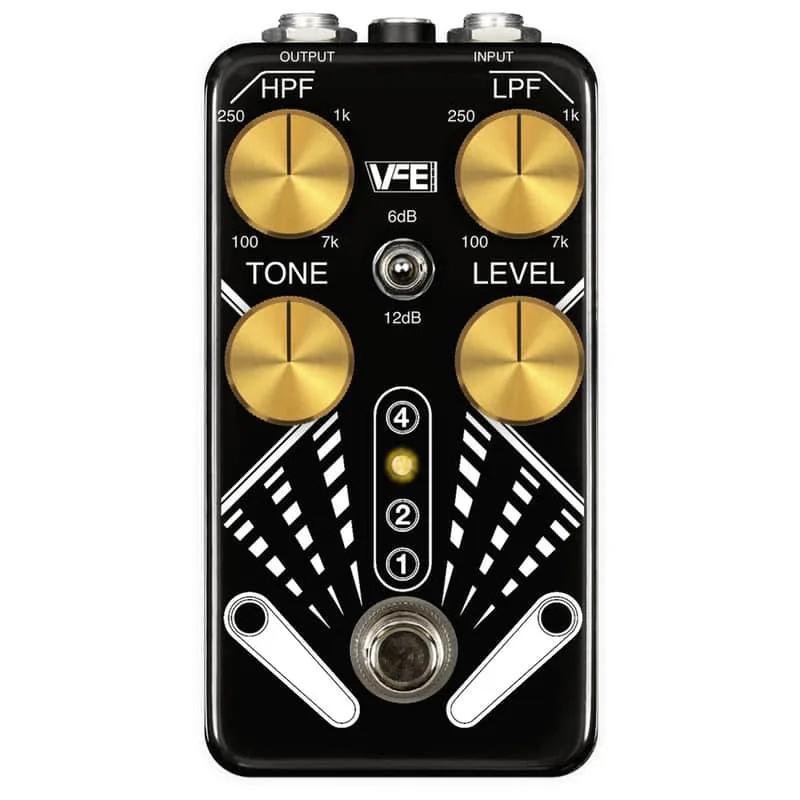

The VFE Pinball v3 is a mid booster and tilt EQ pedal in one box, made by VFE Pedals. A mode switch toggles between the two circuits: mid booster mode, which VFE derives from its Standout circuit, and tilt EQ mode, which comes from the original Pinball boost design1. In plain terms, one mode pushes your midrange forward so a guitar or bass cuts through a mix, and the other tilts the whole frequency balance brighter or darker from a single control point.
The pedal is listed at $199.00 USD regular price, on sale for $139.00 USD1.
The Pinball v3 is sold with a 30-day risk-free return: return it in new condition within the first 30 days for any reason for a full refund1.
Two circuits in one pedal
The v3 combines what were previously two separate designs. The mode switch selects mid booster mode, described by VFE as the original Standout circuit, or tilt EQ mode, the original Pinball1. A tilt EQ works differently from a graphic or parametric EQ: instead of cutting or boosting individual bands, it pivots the spectrum around a center point, so one setting raises highs while lowering lows, and the opposite setting does the reverse.
The BLEND control behaves differently in each mode. In mid boost mode it blends the EQ with a dry signal, so you can dial in how much of the boosted midrange character sits on top of your untouched tone. In tilt EQ mode it blends the high-pass filter with the low-pass filter, giving you control over where the tilt happens in the frequency balance1.
The controls
The Pinball v3 keeps its control set small, with most of the deeper options on internal switches and trimpots.
| Control | What it does |
|---|---|
| LEVEL | Controls the output of the pedal; VFE says there is plenty of clean boost on tap |
| BLEND | In mid boost mode, blends the EQ with a dry signal; in tilt EQ mode, blends the HPF with the LPF |
| 6dB/12dB | Toggles between first-order (6dB) and second-order (12dB) filters |
| Mode switch | Toggles between mid booster mode (original Standout) and tilt EQ mode (original Pinball) |
| DUALMODE | Wait 3 seconds and press tap + tap + hold for 3 seconds with the footswitch to activate or deactivate momentary mode |
| BUFFER/TRUE (internal) | Selects between buffered and true bypass switching |
| LED (internal trimpot) | Affects the brightness of the LED indicator |
The 6dB/12dB switch is worth a closer look for players comparing EQ pedals. A first-order filter cuts or boosts at a gentle 6dB per octave, for a subtle tilt; a second-order filter doubles the slope to 12dB per octave, for a more pronounced shift in the frequency balance1.
DUALMODE gives the footswitch a second behavior: when momentary mode is active, the effect is on only while you hold the footswitch down, which is useful for punching a mid boost into a solo or a single phrase. You switch it on or off by waiting 3 seconds, then pressing tap + tap + hold for 3 seconds1.
Power and bypass options
The Pinball v3 accepts voltage from 9V up to 15V, through the industry-standard 2.1mm pin, 5.5mm barrel, negative-tip power supply1. The wider-than-usual voltage range means it works with a standard 9V supply but can also run at higher voltages where a supply offers them.
The bypass question is answered by an internal switch labeled BUFFER/TRUE, which selects between buffered and true bypass switching1. That choice matters for pedalboard planning: true bypass keeps the pedal out of the signal path entirely when disengaged, while a buffered bypass keeps a buffer in the chain, which can help preserve high end over long cable runs. Because you choose it on the pedal itself, the same unit can serve either role.
Where the mid boost mode comes from
The mid boosting mode is derived from the Standout circuit, one of VFE's earlier designs, and the mode switch is described by the maker as toggling between mid booster mode (original Standout) and tilt EQ mode (original Pinball)1. The v3 is effectively both of those earlier pedals in one enclosure.
The Pinball v3's two modes trace back to two earlier VFE designs: the maker describes mid booster mode as the original Standout and tilt EQ mode as the original Pinball, with a mode switch to toggle between them1. The BLEND control behaves differently in each mode: in mid boost mode it blends the EQ with a dry signal, and in tilt EQ mode it blends the HPF with the LPF1.
Buying and support
VFE Pedals offers a 30-day risk-free return: try any VFE pedal, and return it in new condition within the first 30 days for any reason for a full refund1. The Pinball v3 carries a regular price of $199.00 USD and a sale price of $139.00 USD1.
Videos
VFE Pedals
VFE Pedals
Questions
Does the VFE Pinball v3 have true bypass?
Yes, and buffered bypass too. An internal switch labeled BUFFER/TRUE lets you select between buffered and true bypass switching, so you can set it to suit the rest of your pedalboard. A pedal placed first in a chain, for example, may work better with the buffer engaged.
What voltage can the Pinball v3 run on?
The pedal accepts voltage from 9V up to 15V, through the industry-standard 2.1mm pin, 5.5mm barrel, negative-tip power supply. Running it at higher voltage within that range is an option if your power supply offers it.
What is the warranty on VFE pedals?
All pedals assembled by VFE Pedals carry a 1-year warranty on parts and labor. The maker also offers a 30-day risk-free return: send a pedal back in new condition within the first 30 days for any reason and get a full refund.
Is VFE Pedals closing down?
Yes. The maker states that VFE Pedals will close down at the end of 2026, while continuing to offer repair service indefinitely.
Sources (1)
- Pinball v3, VFE Pedals