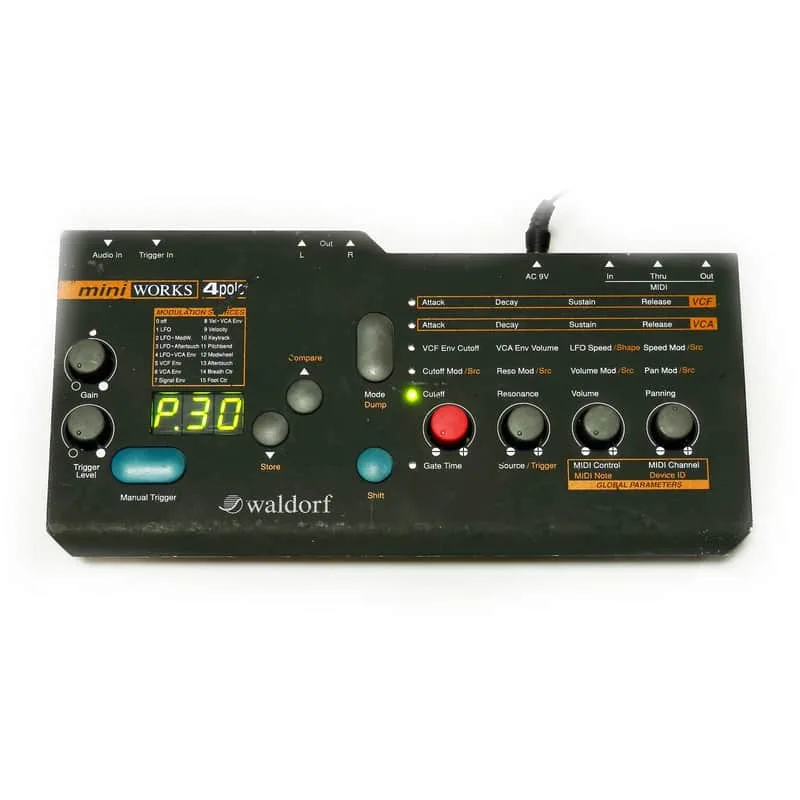



The Waldorf MiniWorks 4-Pole is a stand-alone 4-pole resonant analog filter and modulation module, produced in 1996. It takes an incoming signal, runs it through a 24 dB/oct resonant low pass or band pass filter, and shapes it with programmable modulation, making it a tool for sweeping filters over loops, synths or guitar rather than a playable instrument. Vintage Synth Explorer suggests using it "to create those Daft-Punk filter sweeps on entire drum & rhythm loops!"1
Mono in, stereo out
The MiniWorks 4-Pole is not a true stereo filter. Its input is mono and its output is stereo, so a single signal path is filtered and then sent out in stereo. Vintage Synth Explorer puts it plainly: "If it were a true stereo filter it would be perfect (input is mono, output is stereo)."1
| Specification | Detail |
|---|---|
| Filter | 24 dB/oct resonant low pass and band pass1 |
| Audio path | Mono input, stereo output1 |
| Polyphony | n/a1 |
| Multitimbral | No1 |
| Keyboard | None1 |
| Control | MIDI1 |
| Memory | 20 preset patches, 20 user patches1 |
The module is listed as mono, not multitimbral, and polyphony is listed as n/a, which fits a processor that works on one signal at a time.1
For a guitarist, that means the 4-Pole sits in a chain like a mono effect: one feed in, a widened stereo result out. It belongs to the wider family of filter pedals, though as a rack-style module it is aimed at processing whole mixes and loops as much as a guitar signal1.
Filter, modulation and overdrive
At its core is a 24 dB/oct resonant low pass and band pass filter. Around it, Vintage Synth Explorer describes "many modulation sources that can be programmed between the extensive VCF, VCA, envelope and LFO sections."1
The modulation architecture includes:
- VCF section (the filter itself)1
- VCA section, with two envelopes listed under it1
- Envelope sections1
- LFO sections1
Settings can be edited and "stored in the (20) user memory patches," alongside 20 factory presets.1
The module can also be pushed past clean filtering: "The MiniWorks can also be overloaded for a lo-fi crunchy sound too!"1
The MiniWorks 4-Pole was produced in 1996 and is a rack-style module rather than a pedal: it processes one mono signal at a time and is controlled over MIDI, not from a keyboard or footswitches.1
Control and MIDI
There is no keyboard on the MiniWorks 4-Pole; it is a processor, not a synthesizer. Control is by MIDI, and Vintage Synth Explorer calls the module "not only very flexible but MIDI controllable as well."1
What reviewers said
Vintage Synth Explorer's verdict is favorable within its class: "but in its price range it is the best analog filter module available!"1
Videos
fessx1
Record Press Play
Genshi Media Group
Questions
Is the Waldorf MiniWorks 4-Pole a true stereo filter?
No. Vintage Synth Explorer notes that the input is mono while the output is stereo, so it is not a true stereo filter. A mono signal goes in, and the module's filter and modulation sections shape it before it leaves through a stereo output.
Does the Waldorf MiniWorks 4-Pole have a keyboard?
No. The MiniWorks 4-Pole has no keyboard. It is a stand-alone filter and modulation module designed to process an incoming signal, and it is controlled via MIDI rather than played from keys.
Can the Waldorf MiniWorks 4-Pole be controlled by MIDI?
Yes. Vintage Synth Explorer describes the module as very flexible and MIDI controllable, with MIDI listed as its control method.
How many patches can the MiniWorks 4-Pole store?
The MiniWorks 4-Pole stores 20 preset patches and 20 user patches. Edited settings can be saved into the 20 user memory locations.
What kind of filter does the MiniWorks 4-Pole have?
It has a 24 dB/oct resonant low pass and band pass filter, described by Vintage Synth Explorer as a 4-pole resonant analog filter at the heart of a stand-alone filter and modulation module.
Can the MiniWorks 4-Pole be overdriven?
Yes. Vintage Synth Explorer notes that the MiniWorks can be overloaded for a lo-fi crunchy sound, on top of its filtering and modulation duties.
Sources (1)
- Waldorf MiniWorks 4-Pole, Vintage Synth Explorer, 2026