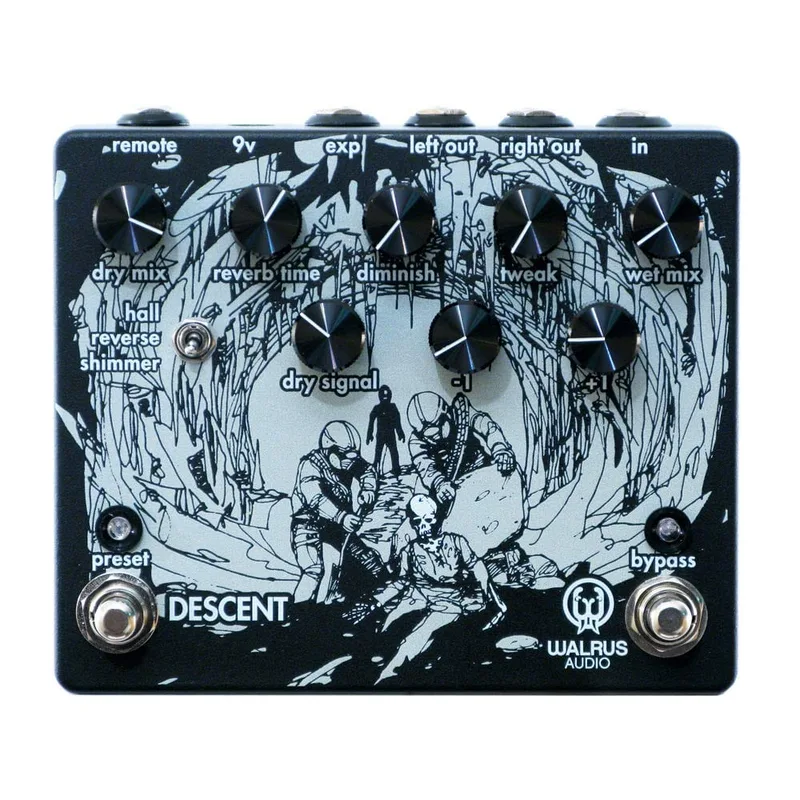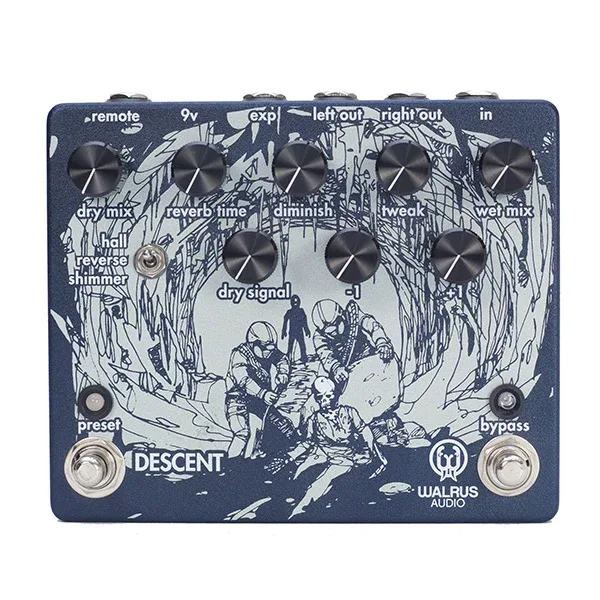


The Walrus Audio Descent Reverb/Octave Machine is a reverb pedal with octave features, designed to create ambient textures of sound, from thick and endless hall reverbs to symphonic shimmers. It is a three-mode reverb system: hall, reverse, and shimmer, and in each mode the user can feed +1 and -1 octaves into the reverberated signal. The pedal is discontinued and no longer available1.
The three modes
Each mode shapes the reverb differently, and the octave feeding works across all of them1.
| Mode | What it does |
|---|---|
| Hall | A classic reverb sound that can move your signal from a small-room-echo to a haunting long hall-echo1 |
| Reverse | Smoothly flips your signal to playback unique responses, manipulated with pre-delay time controls1 |
| Shimmer | Highlights the octave features, dry signal, -1, and +1 to mix in your signal and creates a symphony of sound1 |
The octave feeding is the Descent's distinguishing feature: rather than a straight reverb, it lets the player blend octaves above and below the note into the reverberated signal, which is what gives the shimmer mode its character. For more on how octave circuits work in general, see Octave & Pitch Pedals, and for other reverb designs, see Reverb Pedals1.
Controls, presets and expression
The Descent offers eight controls to precisely hone in your perfect reverb1. Beyond the front panel, two connections extend what the pedal can do:
- Fav input: an auxiliary momentary switch can be plugged in here to switch the pedal on/off and/or save presets1
- Expression pedal: works with most on-the-shelf expression pedals; it sets high and low parameters of each control and fades them in and out by moving the pedal1
Saving presets requires an auxiliary momentary switch plugged into the fav input. The pedal's own footswitch handles on/off, but preset storage is done through that external switch.
Power and bypass
The Descent runs on 9VDC at 130mA minimum, and a power supply is not included. Walrus Audio recommends an isolated power supply for all Walrus Audio pedals and does not recommend daisy chain power supplies, so plan a dedicated isolated output on your board's power supply1. Bypass is buffered rather than true bypass1.
Context in the Walrus Audio range
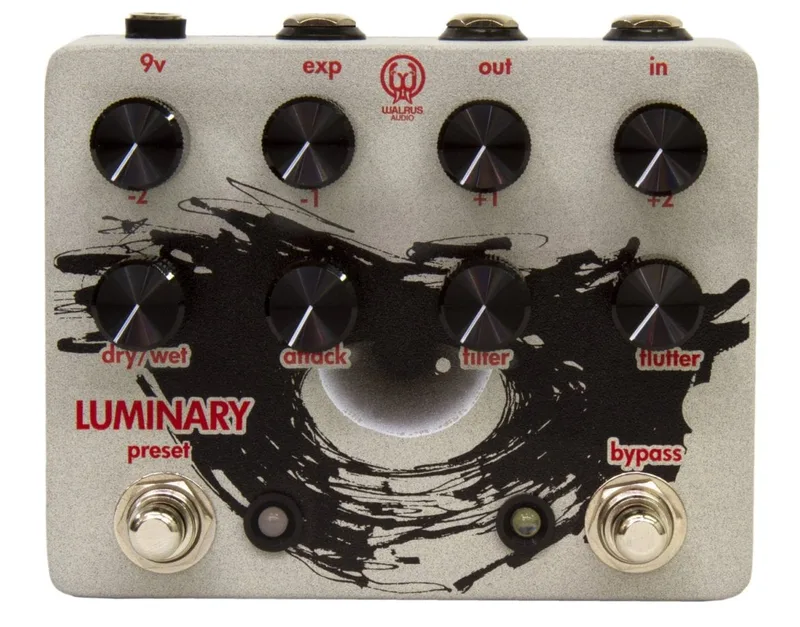
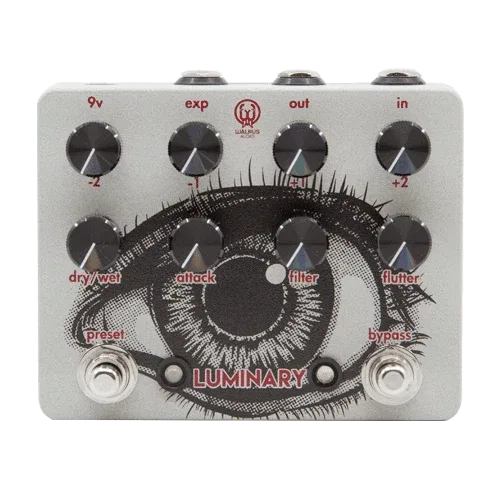
The Descent sits alongside Walrus Audio's other octave-oriented pedals. The maker's Luminary line, including the Luminary V2 and the original Luminary Quad Octave Generator, takes a different approach: a polyphonic quad octave generator rather than a reverb with octave feeding. Where the Descent blends octaves into a reverberated wash for ambient textures, the Luminary builds octave voices as the core effect1.
Videos
ProGuitarShopDemos
Premier Guitar
Premier Guitar
Questions
Is the Walrus Audio Descent still made?
No. Walrus Audio lists the Descent as discontinued and no longer available. The pedal was a three-mode reverb with octave features, offering hall, reverse and shimmer modes. Players looking for Walrus Audio's current ambient and octave-oriented pedals can check the maker's brand page for what is in the lineup now, since the Descent itself is no longer in production.
Does the Descent have true bypass?
No. The Descent uses buffered bypass rather than true bypass. A buffer keeps the signal path driven when the pedal is off, which can help preserve tone over long cable runs and large pedalboards. It is worth knowing when planning a board, since a buffered pedal behaves differently from true bypass pedals in how it interacts with the rest of the chain.
Does the Descent come with a power supply?
No, a power supply is not included. Walrus Audio specifies 9VDC at 130mA minimum and recommends using an isolated power supply. Daisy chain power supplies are not recommended. Players should plan a spare isolated output on their power supply, since sharing an output on a daisy chain is not advised for this pedal.
Can you save presets on the Descent?
Yes, but not from the pedal's front panel alone. The Descent's fav input accepts an auxiliary momentary switch, which the user can use to switch the pedal on and off and/or save presets. That means saving a preset requires adding a separate momentary footswitch plugged into the fav input.
Can you use an expression pedal with the Descent?
Yes. Walrus Audio says the expression pedal control works with most on-the-shelf expression pedals. The expression pedal sets high and low parameters of each control and fades them in and out by moving the pedal, so a player can sweep reverb character in real time during a performance.
Sources (1)
- Descent Reverb/Octave Machine, Walrus Audio