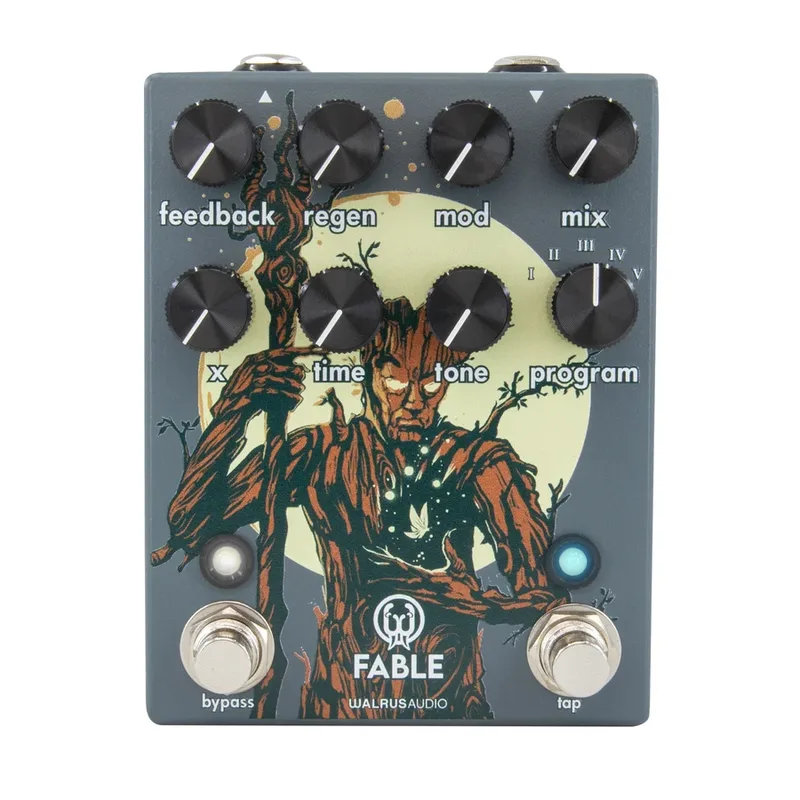


The Walrus Audio Fable is a granular delay pedal, sold as a Granular Soundscape Generator, that takes your delay repeats, chops them into tiny sampled grains, and plays those grains back at double speed, half speed, backwards, or in randomized order1. Where a conventional delay pedal echoes what you played, the Fable rebuilds it: Walrus Audio says players will discover soundscapes ranging from smooth, flowing ambience to bizarre, organic reverberance to chaotic, glitchy swarms2. Released in 2023 as the second entry in the company's Storybook range, it now exists in two versions: the original mono Fable and the stereo Fable MKII announced in October 2026234.
The core idea is granular processing: short samples called grains are read from a delay buffer, with adjustable sampling length, position and buffer size, and each grain can be played at double or half speed, in reverse, or from multiple positions in the buffer2. Those grains then run through a dual feedback path, where the signal passes through two separate effects in series, controlled independently by the Feedback and Regen knobs, and loops back through both again before reaching the output2.
What the five modes do
Each mode (called programs on the original) pairs two effects that feed into each other through separate feedback paths, so the sound keeps developing as it recirculates2. The five pairings, per Walrus Audio210:
| Mode | Pairing | What happens |
|---|---|---|
| I | Reverse Delay into Reverse Granular | Sampled grains play backward; reversal and re-reversal build up in the feedback paths |
| II | Forward Delay into Octave Up Granular | Grains play at double speed, for bright, airy cascades |
| III | Analog-Style Delay into Octave Down Granular | Grains play back at half speed, for deep, thunderous footfalls and thick, murky ambience |
| IV | Multi-Tap Granular into Multi-Tap Granular (Grain-Verb) | Two multi-tap granular algorithms in series create glitchy clouds and organic reverberance; Time controls time-stretching of both |
| V | Forward Delay into Randomized Pitch Granular | Each grain plays back at a randomly selected speed and direction |
The X knob changes function from mode to mode. In Mode I it sets grain size, from long, smooth reversed transients at one end to stuttering reverse glitch at the other; in Mode V it controls the rate of randomized pitch modulation211.
The controls
The original pedal carries Feedback, Regen, Mod, Mix, X, Time, Tone and a Program selector, plus Bypass and Tap footswitches5. Feedback and Regen each control one of the two series effects in the dual feedback path, which is what lets you shape how the two halves of a mode interact as the signal loops14.
The MKII keeps that core layout and adds a Tweak control with five parameters12:
| Tweak parameter | What it does |
|---|---|
| Width | Sets how far the wet signal spreads between left and right channels |
| Mod Rate | Sets the modulation LFO rate, from 0.1 Hz to 5 Hz |
| Mod Shape | Selects sine, square, or random LFO shape |
| Shift | Sets where Dive/Rise lands, from 0.5x to 2x |
| Ramp | Sets how long Dive/Rise takes to travel to the Shift target, from 50 ms to 5000 ms |
Dive/Rise is a momentary feature: holding the tap tempo switch shifts the pedal's clock rate down or up and holds it there for as long as the switch is pressed2. On the MKII, all five modes also interface with the expanded Dive/Rise pitch system and secondary LFO shapes, warping pitch and sample rate through the Shift and Ramp architecture7.
Power and connections
Both versions run on 9V DC, center negative, with a 300mA minimum draw313. There is no battery option: the original is powered by a nine-volt mains supply only9. Walrus Audio recommends an isolated power supply and advises against daisy chains, and no supply is included in the box1.
At 300mA minimum, the Fable needs a dedicated 9V output from a pedalboard power supply. A typical 100mA output will not run it, and daisy-chaining it with other digital pedals is not recommended by the maker132.
The original is mono, with a standard input and standard output, and no expression pedal facility5. The MKII is fully stereo, with two inputs and two outputs, and adds MIDI (1/8-inch TRS Type A), an expression jack that can be assigned to any knob or set up as an external tap, and preset saving2. Over MIDI, clock controls delay time from 100 ms to 1000 ms in Modes I, II, III and V and drives the sample rate stretch in Mode IV, and every knob is available over MIDI CC along with mode select, bypass and tap2.
History and versions
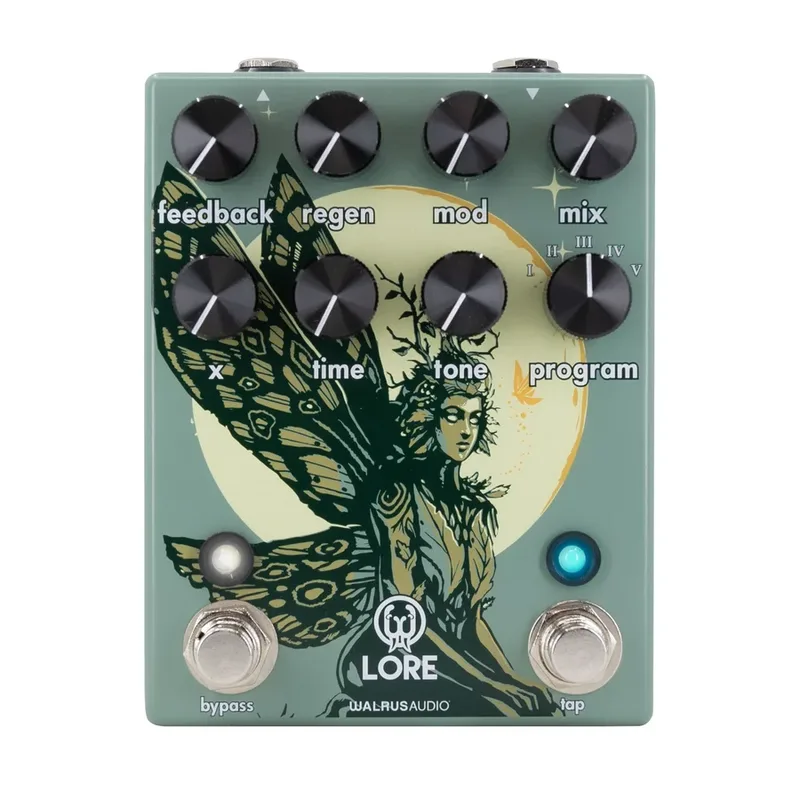
Walrus Audio launched the Fable in March 2023 as the second entry in its Storybook Sonic Adventure stompbox range, following the Lore, the company's reverse soundscape generator from 202267. The Fable was developed on the Lore's platform, and shipped in a slate gray die-cast enclosure with art by David Hüttner, at $299514. It was the original's mono I/O footprint that constrained it, as Delicious Audio put it when the MKII arrived7.
The Fable MKII, announced in October 2026, migrates the circuit to Walrus Audio's proprietary MDSP platform, developed entirely in-house by the company's engineering team715. It comes in an illustrated standard version with artwork by English illustrator Niall Grant in gray, or a Minimal Black version with a simplified icon on a black enclosure815. Both the Lore MKII and Fable MKII are available at $349.99 each from authorized Walrus Audio dealers8.
What reviewers said
Guitar World's Trevor Curwen reviewed the original and found it a pedal of unusual range5:
"This is certainly a pedal that can create otherworldly soundscapes, but they don't have to be completely outlandish, because you have a Mix knob to dial things back."5
His review listed no preset storage and no expression pedal facility among the pedal's limitations5. Guitar.com's Richard Purvis described the effect in plain terms: it "chops its repeats up into tiny pieces and spits them out in a randomised order," calling the result a magical universe of glitchy weirdness9. Gearnews' writer put it more simply: "If you like glitchy delays, then I would hazard a guess that this could be for you"4. On the MKII, Guitar Pedal X's Stefan Karlsson felt the Fable "mixes things up a touch more, with a little more variety than the Lore," and said he would settle for the Fable first12.
Videos
walrusaudioeffects
walrusaudioeffects
walrusaudioeffects
Questions
Is the Walrus Audio Fable stereo?
The original 2023 Fable is mono, with a standard input and a standard output. The Fable MKII, announced in October 2026, is fully stereo, with two 1/4-inch unbalanced inputs and two 1/4-inch unbalanced outputs, and Walrus Audio describes all of its processing as happening in stereo.
What changed on the Fable MKII?
The MKII moves to Walrus Audio's in-house MDSP platform, adds true stereo operation, an expanded Tweak control with Width, Rate, Shape, Shift and Ramp parameters, MIDI over 1/8-inch TRS, an expression input, external tap, and preset saving. It lists at $349.99, against the original's $299.
Can the original Fable save presets?
No. Guitar World's review lists no preset storage among the original pedal's limitations. The MKII fixes this, with three presets savable on the pedal itself in red, green and blue, a live mode, and another 127 presets available over MIDI.
Does the Fable take an expression pedal?
The original Fable has no expression pedal facility, as Guitar World's review notes. On the MKII, any knob can be assigned to the expression input, or the jack can be set up as an external tap instead.
What is the difference between the Fable and the Lore?
The Lore, released in 2022, is Walrus Audio's reverse soundscape generator, and the Fable was developed on its platform as the second entry in the Storybook range. The Fable is built around granular delay; Guitar Pedal X's writer felt the Fable mixes things up a touch more, with a little more variety than the Lore.
How much current does the Fable draw?
Both the original Fable and the Fable MKII require a 9V DC center-negative supply delivering at least 300mA. There is no battery option; the original runs on a nine-volt mains supply only, and Walrus Audio recommends an isolated supply rather than a daisy chain.
Sources (15)
- Fable Granular Soundscape Generator, Walrus Audio
- Fable Stereo Granular Soundscape Generator MKII, Walrus Audio
- Fable by Walrus Audio, RockBoard PedalPedia, 2026
- Walrus Audio Fable Granular Soundscape Generator: Granular Delay, gearnews.com, 2023-03-07
- Walrus Audio Fable review, Guitar World, 2023-06-15
- Walrus Audio unveils The FABLE, hosting five granular delay programmes, guitar.com, 2023-03-07
- Updated Pedal: Walrus Audio Fable MkII Granular Soundscape Generator, Delicious Audio, 2026-10-14
- Walrus Audio revives its Storybook Series with MKII versions of its much-loved Lore and Fable pedals, Guitar.com
- Walrus Audio Fable review: For all your glitchy soundscaping needs, Guitar.com, 2023-04-24
- Walrus Audio Lore and Fable MKII, Bass Magazine, 2026-10-13
- Walrus Audio Fable Granular Soundscape Generator, Pedal of the Day, 2023-03-07
- Guitar Pedal X, Guitar Pedal X, 2026-10-15
- Fable Granular Soundscape Generator, Walrus Audio
- Walrus Audio Launches Fable Granular Delay Pedal, Premier Guitar, 2023-03-09
- Updated Pedal: Walrus Audio Lore MkII Reverse Soundscape Generator, Delicious Audio, 2026-10-14