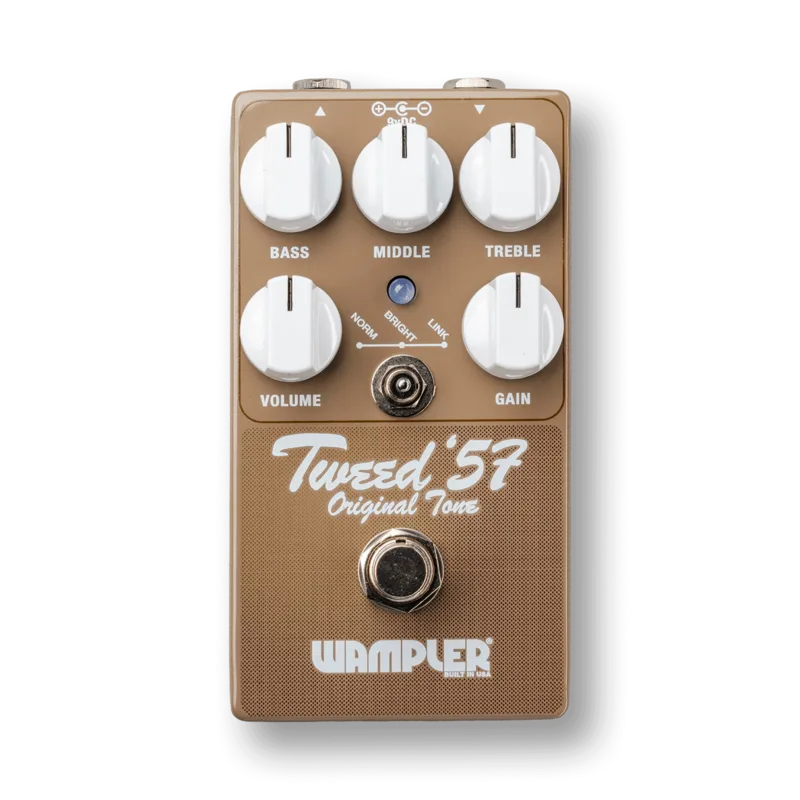


The Wampler Tweed '57 is an analog amp-in-a-box overdrive pedal from Wampler, built to put the sound of a Fifties Fender tweed amp on a pedalboard. Wampler describes the target as the "warm and woolly sound and pushed volume tube break-up" of tweed amps, and says it is Brian Wampler's take on the special topology and tones of amps like the classic tweed Deluxe, Bandmaster and Bassman1. Guitar World described it as "designed to replicate those fantastic Fender tones from that legendary Fifties amp"2.
The pedal sits in Wampler's Heritage series, which Premier Guitar describes as being "all about the classics", alongside the Plexi-Drive and the Black '653. It was previously out of production and was reissued in 2023 for a limited time only4; the current Limited Edition run is sold out at Wamplerpedals.com as of August 20261.
A tweed Fender amp in a pedal
Wampler Pedals specializes in putting amp tones in a box, and the Tweed '57 is the company's tweed entry. Premier Guitar notes that it is not designed to replicate one particular model, such as the Champ, Bassman, Deluxe or Twin; rather, it replicates the shared dynamics of pre-blackface Fender tweed amps3. Wampler's own framing is similar, naming the tweed Deluxe, Bandmaster and Bassman as the amps whose topology and tones the circuit draws on1.
The design also had an unusual origin: Premier Guitar reports that the Tweed '57's design sprang, in part, from a collaboration between Brian Wampler and the company's Facebook fans3.
Inside, the circuit is what one independent technical analysis called "one of those jfet tube simulacrums tweaked to the nines": a JFET tube simulator circuit with six JFET stages, Q1 to Q6, with Q6 serving as a post-volume buffer5. Builders tracing the circuit report J201 JFETs in the gain stages, and one builder who tried 2N5457 JFETs instead called it "a big mistake"5.
The controls and the input selector
The control complement comprises Volume, Gain, Bass, Middle and Treble dials plus an Input Selector switch14. Premier Guitar describes the layout as a top row of bass, mid and treble knobs for tailoring the tweed sound3.
| Control | What it does |
|---|---|
| Volume | Sets the output level |
| Gain | Sets the amount of overdrive |
| Bass | Low-end EQ |
| Middle | Midrange EQ |
| Treble | High-end EQ |
| Input Selector | Switches between Normal, Bright and Linked input simulations4 |
The input selector is the pedal's distinctive feature. Wampler calls it a unique input selector that reacts like the different inputs on the amps of the era1. MusicRadar explains it in concrete terms: the switch simulates the Normal and Bright inputs you would find on an old Bassman, with the Linked position emulating the sound of the amp with its inputs jumpered4. On the real amps, players ran a patch cable between the two inputs to combine them, and the Linked position recreates that sound.
Premier Guitar's reviewer found each position had its own character: moving the selector to Bright "opened up the sound a bit, adding air and a janglier top end", while Linked was noticeably louder and quite brash3.
"Moving the input selector to bright opened up the sound a bit, adding air and a janglier top end."
Power: 9V to 18V
The Tweed '57 has both a battery connection and a 9V power jack1, so unlike many modern pedals it can run on a battery. From a pedalboard supply it accepts 9V to 18V4. Current draw is between 3mA at 9V and 9mA at 18V1, which is light enough that it places little demand on most power supplies.
What reviewers and builders said
Premier Guitar's review was unreservedly positive, listing as pros "excellent tones, dynamics, and flexibility across the whole gain spectrum" and listing no cons3.
The DIY community that traced and built the circuit on vero board had more mixed views. One builder reported a successful build that "sounds great and is super quiet"5. Another, who owned an original pedal, was disappointed: "I sold an original about a month ago, I couldn't like it at all. I was expecting sonic bliss but it was 'Oh right, that'"5. A third builder suggested the sound may depend heavily on the amp setup used5.
Players who owned real tweed Deluxes offered the most specific comparisons. One builder who owned '55 and '57 Tweed Deluxe amps wrote that "Brian did a nice job of capturing the amp's 'looseness'", and that the pedal can emulate a Tweed Deluxe well when dialed in, though it can go beyond one distortion-wise5. Another builder found it "captures some of the 'almost out of control' spit and sag, but not so much the compression" of a Tweed Deluxe type amp5.
"IMO, Brian did a nice job of capturing the amp's 'looseness'."
Videos
Sweetwater
Brett Kingman
Harry Maes
Questions
Can the Wampler Tweed '57 run on a battery?
Yes. The pedal has a battery connection as well as a 9V power jack, and it can be run from a pedalboard supply at 9V to 18V. Current draw is between 3mA at 9V and 9mA at 18V, so it is light on power either way.
What do the Normal, Bright and Linked inputs do on the Tweed '57?
The Input switch simulates the Normal and Bright inputs you would find on an old Fender Bassman, with the Linked position emulating the sound of the amp with its inputs jumpered together. Premier Guitar's reviewer found Bright added air and a janglier top end, while Linked was noticeably louder and quite brash.
Which Fender amp is the Tweed '57 based on?
It is not a model-for-model copy. Wampler describes it as Brian Wampler's take on the topology and tones of the classic tweed Deluxe, Bandmaster and Bassman, and Premier Guitar notes it replicates the shared dynamics of pre-blackface tweed amps rather than one particular model.
Is the Wampler Tweed '57 still in production?
The current Limited Edition run is sold out at Wamplerpedals.com as of August 2026. It was previously out of production and was reissued in 2023 for a limited time only, so availability has come and gone in waves.
Where is the Wampler Tweed '57 made?
Wampler states that the Tweed '57 Limited Edition is built in the U.S.A. It carries a five year limited warranty to the original purchaser against defects in material and workmanship.
What transistors are in the Wampler Tweed '57?
The circuit is a JFET tube simulator with six JFET stages, Q1 to Q6, with Q6 acting as a post-volume buffer. Builders tracing the circuit report J201 JFETs in the gain stages, and one builder found 2N5457 JFETs to be a poor substitute.
Sources (5)
- Tweed '57 Limited Edition, Wampler Pedals (wamplerpedals.com), 2026-08-18
- Stomping Ground: 30 of the Coolest New Stomp Boxes and Tried-and-True Favorites, Guitar World, 2013-07-23
- Wampler Tweed '57 Pedal Review, Premier Guitar, 2012-09-05
- Wampler brings back its Fender-inspired Tweed '57 and Black '65 amp-in-a-box drive pedals, MusicRadar, 2023-09-22
- Guitar FX Layouts: Wampler Tweed '57, Guitar FX Layouts (tagboardeffects.blogspot.com), 2012-06-07