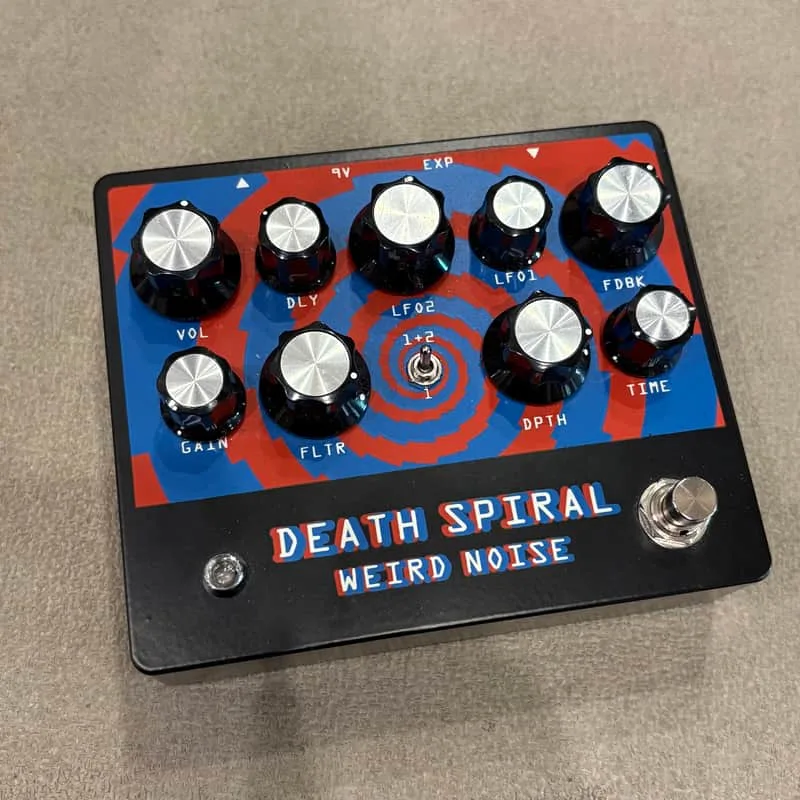

The Weird Noise Death Spiral is a delay pedal from Weird Noise Pedals that sits in the creative corner of the delay pedals world. Paolo De Gregorio, writing on Delicious Audio, describes it as "A digital, creative modulated, and fuzzed-up delay based on the PT2399 chip"1. Rather than a clean repeats machine, it stacks a fuzz circuit, two LFOs and a Low Pass filter on top of the delay line, with expression control on top of that.
The PT2399 at its core
The PT2399 is a delay chip with a long history in pedal building. De Gregorio calls it "a semi-obsolete component that still inspires hundreds of boutique pedal builders"1. GuitarPCB's documentation on the chip notes that "The PT2399 chip provides smooth delay effects with a maximum delay time of approximately 600 milliseconds," adding that subtle artifacts can appear at maximum delay time and vary with each chip's tolerance2. That character is part of why builders keep reaching for it: the chip is not a pristine digital delay line, and the Death Spiral leans into that.
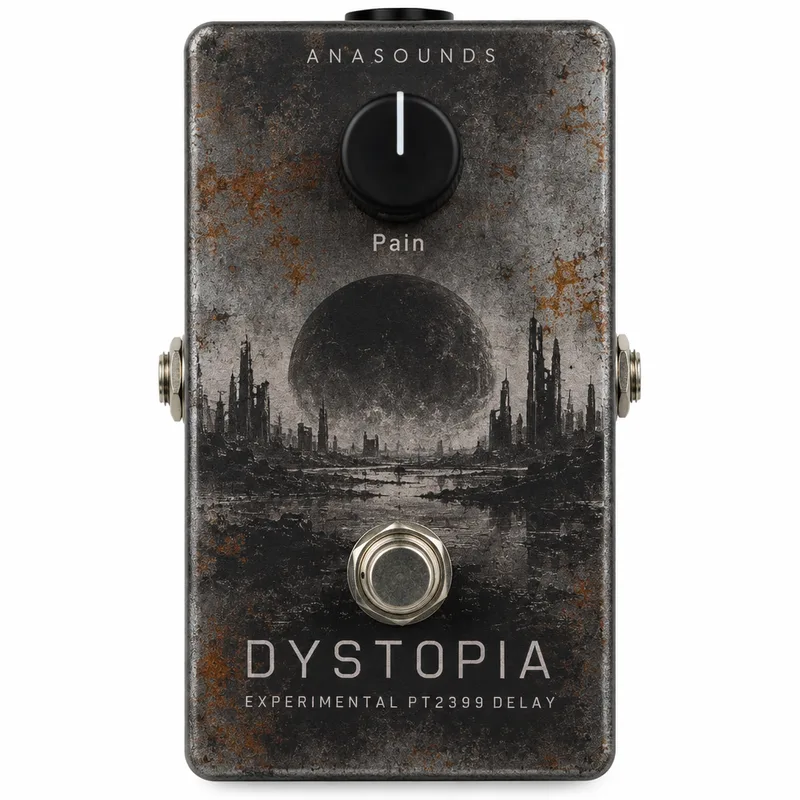
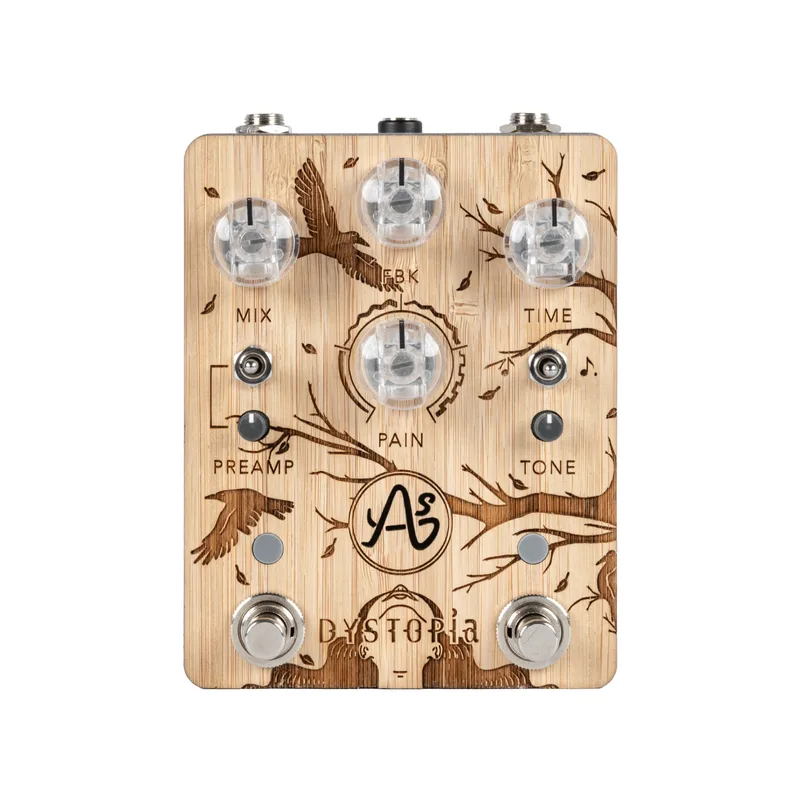
Other builders work the same territory. Guitar Pedal X's Stefan Karlsson listed the Anasounds Dystopia Experimental PT2399 Delay among 2023's time-based releases, calling it a "Really cool PT2399 Delay with a more worn-out Tape Sound - Crazy 'Pain' Modulation, and a 4-step sequencer"3. The Death Spiral takes a different route on the same chip, putting fuzz and dual LFOs in front of the repeats.
Controls
| Control | What it does |
|---|---|
| Gain | Alters the dry signal fed to the delay; behaves like a fuzz at higher settings1 |
| Low Pass filter | Turning clockwise closes the filter, giving darker, vintage-sounding repeats and more resonant tones at darker settings; facilitates self-oscillation at maximum1 |
| FDBK (right of pedal) | Feedback control that interacts with the Low Pass filter1 |
| LFO toggle (center) | Selects LFO1 by itself or adds LFO2 on top of it1 |
The two LFOs are deliberately different designs. LFO1 is an IC-based design with Depth and Speed controls, and De Gregorio describes it as sounding like a chorus; it affects only the repeats of the delay1. LFO2 is a transistor and optical design with only a speed knob, described as sounding like a tremolo, and the toggle lets you run it on top of LFO11. Players who want to hear that chorus and tremolo character on their own will find more on the chorus pedals and tremolo pedals pages.
The Low Pass filter and feedback control work together: at the filter's maximum setting the pedal facilitates self-oscillation, so runs of swelling repeats are part of the design rather than a fault1.
What reviewers said
Delicious Audio's write-up is the main published account of the pedal. De Gregorio's summary of what it offers: "offers two LFOs, a Low Pass filter and a fuzz circuit, along with expression control"1. Guitar Pedal X's coverage of the wider PT2399 creative-delay field, including the Anasounds Dystopia, gives context for where a pedal like this sits among boutique builders' takes on the chip3.
Videos
Pedal Experiments
Boring Gear Reviews
Questions
Is the Weird Noise Death Spiral analog or digital?
It is a digital pedal. Delicious Audio's Paolo De Gregorio describes it as a digital, creative modulated and fuzzed-up delay. The digital side comes from the PT2399 chip at its core, a delay chip that provides smooth repeats up to roughly 600 milliseconds, with the fuzz circuit and modulation shaping what those repeats sound like.
What chip is the Death Spiral based on?
The Death Spiral is based on the PT2399 chip. De Gregorio calls it a semi-obsolete component that still inspires hundreds of boutique pedal builders. GuitarPCB notes the chip provides smooth delay effects with a maximum delay time of approximately 600 milliseconds, with possible subtle artifacts at maximum that vary with each chip's tolerance.
What does the LFO toggle switch do on the Death Spiral?
A toggle switch in the center of the pedal selects LFO1 by itself or adds LFO2 on top of it. LFO1 is an IC-based design with Depth and Speed controls that sounds like a chorus and affects only the repeats. LFO2 is a transistor and optical design with only a speed knob that sounds like a tremolo.
Does the Death Spiral have expression pedal control?
Yes. Along with its two LFOs, Low Pass filter and fuzz circuit, the pedal offers expression control, so an expression pedal can be used to work one of its parameters in real time while playing.
Can the Death Spiral self-oscillate?
Yes. The Low Pass filter facilitates self-oscillation at its maximum setting, and the feedback control on the right of the pedal interacts with that filter. Turning the filter clockwise closes it, producing darker, vintage-sounding repeats and more resonant tones at darker settings.
What does the Gain knob do on the Death Spiral?
The Gain knob alters the dry signal fed to the delay. At higher settings it behaves like a fuzz, which is what gives the pedal its fuzzed-up character before the signal reaches the delay and modulation stages.
Sources (3)
- Weird Noise Death Spiral, Delicious Audio, 2024-04-22
- NostalgiTone-Space-Modulator, GuitarPCB, 2024-09
- Guitar Pedal X, Guitar Pedal X, 2023-12-20