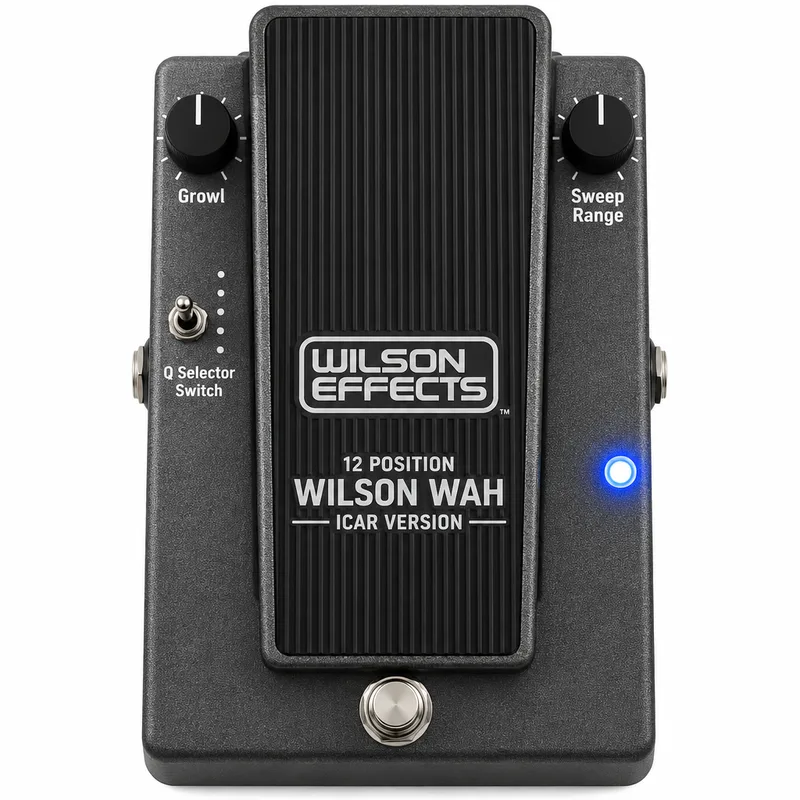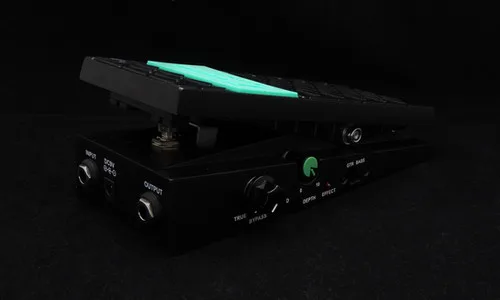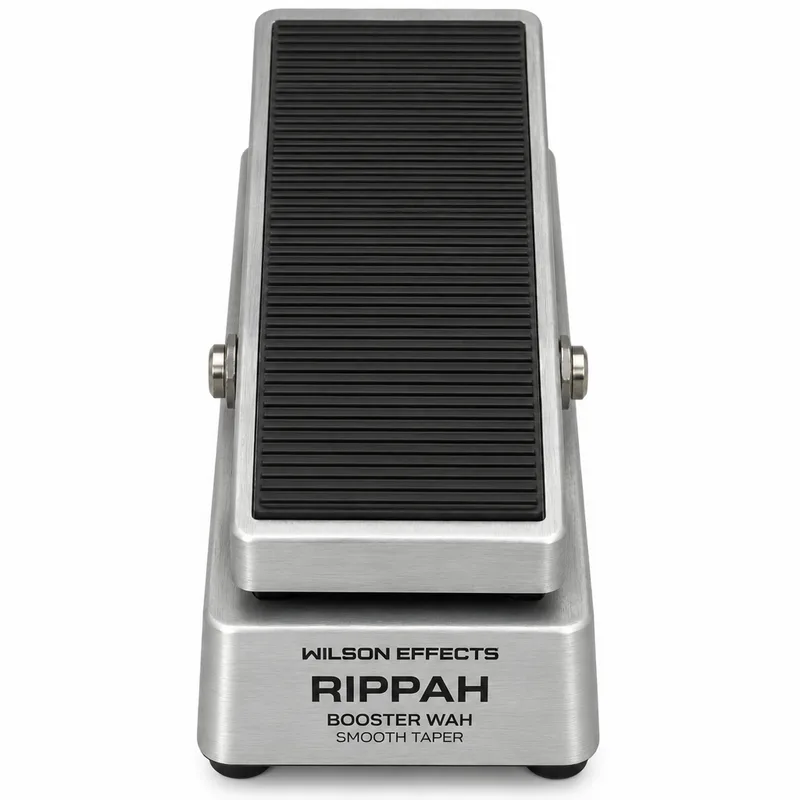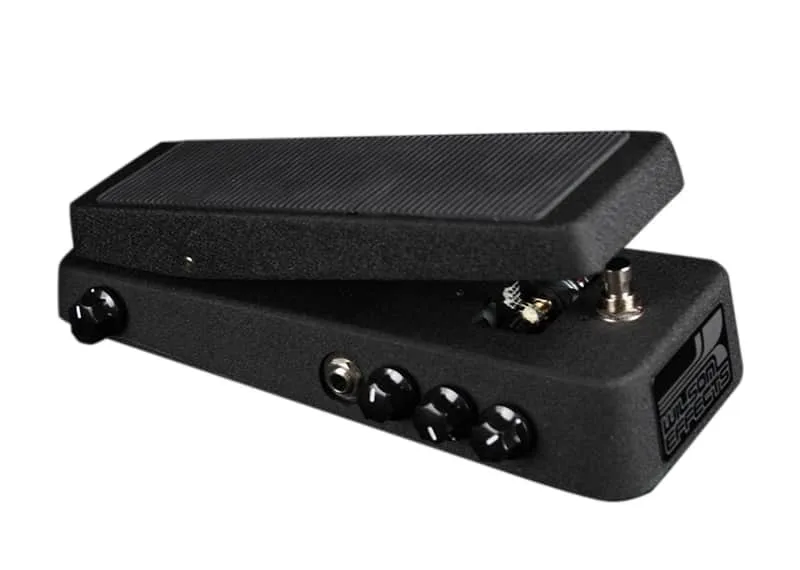



The Wilson Effects 12 Position Wilson Wah is a wah pedal that Wilson Effects describes as "a faithful reproduction the original Halo wah with every mod at your finger tips"1. Where a stock vintage wah locks you into one fixed voicing, this one puts the voicing on a rotary switch: twelve Q settings that run from dark and warm to bright and sharp, plus internal trimmers for midrange and output volume. Wilson Effects pitches its range as "Late 60's early 70's and modern tones!"1.
The circuit is the classic vintage wah design, modified to increase the bass response on the input2, and the parts list leans vintage: NOS ARG Italian 250v capacitors, which the maker credits with a rich, vintage tone1. Every pedal is hand-built in the U.S.A. and carries a one-year warranty on parts and labor1.
Late-60s and modern wah tones from a Halo-based circuit
The pedal's foundation is the original Halo wah. Wilson Effects reproduces that circuit and then layers the modifications on top: the input stage is altered for more bass response than the vintage circuit had2, and the Q selector lets you push the voicing toward either end of the vintage-to-modern spectrum1.
Two component choices stand out. The NOS ARG Italian 250v capacitors are new-old-stock parts, the kind of thing builders use when they want the tonal character of the originals rather than a modern equivalent1. And the built-in fuzz buffer addresses one of the oldest problems in wah history: fuzzes and wahs loading each other when chained together. Wilson Effects says the buffer "allows the pedal to interact with different fuzzes and overdrives"4, so a fuzz pedal in front of it should behave.
The controls
Most of the tuning happens without opening the pedal. The Q selector is the headline control, and the internal trimmers handle the fine adjustment124.
| Control | What it does |
|---|---|
| Q Selector Switch | 12-position switch choosing between darker and brighter Q settings; clockwise for dark and warm, counterclockwise for bright and sharp12 |
| Growl | Shapes bass and gain response; clockwise thins the tone (excessive thinning may lower volume), counterclockwise gives a thicker, darker sound1 |
| Top Trimmer (internal) | Adjusts the midrange response1 |
| Bottom Trimmer (internal) | Controls the overall volume output1 |
The two blue trimmers sit inside the pedal and are turned with a small flathead or Phillips screwdriver2. The ICAR version adds a Sweep Range control: fully clockwise gives the pedal its greatest sweep depth, and fully counterclockwise the sweep disappears2.
ICAR and Smooth Taper versions
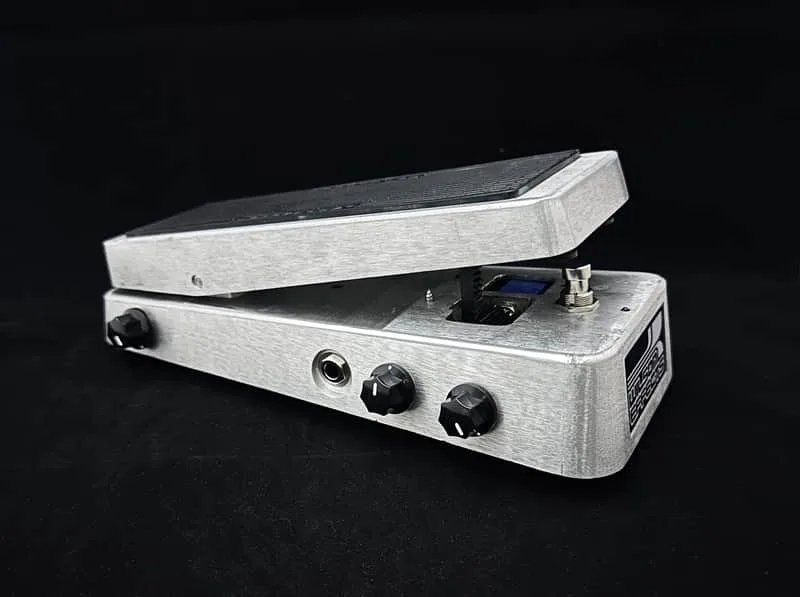
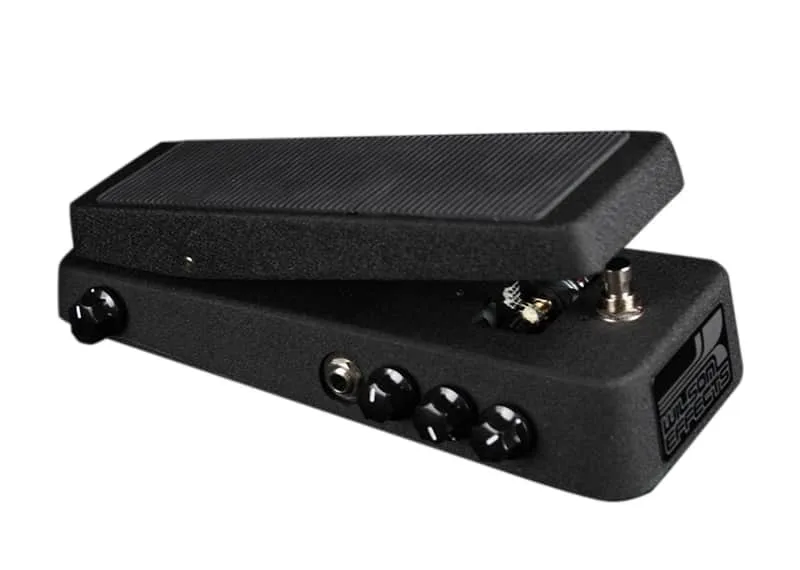
The 12 Position Wilson Wah comes in two pot options, each available in the traditional Black Powder finish or a Brushed Aluminum finish1:
- ICAR pot: Wilson Effects notes that when ICAR pots were originally developed, the wah pedals using them had a very limited physical sweep1. The ICAR version reproduces that character.
- Smooth Taper pot: The Smooth Taper version contains a Wilson Effects vintage taper wah pot, replicated by measuring the taper of a vintage Car taper pot4. Wilson Effects says the smooth taper option "allows the pedal to maintain a smoother transition through the sweep of the Q range"1.
The brushed aluminum finishes are listed as their own products, in both Smooth Taper and ICAR Taper forms35.
Power, bypass, and build
Power is flexible: the pedal runs on an industry standard 2.1mm center negative supply, the connector found on most pedalboard power bricks, or on a high-quality alkaline battery12. Switching is true bypass, with a super bright LED mounted on the side so you can see at a glance whether the wah is engaged12.
The battery option is worth noting if you play without a power supply, but the maker specifies a high-quality alkaline battery rather than any battery1.
All versions are hand-built in the U.S. and covered by the same one-year warranty on parts and labor124.
Videos
Brett Kingman
gearmanndude
gearmanndude
Questions
What is the difference between the ICAR and Smooth Taper versions of the Wilson Wah?
The ICAR version uses a pot in the style of the original ICAR pots, which historically gave wah pedals a very limited physical sweep. The Smooth Taper version uses a Wilson Effects vintage taper pot, replicated by measuring the taper of a vintage Car taper pot, and keeps the transition through the Q range smoother. Both share the same circuit, controls, and finishes.
What does the Q selector switch do on the 12 Position Wilson Wah?
It is a 12-position rotary switch that chooses between darker and brighter Q settings. Turning it clockwise gives darker settings and counterclockwise gives brighter settings, so you can fine-tune the wah's tonal character from dark and warm to bright and sharp without opening the pedal.
Is the 12 Position Wilson Wah true bypass?
Yes. Wilson Effects fits true bypass switching with a super bright LED on the side, so you can see when the pedal is engaged and avoid leaving it on by accident.
Does the Wilson Wah work with fuzz pedals?
Yes. The pedal has a built-in fuzz buffer that Wilson Effects says allows it to interact with different fuzzes and overdrives, addressing the loading problems wahs and fuzzes often cause each other when chained directly.
Can the 12 Position Wilson Wah run on a battery?
Yes. It runs on a high-quality alkaline battery or on an industry standard 2.1mm center negative power supply, the same connector used by most modern pedalboard power supplies.
Where is the Wilson Wah made?
Every pedal is hand-built in the U.S.A. by Wilson Effects and covered by a one-year warranty on parts and labor.
Sources (5)
- 12 Position Wilson Wah, Wilson Effects
- 12 Position Wilson Wah ICAR Version, Wilson Effects
- Brushed Aluminum 12 Position Wilson Wah Smooth Taper, Wilson Effects
- 12 Position Wilson Wah Smooth Taper Version, Wilson Effects
- Brushed Aluminum 12 Position Wilson Wah ICAR Taper, Wilson Effects