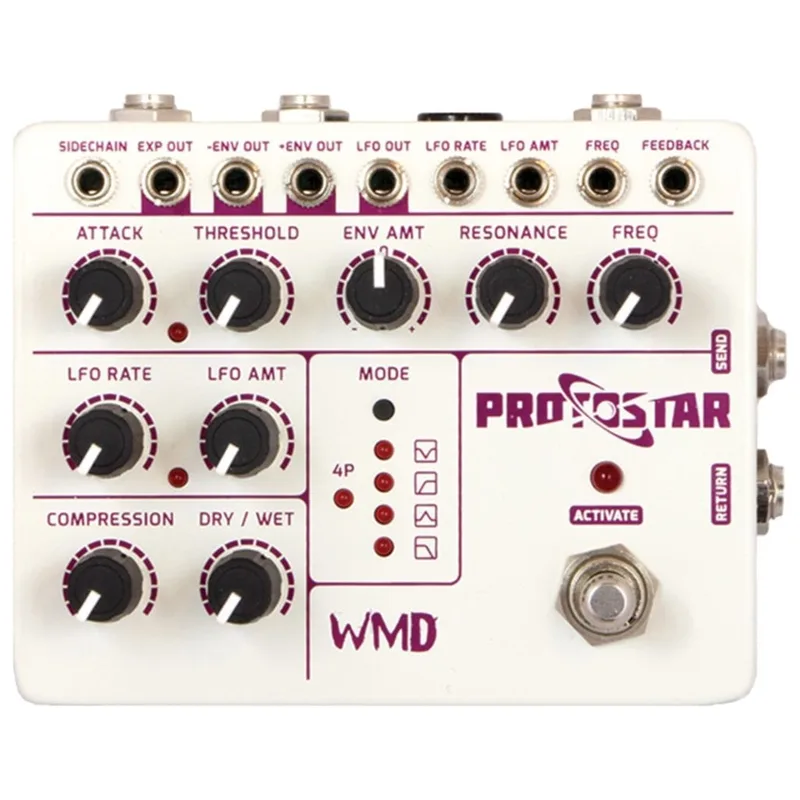


The WMD Protostar is an analog envelope filter pedal from WMD, a maker better known to modular synth players than to guitarists. WMD describes it as the evolution of the company's Super FatMan envelope filter, with what the maker calls "even more pro level features"1. An envelope filter, also called an auto-wah, sweeps a filter across your signal in response to how hard you play, so the Protostar reacts to your picking dynamics rather than being controlled only by knobs.
WMD's own claim for the pedal is a bold one: "this is the most powerful/versatile envelope filter on the planet"1. What backs that claim up is the pedal's Harmonic Density Engine, which WMD says includes a built-in LFO, four filter modes, a full CV patch bay, and an expression pedal input1. That patch bay is the feature that sets the Protostar apart from most envelope filters built for guitar boards, and it is why the pedal also appeals to synth players.
The 400mA current draw is far above a typical analog pedal. A standard 9V battery or a low-current daisy chain output will not run the Protostar; plan on an isolated or high-current supply. WMD also warns not to exceed 9V1.
An envelope filter based on the Super FatMan
The Protostar's circuit descends from WMD's Super FatMan envelope filter, a design the maker originally built for the modular and bass world. WMD positions the Protostar as that circuit grown up: "The Protostar is the evolution of the Super FatMan envelope filter with even more pro level features"1. For a player, that lineage means the pedal behaves like a classic envelope follower, opening and closing a filter as your attack rises and falls, but with the routing flexibility of a synth module.
RockBoard's PedalPedia listing confirms the pedal's core identity: an analog envelope filter with four filter modes2. Four modes give you different filter shapes and sweep characters to choose from before you start tweaking the response controls.
The controls and CV patch bay
WMD documents the Protostar's controls and patch points on its product page. The ones the maker describes in detail:
| Control or jack | What it does |
|---|---|
| Attack | How fast the envelope reacts to the incoming signal; controls both attack and release1 |
| Dry / Wet | The amount of unaffected versus affected signal at the output1 |
| Feedback | CV input for control over resonance1 |
| LFO Out | Constantly sends the triangle wave LFO CV signal, reacts to the LFO rate knob1 |
| Expression Input (back panel) | TRS connection for any expression pedal1 |
| Exp Out | Output for the expression pedal input; not connected to any control internally and must be patched1 |
The patch bay is where the Protostar's CV connections come in. The Feedback jack is a CV input for control over resonance, and the LFO Out jack constantly sends the pedal's triangle wave LFO CV signal, reacting to the LFO rate knob1. Writing about pedals with CV connections, Delicious Audio's Paolo De Gregorio noted that the Protostar's patch points "offer up an even greater degree of CV connectivity, with outputs for both the envelope and the LFO on the unit's top panel"3.
The expression system works like a modular patch rather than a conventional pedal. As WMD puts it: "Plug a TRS cable from any expression pedal into this, patch the exp out to what you want to contol, and express yourself"1. The expression input accepts a 10k to 1M pot over a TRS connection, and because the Exp Out jack is not wired to any internal control, you choose what the pedal operates by patching it yourself1.
Power and switching
The Protostar runs on 9V DC from a Boss-style center negative connector and draws 400mA, with WMD's warning not to exceed 9V1. Switching is relay true bypass with a soft touch switch, so your dry signal passes through untouched when the pedal is off1.
Videos
WMDevices
WMDevices
WMDevices
Questions
What power supply does the WMD Protostar need?
The Protostar runs on 9V DC from a Boss-style center negative supply and draws 400mA. WMD warns not to exceed 9V. That current draw is high for a pedal, so it needs a supply with enough headroom rather than a typical low-current output.
Is the WMD Protostar true bypass?
Yes. WMD specifies relay true bypass with a soft touch switch, so the signal path is fully bypassed when the pedal is off and the switch itself is the quiet, low-effort type players often prefer over a mechanical stomp switch.
What expression pedal works with the WMD Protostar?
Any expression pedal with a 10k to 1M pot and a TRS connection works. You plug a TRS cable into the expression input on the back panel, then patch the Exp Out jack to whichever control you want the pedal to operate, since the expression input is not wired to any control internally.
Can the Protostar be used with modular synths?
Yes. The Protostar has a full CV patch bay with outputs for both the envelope and the LFO on its top panel, plus CV inputs such as the Feedback jack for controlling resonance. That lets it send and receive control voltage with modular gear and other CV-equipped devices.
Sources (3)
- Protostar Envelope Filter: Harmonic Density Engine, WMD (wmdevices.com)
- Protostar by WMD, RockBoard PedalPedia, 2026
- The Best Pedals For Synths With CV In/out In 2022, Delicious Audio, 2020-10-01