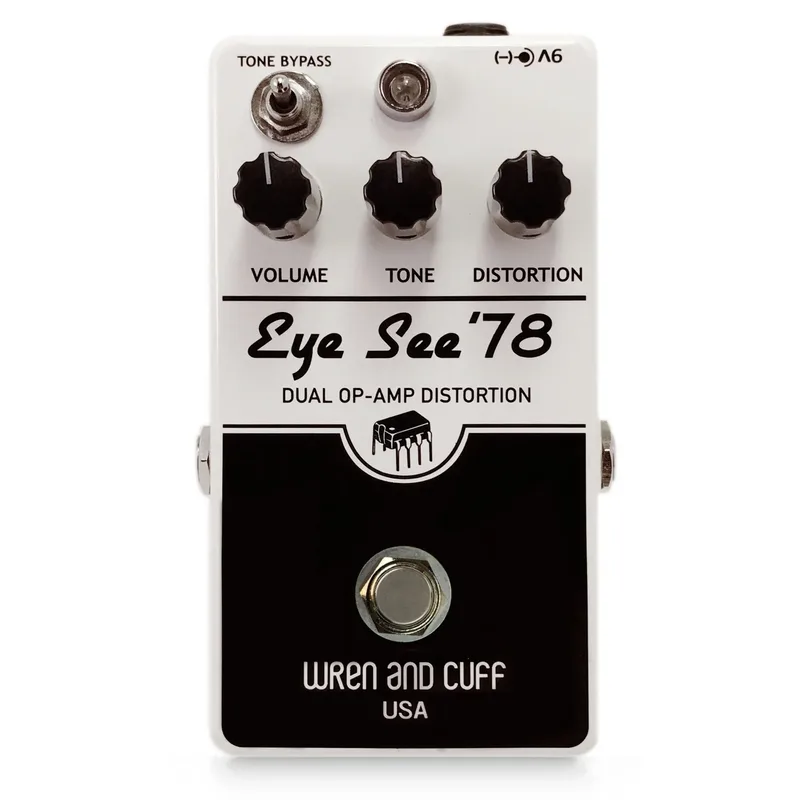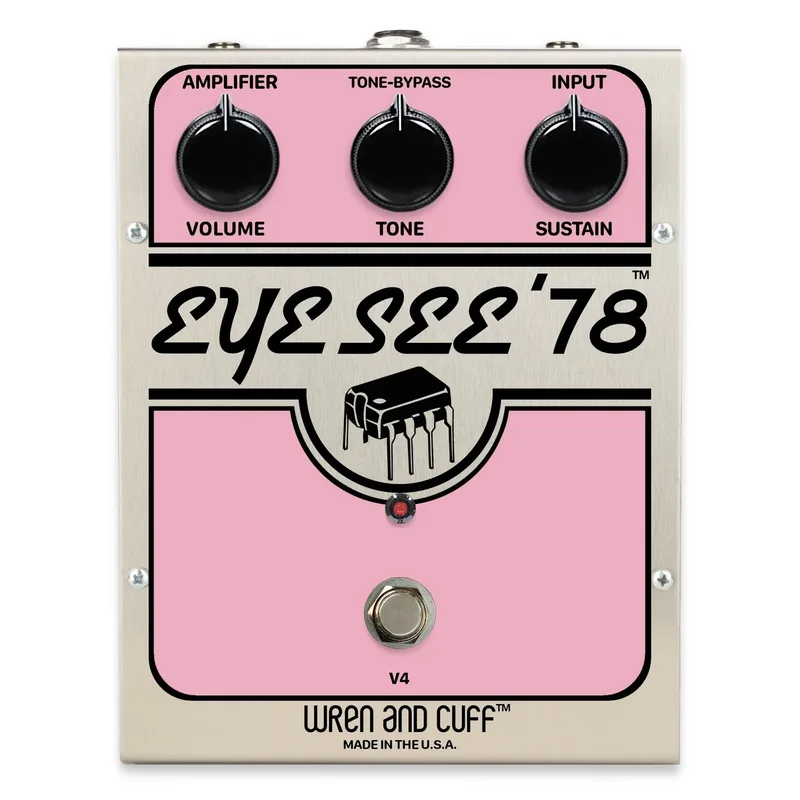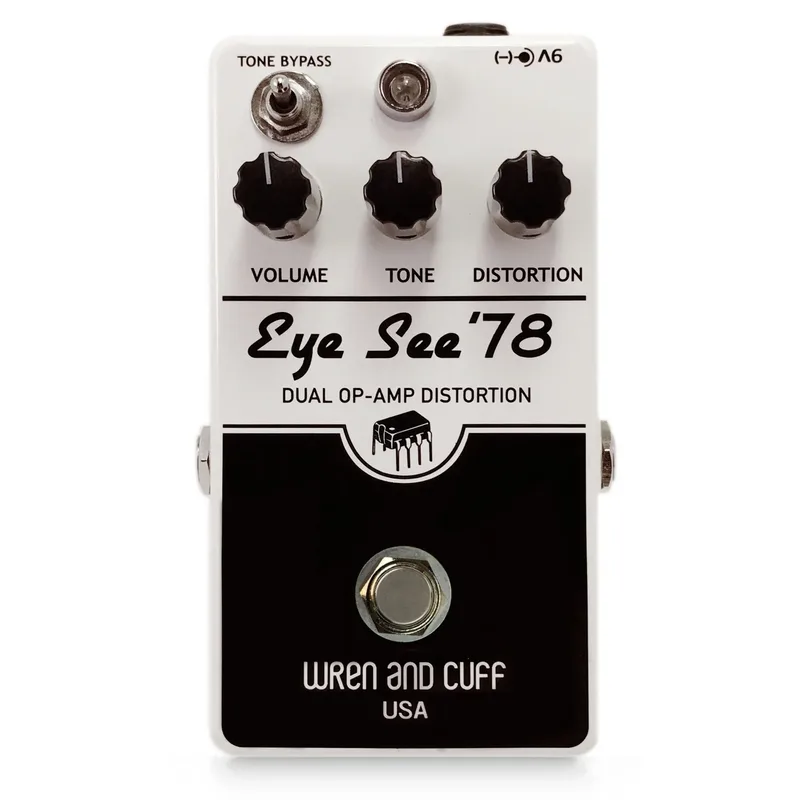


The Wren and Cuff Eye See '78 Dual Op-Amp Distortion is a distortion and fuzz pedal that recreates a specific chapter of Big Muff history: the 1978 version of the circuit in which the transistors were scrapped in favor of operational amplifiers, otherwise known as op-amps, which are integrated circuits1. Wren and Cuff calls it an "Authentic recreation of the 1978 IC Big Muff"1. It was first released in 2014, when Delicious Audio described the company as having "crafted the definitive version of the non-transistorized fuzzbox"2.
The pedal is built by Wren and Cuff, and its designer is Matt Holl, whom Premier Guitar's reviewer called a "Big Muff wizard/scientist"3.
A Big Muff with op-amps instead of transistors
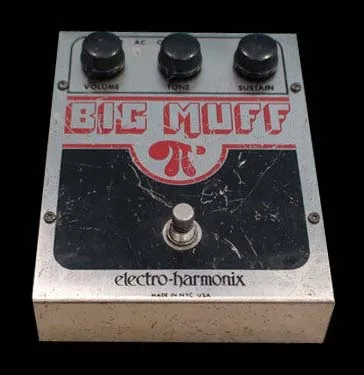
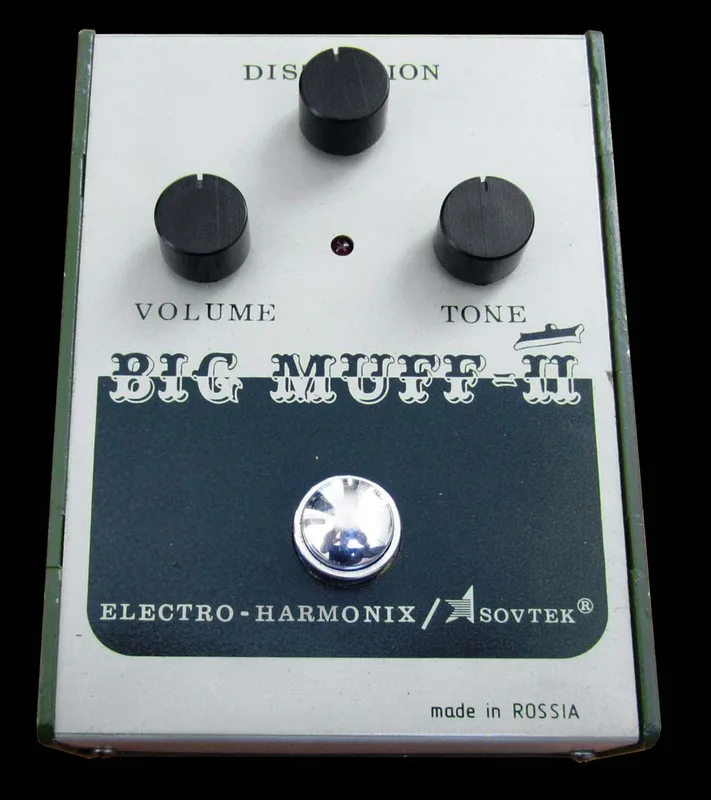
Nearly every Big Muff variant is built around transistors. The op-amp Big Muff is the exception: in 1978, Electro-Harmonix replaced the four transistors of the Big Muff architecture with op-amp ICs, a design Kit Rae's history of the circuit refers to as the IC or V4 Big Muff567. Premier Guitar describes the original 1978 Op-Amp Muff as having "dispensed with all that, substituting Op-Amps for the four transistors"5. The op-amp version was short-lived: Kit Rae's history notes these were the last op-amp Big Muffs made before they were phased out around 1980 or '81, when the transistor version continued6.
The Eye See '78 follows that 1978 to 1980 design. Pedal of the Day describes it as taking "a peek at a very particular piece of Big Muff history," the period when the usual transistors were scrapped in favor of op-amps46. Apart from the lack of transistors, the pedal features a clipping section the reviewer described as drastically different from a standard Big Muff4.
For a player, the practical difference is in the character of the gain. Wren and Cuff says the Eye See '78 is "certainly crunchier and more ballsy than a standard Muff," with a monstrously woolly sound1. Pedal of the Day echoed the maker's description, adding that most vintage Muffs are a little "sweeter" sounding by comparison4.
"The Eye See '78 is most certainly different than those circuits."
Controls and the Tone Bypass switch
The pedal carries the controls of the circuit it recreates, plus one addition borrowed from the original's later life. In 1978, a switch was added to the back of the original op-amp Big Muff, and the Eye See '78 includes this switch as well4.
| Control | What it does |
|---|---|
| Tone Bypass switch | Removes the passive tone stack from the circuit for a volume boost and a significantly more raw and open sound; renders the tone control useless when engaged14 |
| Tone control | Adjustes the passive tone stack; has no effect while the Tone Bypass switch is engaged8 |
Wren and Cuff describes the switch's effect plainly: "Essentially, it removes the passive tone stack from the circuit for a volume boost and a significantly more raw and open" sound1. Delicious Audio's write-up of the big-box version adds that removing the tone stack results in a mid-bump as well2.
Original and slimmed-down versions
The Eye See '78 has existed in two enclosures. The original version used a bigger, near Muff-sized enclosure; the current version has been slimmed down to a smaller footprint that Pedal of the Day called more pedalboard-friendly4. Wren and Cuff notes that demo videos showing the first full-size version look cosmetically different, but the circuit is exactly the same1.
The big-box version was later sold as the Eye See '78 OG, which Wren and Cuff describes as an authentic replication of the V4 circuit8. That version is now sold out8.
The Eye See '78 OG is sold out, according to Wren and Cuff's product page8. The current slimmed-down Eye See '78 uses the same circuit1.
The OG version also carried a secret internal adjustment to fine tune tone beyond the stock V4 circuit, which Wren and Cuff invited players to discover by taking a peek inside8. That internal trim applied only to serial numbers 39-001 through 39-120; following batches were changed to avoid confusion8.
Where it came from and what reviewers said
Wren and Cuff released the Eye See '78 in 2014 as its take on the 1978 non-transistorized op-amp Big Muff2. In 2023 the company returned to the format with a big-box version, announced by Delicious Audio as a replication of the V4 circuit with the added bonus of the V5 tone bypass switch2.
Pedal of the Day reviewed the current slimmed-down version in January 2023 and framed it for players in the market for something specific: "If you're looking for a largely-untamed IC-based fuzz and distortion machine," this is that piece of Big Muff history4. Premier Guitar's 2024 review focused on how the pedal sits among the classic Big Muff variants a player might already know, finding it clearly distinct from the Sovtek tones and Ram's Head sounds the reviewer usually chases3.
Videos
Fuzzed Drones
Pedal of the Day
Pedal Empire
Questions
Is the Wren and Cuff Eye See '78 a Big Muff clone?
It is an authentic recreation of the 1978 IC Big Muff, the version of the circuit that used op-amp integrated circuits instead of transistors. Wren and Cuff describes it as an authentic recreation of that specific circuit rather than the more common transistor-based Big Muff variants, so it clones one particular era of Big Muff history.
Does the Eye See '78 use transistors?
No. The pedal is IC-based, with no transistors in the signal path. It follows the 1978 Big Muff design in which the transistors were scrapped in favor of operational amplifiers, which are integrated circuits. It also uses a clipping section that Pedal of the Day described as drastically different from a standard Big Muff.
What does the Tone Bypass switch do on the Eye See '78?
The Tone Bypass switch removes the passive tone stack from the circuit. Wren and Cuff says this gives a volume boost and a significantly more raw and open sound. With the switch engaged, the tone control is rendered useless, since the tone circuit it adjusts is no longer in the signal path.
Is the original Eye See '78 still available?
The original big-box version, sold as the Eye See '78 OG, is sold out according to Wren and Cuff's product page. The current version of the Eye See '78 uses a smaller, slimmed-down enclosure than the original's near Muff-sized box, and Wren and Cuff says the circuit is exactly the same in both.
How does the Eye See '78 sound different from a standard Big Muff?
Wren and Cuff says the Eye See '78 is crunchier and more ballsy than a standard Muff, with a monstrously woolly sound, while most vintage Muffs are a little sweeter sounding. Premier Guitar's reviewer found it clearly different from the Sovtek and Ram's Head Big Muff circuits they usually chase.
Sources (8)
- Eye See '78, Wren and Cuff
- New Pedal: Wren And Cuff Eye See '70 Fuzz, Delicious Audio, 2023-09-05
- Wren and Cuff See Eye ’78 Review, Premier Guitar, 2024-03-23
- Wren and Cuff Eye See '78 Dual Op-Amp Distortion, Pedal of the Day, 2023-01-18
- Quick Hit: Electro-Harmonix Op-Amp Big Muff, Premier Guitar, 2018-10-02
- The Big Muff History of All Versions Part 1, Kit Rae (kitrae.net), 2024-02
- Best Big Muff Pedals In 2025: Reissues, Clones & Evolutions, Delicious Audio, 2025-04-07
- Eye See '78 OG, Wren and Cuff