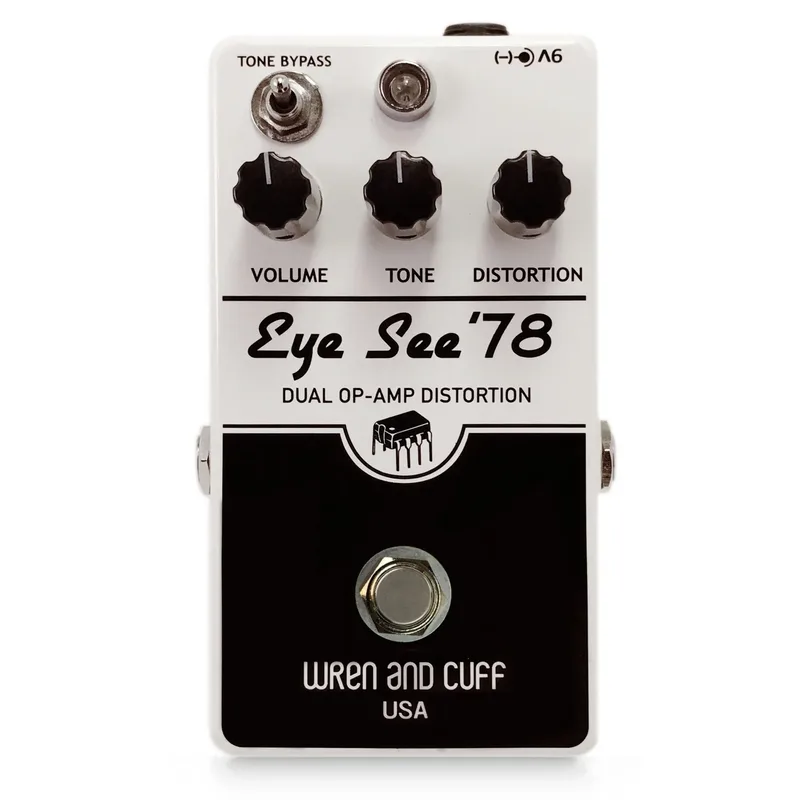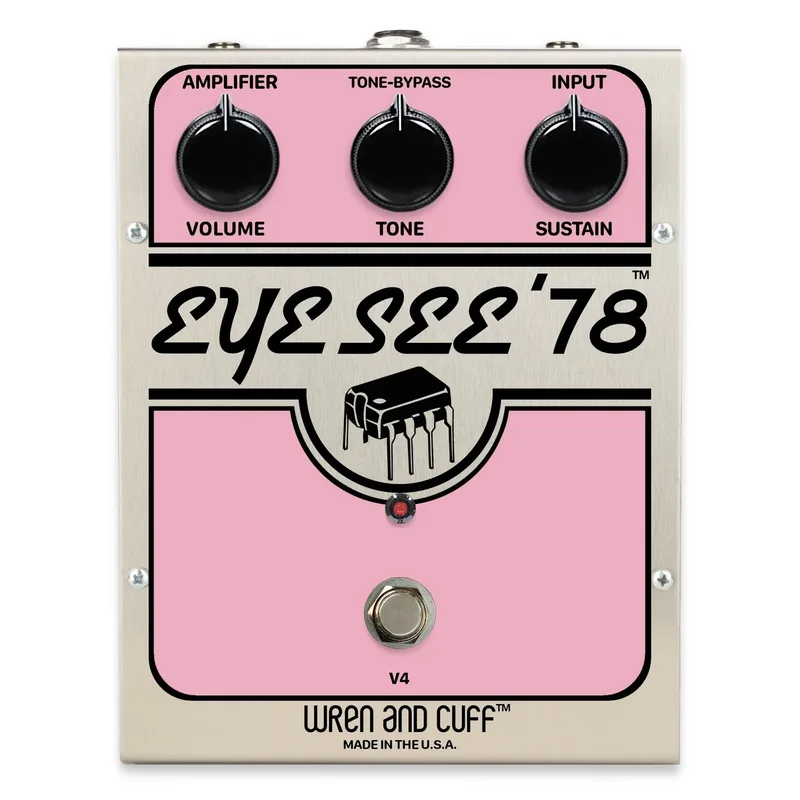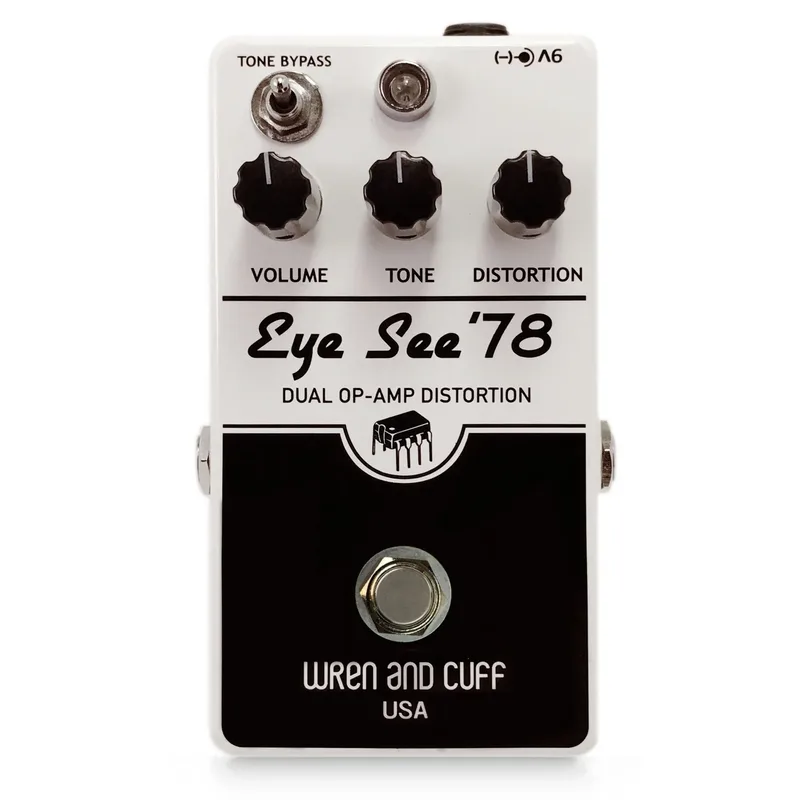


The Wren and Cuff Eye See '78 is a fuzz and distortion pedal that recreates the 1978 IC Big Muff, the version of the Electro-Harmonix circuit in which the usual transistors were scrapped in favor of operational amplifiers, otherwise known as op-amps, which are integrated circuits1. Wren and Cuff calls it a largely untamed IC-based fuzz and distortion machine, and describes it as crunchier and more ballsy than a standard Muff1. It first appeared in 2014 and is currently sold in a smaller-footprint enclosure, made in the USA with a lifetime warranty, at a list price of $199.991.
The pedal's distinguishing feature is a Tone Bypass switch, carried over from the 1978 original, where a switch was added to the back of the pedal. Engaging it removes the passive tone stack from the circuit for a volume boost and a significantly more raw and open sound, and it renders the tone control useless while it is on1.
An op-amp Big Muff with a Tone Bypass
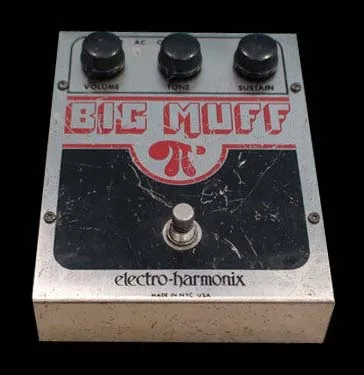
In 1978 the vintage Muff circuit design changed drastically: the transistors inside were replaced with operational amplifiers, which are integrated circuits2. Kit Rae's history of the op-amp Big Muff notes that Electro-Harmonix marketed the later reissue of this circuit as "our faithful re-creation of the late '70s circuit," and that the op-amp design, sometimes called the IC or V4 Big Muff, differs from the traditional transistor-based Big Muff in using op-amps to achieve its sustaining distortion sound3. The op-amp versions were the Big Muff Pi V4 and the V5 tone bypass Big Muff Pi, both released in 197845.
The Eye See '78 is Wren and Cuff's take on that circuit. Pedal of the Day reviewed it as a Dual Op-Amp Distortion that takes a peek at a very particular piece of Big Muff history, the circuit as it existed around 1978, and found it produces "a monstrously woolly distortion sound" that is crunchier and more ballsy than a standard Muff6. Delicious Audio made a similar comparison, noting that while most vintage Muffs are a little sweeter sounding, the Eye See '78 is crunchier and more ballsy7.
Premier Guitar's reviewer found the character aggressive rather than sweet:
"It's aggressive, with a buzzy mid-forward voice that tops out with an acerbic, searing, almost giant Tone Bender-like character when you crank up the treble."
The Tone Bypass switch
The Tone Bypass switch is the feature that sets the op-amp Muffs apart from the rest of the family. In 1978 a switch was added to the back of the original, and the Eye See '78 includes this switch as well1. Essentially, it removes the passive tone stack from the circuit for a volume boost and a significantly more raw and open sound, at the cost of making the tone control useless while engaged1.
Kit Rae's history describes the same behavior on the Electro-Harmonix op-amp reissue: the Tone Bypass switch completely bypassed the tone stage of the circuit, making for a brighter and harsher sound but missing the trademark mid scoop3. Pedal of the Day's reviewer considered the trade worthwhile, writing that "you won't miss it, the sound this switch provides is just too cool"6.
Power and connections
The Eye See '78 runs on a 9V DC adapter with a negative tip, the standard center-negative arrangement used by most guitar pedals, or on a 9V battery through a 2.1mm connector1. Current draw is 5mA1, low enough that a battery lasts a long time and the pedal places almost no strain on a pedalboard power supply. Bypass is true hard-wire bypass, so the circuit is out of the signal path when the pedal is off1.
History and versions
The Eye See '78 dates to 2014, when Wren and Cuff crafted what it calls the definitive version of the non-transistorized fuzzbox1. The original came in a bigger, near Muff-sized enclosure, which has been slimmed down for the current version6. Wren and Cuff notes that some demo videos show the first full-size version, and although the two are cosmetically different, the circuit is exactly the same1.
| Version | Enclosure | Circuit | Status |
|---|---|---|---|
| Eye See '78 (2014 original) | Bigger, near Muff-sized | 1978 op-amp Big Muff | Superseded16 |
| Eye See '78 (current) | Smaller footprint, 4.8" x 2.6" x 1.6" | Same circuit | In production, $199.991 |
| Eye See '78 OG | Big box, folded steel | Authentic replication of the V4 circuit, 100% through-hole components | Sold out2 |
The big-box OG version is an authentic replication of the V4 circuit, built with 100% through-hole components on a vintage style circuit board and specially selected ICs for authenticity2. Its enclosure is heavy duty folded steel, with a lacquer clear-coated top, old school hand silk screened graphics and polished bakelite style knobs2. One early batch detail worth knowing: a note on the OG page applies only to serial numbers 39-001 through 39-120, and following batches were changed to avoid confusion2.
The Eye See '78 OG big-box version is sold out at Wren and Cuff. The smaller-footprint Eye See '78 remains in production with the same circuit12.
In 2023 Wren and Cuff also announced the Eye See '70, a big box version of the Eye See '78 that replicates the 1978 op-amp V4 Muff circuit with a V5 tone bypass switch, and includes a secret internal adjustment to fine tune the tone beyond the stock V4 circuit7. Premier Guitar's review covered the big-box Eye See '78, which the reviewer attributed to "Big Muff wizard/scientist Matt Holl"8.
Videos
WrenAndCuff
AndyDemos
Fuzzed Drones
Questions
Does the Eye See '78 take a battery?
Yes. It runs on a 9V battery or a 2.1mm adapter, with 9V DC center negative power. Current draw is 5mA, so a battery lasts a long time and the pedal is easy to run from most pedalboard power supplies.
Is the Eye See '78 true bypass?
Yes. Wren and Cuff lists true hard-wire bypass for both the current smaller-footprint Eye See '78 and the big-box OG version, so the pedal is out of the signal path completely when switched off.
What is the Eye See '78 based on?
It is an authentic recreation of the 1978 IC Big Muff, the V4 circuit in which Electro-Harmonix replaced the usual transistors with operational amplifiers. Wren and Cuff describes the result as crunchier and more ballsy than a standard Muff.
Who designed the Eye See '78?
The Eye See '78 comes from Wren and Cuff, the US builder known for its Big Muff recreations. Premier Guitar's reviewer described the big-box version as the work of Big Muff wizard and scientist Matt Holl.
What is the difference between the full-size and smaller Eye See '78?
The original 2014 Eye See '78 came in a bigger, near Muff-sized enclosure. The current version is slimmed down to 4.8 by 2.6 by 1.6 inches. Wren and Cuff says the two are cosmetically different but the circuit is exactly the same.
What polarity power supply does the Eye See '78 need?
It needs a 9V DC adapter with a negative tip, the standard center-negative arrangement used by most guitar pedals, or a 9V battery. The connector is the common 2.1mm barrel type.
Sources (8)
- Eye See '78, Wren and Cuff
- Eye See '78 OG, Wren and Cuff
- The Big Muff History of All Versions Part 1, Kit Rae (kitrae.net), 2024-02
- A Fuzz and Muff pedal Timeline, Kit Rae (kitrae.net), 2014-07
- The history of the big muff over time, anasounds.com, 2022-06-08
- Wren and Cuff Eye See '78 Dual Op-Amp Distortion, Pedal of the Day, 2023-01-18
- New Pedal: Wren And Cuff Eye See '70 Fuzz, Delicious Audio, 2023-09-05
- Wren and Cuff See Eye ’78 Review, Premier Guitar, 2024-03-23