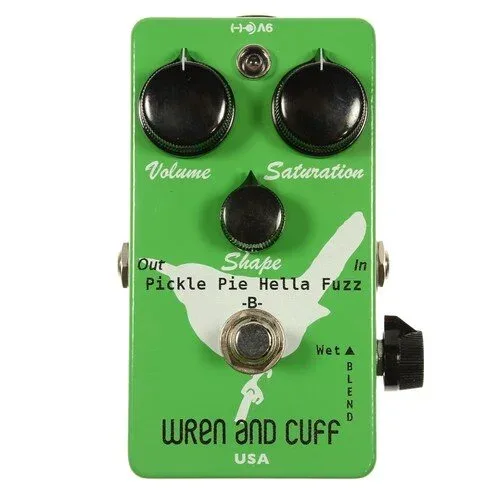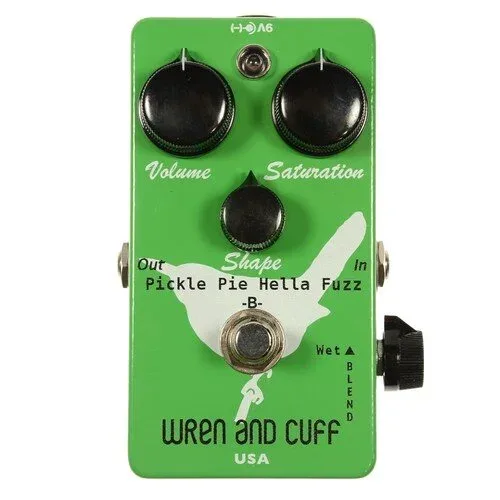


The Wren and Cuff Pickle Pie B is a bass distortion pedal built around a clean-blended fuzz circuit. It descends from The Pickle, the original Pickle Pie, a fuzz that Wren and Cuff says earned a reputation as a "guitar" pedal that could handle the low frequencies of the bass and still give a nice spongy fuzz1. The Pickle Pie B keeps that same basic circuit skeleton but reworks it for bass players who want distortion without losing their low end.
The core idea is the clean blend. A FET buffered active clean-boost runs alongside the fuzz side, so your fundamental low end stays intact while the fuzz layer sits on top. Wren and Cuff says the pedal can go from a dirty, gritty, slightly over-driven clean-blended bass sound all the way to fully saturated, with tighter lows at high fuzz settings1. Pedal of the Day's reviewer found that the FET-hybrid clipping section helps the fuzz mesh with the clean signal naturally, "instead of just sitting on top of the dry signal like some fuzzers with clean blends can do"2.
A clean-blended fuzz built for bass
The Pickle Pie B sits in the overlap between fuzz and distortion, aimed squarely at bass rather than guitar. Where a typical Muff-style fuzz can swallow a bass player's fundamentals, the Pickle line was already known for handling low frequencies, and the "B" version takes that further with a blend of clean and fuzz signals1.
Two design choices do most of the work:
- FET buffered active clean-boost: your dry low end is actively boosted and mixed back in, rather than simply passing through1.
- Reworked FET-hybrid clip sections: Wren and Cuff changed the clipping topology entirely from the original, and Pedal of the Day's reviewer credited this section with making the fuzz mesh naturally with the clean signal12.
The tone stack was also widened and geared specifically for bass. Pedal of the Day's reviewer found this gives a much less pronounced mid-scoop than the original, which helps the pedal retain presence in a live playing situation2. That matters for bass players who have fought fuzz pedals that disappear in a band mix.
"It can get downright dirty, but still maintains a level of clarity and punch not often associated with bass-centric effects units."
The controls
The control set is compact, with three main elements described by the maker and press12:
| Control | What it does |
|---|---|
| Saturation (Fuzz) | Altered from the original to be highly usable at lower gain settings, with tighter lows at high fuzz settings1 |
| Shape | Altered tone-stack range geared specifically for bass, with a widened range of usable tones and a less pronounced mid-scoop12 |
| Clean blend | FET buffered active clean-boost mixed with the fuzz side1 |
The Saturation knob is the one most changed from the original Pickle Pie. Both Wren and Cuff and Pedal of the Day describe it as usable at lower gain settings, giving a range from a dirty, gritty, slightly over-driven clean-blended sound to fully saturated fuzz12. The knobs themselves are genuine Davies "Daka-ware" knobs, a vintage-style part Wren and Cuff uses across its pedals1.
Power, bypass and build
Power comes from a 9VDC center-negative adapter through an insulated 2.1mm Boss-style jack, or from a 9V battery, and the pedal ships with a new battery installed1. At 5mA of current draw, it is easy on a power supply and easy on a battery1. Bypass is true hard-wire via a 3PDT switch, so the effect is fully out of the signal path when disengaged1.
The enclosure is powder-coated and hand-screened in the USA, and the pedal carries a lifetime warranty from Wren and Cuff1.
The Pickle Pie B reviewed by Pedal of the Day in March 2023 was the "Hella Fuzz" version, a green enclosure variant of the same pedal2. See the Pickle Pie B Hella Fuzz page for that version.
How it differs from the original Pickle Pie
The Pickle Pie B uses the same basic circuit skeleton as the original Pickle Pie, but Wren and Cuff lists the changes that make it a bass pedal1:
- A FET buffered active clean-boost added for the blend
- Totally changed FET-hybrid clip sections
- The saturation (fuzz) knob altered for lower-gain usability
- A widened range of usable tones from the shape knob, with a less pronounced mid-scoop
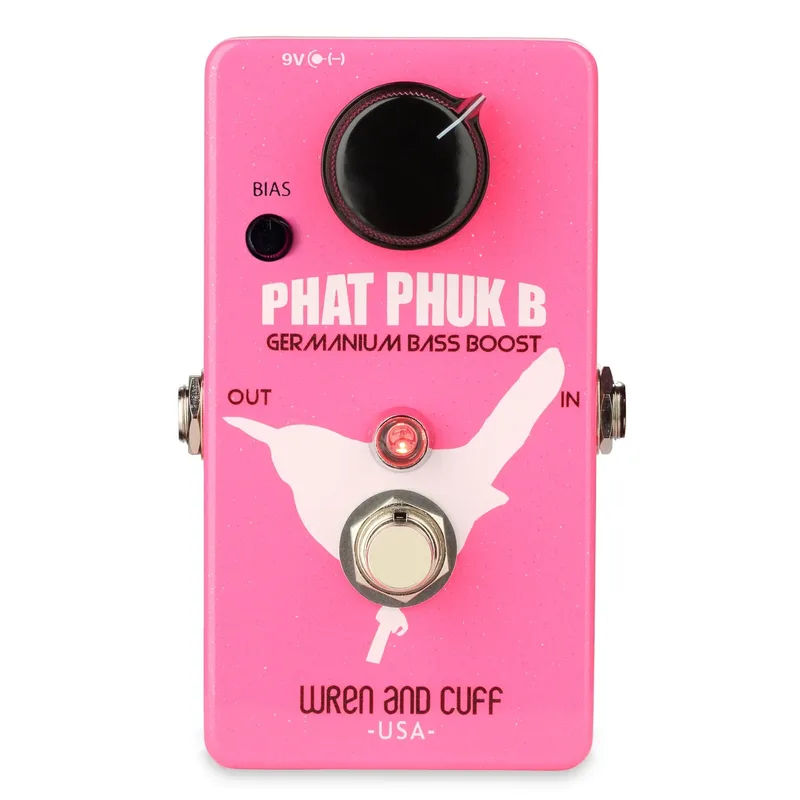
For bass players comparing Wren and Cuff options, the company also released the Phat Phuk B, a JFET/germanium hybrid boost pedal designed for bass, back in 2011. That pedal is a clean boost rather than a fuzz, so the two cover different ground on a bass pedalboard.
Videos
WrenAndCuff
WrenAndCuff
The Bass Channel
Questions
Does the Wren and Cuff Pickle Pie B take a battery?
Yes. The Pickle Pie B runs on a 9V battery or a 9VDC center-negative adapter through an insulated 2.1mm Boss-style jack, and Wren and Cuff ships each pedal with a new battery installed. At 5mA of current draw, a battery lasts a long time.
Is the Pickle Pie B true bypass?
Yes. The pedal uses a 3PDT footswitch for true hard-wire bypass, so your clean signal passes through untouched when the effect is off. The clean blend inside the effect is a separate FET buffered active clean-boost.
How is the Pickle Pie B different from the original Pickle Pie?
It keeps the same basic circuit skeleton as the original Pickle Pie but adds a FET buffered active clean-boost for bass, changes the FET-hybrid clipping sections, alters the saturation knob to work at lower gain, and widens the shape knob's tone-stack range with a less pronounced mid-scoop.
How much current does the Pickle Pie B draw?
The Pickle Pie B draws 5mA, which is low enough that it runs happily on a 9V battery and puts almost no strain on a pedalboard power supply. Power comes from a 9VDC center-negative adapter or the internal battery.
Where is the Pickle Pie B made?
The Pickle Pie B is made in the USA. The enclosures are powder-coated and hand-screened in the USA as well, and Wren and Cuff backs the pedal with a lifetime warranty.
Sources (2)
- Pickle Pie B, Wren and Cuff
- Wren and Cuff Pickle Pie B Hella Fuzz Bass Distortion, Pedal of the Day, 2023-03-26