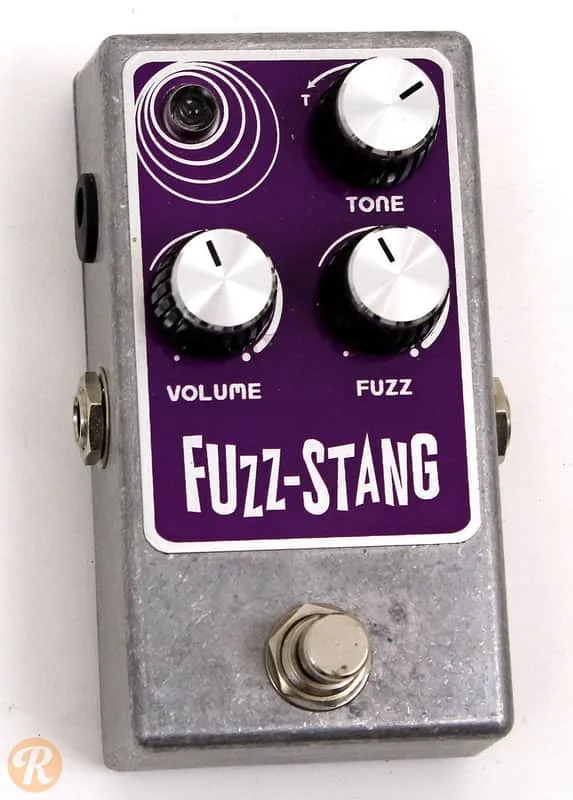


The Wrightsounds Fuzz-Stang is a fuzz pedal built by Matt Wright of Wright Sounds in Portland, Oregon. It is a clone of the ultra-rare Sam Ash Fuzz-Stainer, a fuzz pedal believed to have been released sometime in the early 1970s12. Wright built the first Fuzz-Stang on a whim in 2011, advertised it as a limited edition, and the original batch of 100 sold out within a year1. After that batch sold out he developed a distinct second version, the Fuzz-Stang Mark II, which added a fourth knob and a clean boost stage1.
Where the circuit comes from
The Fuzz-Stang traces back to the Sam Ash Fuzz-Stainer, a rare fuzz circuit believed to date from the early 1970s2. Delicious Audio has called the Fuzz-Stainer MK II "the rare and notoriously wild Sam Ash Fuzz-Stainer MK II"4. Wright came to it by buying one himself: "I got this crazy fuzz pedal, a Sam Ash Fuzz-Stainer"1. In his own assessment it is "just the standard vintage-style set-it-and-forget-it fuzz pedal. It's not super-versatile, in terms of tone"1.
The transistors are silicon, not germanium, and they are the same exact model number as the ones in the original Fuzz-Stainer. They are still manufactured today, and the Mark II uses the same batch as the first Fuzz-Stang1.
Mark I and Mark II
The first version was hand-wired through perf board, with a tiny internal trim pot used to dial in the attack. That trim pot was usable only from 11 o'clock to 1 o'clock1. After the 100-unit run sold out, Wright wanted to change the design enough to feel like a distinct pedal, and the Mark II came out of that1.
| Mark I | Mark II | |
|---|---|---|
| Build | Hand-wired perf board1 | Circuit board, layout helped by Mark Keppinger1 |
| Controls | External knobs plus internal attack trim pot, usable 11 to 1 o'clock1 | Volume, Tone, Fuzz and Attack knobs13 |
| Output level | Original1 | Louder, with a clean boost stage at the end of the circuit1 |
| Feel | Set-it-and-forget-it vintage fuzz1 | Touch-sensitive, so how you're playing changes the sound1 |
The Mark II's clean boost stage sits at the end of the circuit and, in Wright's words, "doesn't really affect the fuzz at all, it just makes it louder"1. The first batch of 25 Mark II enclosures was hand-drilled1.
Controls and sound
The Mark II carries Volume, Tone and Fuzz controls plus the Attack knob3. Wright describes the Attack control as "kind of a gate, you can get the thing to really choke down, or make it wide open with plenty of sustain"; its full sweep equals the 11-to-1 range of the Mark I's trim pot1. Pedal of the Day put it in playing terms: "The Attack knob lets you dial in your perfect amount of spitty, spluttery, gated fuzz, or giving the overall fuzz tone a" boost in sustain and presence3.
The same reviewer found the range wide, "going from an almost overdrive-like sound with Attack maxed and Fuzz almost off, to a super-fuzzy, face-melting, bone-crushing fuzz with both dials dimed"3.
"the Fuzz-Stang MkII is one of the most powerful, smooth, gritty, sputtered and clear fuzzes we've ever played"
Who uses it
- Jon Spencer owns Mark II Number One, the very first Mark II Wright built1. Pedal of the Day also lists him among artists who use it, along with Robbie Seahag Mangano3.
- Bill Frisell used a Fuzz-Stang at a solo show in Colorado, telling Wright he was "getting some really cool Close Encounters of the Third Kind sounds"1.
What came next
As of November 2018, Wright was considering a Mark III: a smaller enclosure, possibly no battery and plug-in adapter only, at a lower price. A tremolo pedal project had been set aside, and he was considering tweaks to his boost pedal so it could do more than boost alone1.
Videos
gearmanndude
JetCityMusic
musictoyznetwork rasch
Questions
What is the difference between the Wrightsounds Fuzz-Stang Mark I and Mark II?
The Mark I was a hand-wired perf-board build with three external knobs and an internal trim pot for the attack, usable only between 11 o'clock and 1 o'clock. The Mark II moved to a circuit board, added a clean boost stage at the end of the circuit, and put the attack range on a full Attack knob, making it louder and more touch-sensitive.
What does the Attack knob do on the Fuzz-Stang Mark II?
Matt Wright describes it as kind of a gate. Turned one way it chokes the sound down for spitty, spluttery, gated fuzz; turned the other it opens wide with plenty of sustain and presence. Its full sweep equals the 11-to-1 range of the Mark I's internal trim pot.
Does the Fuzz-Stang Mark II run on a battery?
Yes. Both the first and second versions can be powered with a nine volt battery or a plug-in adapter. Wright has said a possible future Mark III would drop the battery and run on a plug-in adapter only, in a smaller enclosure at a lower price.
What transistors does the Fuzz-Stang Mark II use?
Silicon transistors, the same exact model number as the original Sam Ash Fuzz-Stainer, and the same batch as the first Fuzz-Stang. Unlike germanium parts, they are still manufactured today.
What is the Sam Ash Fuzz-Stainer?
A rare fuzz pedal believed to have been released sometime in the early 1970s, described by Delicious Audio as rare and notoriously wild. Matt Wright bought one, found it a standard vintage-style set-it-and-forget-it fuzz, and cloned it as the Fuzz-Stang.
Who builds the Wrightsounds Fuzz-Stang?
Matt Wright of Wright Sounds, based in Portland, Oregon. He built the first Fuzz-Stang on a whim in 2011, hand-wiring it through perf board, and later moved the Mark II to a circuit board with layout help from Mark Keppinger.
Sources (4)
- Wrightsounds, Stompbox Book, 2018-11-09
- Fuzz Banger, BLAMMO! Electronics
- Wright Sounds Fuzz-Stang MkII Fuzz, Pedal of the Day, 2017-01-11
- New Pedal: BLAMMO! Electronics Fuzz Banger, Delicious Audio, 2025-01-10