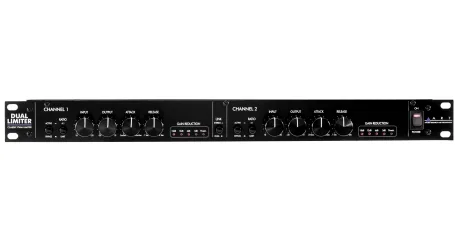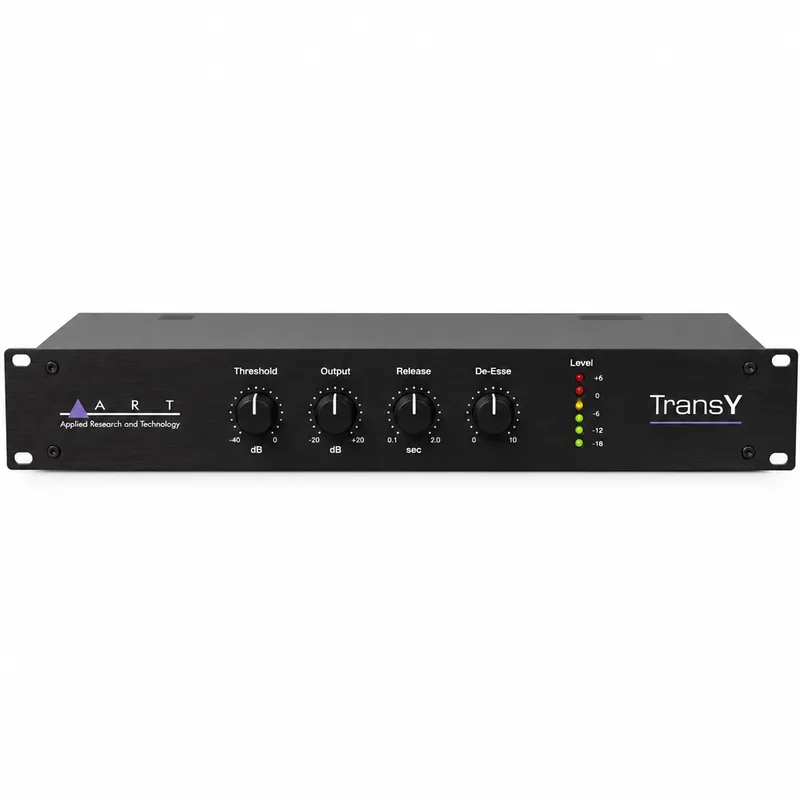


The ART TransY is a two-channel, discrete transistor FET-based compressor/limiter from Applied Research and Technology (A R T), built into a painted steel rack chassis designed for continuous professional use1. The audio path is fully analog: a discrete, low-noise transistor circuit uses a Field Effect Transistor for level control, and ART says the feed-forward detector topology and servo FET drive circuitry give the unit its flexibility and tone1. ART describes the range of the unit as running "from smooth and unobtrusive to full-blown deep sustain," always producing what the manual calls a musical result1.
For a player used to compressor pedals, the TransY is a different animal: a balanced, line-level studio processor with XLR and TRS jacks, a de-esser, and link mode for stereo work, rather than a stompbox on a pedalboard1.
The controls
Each channel of the TransY carries the same core control set, with a de-esser and metering on top of the usual compressor knobs1.
| Control | What it does |
|---|---|
| Threshold | Sets the point at which the TransY acts on a signal; counter-clockwise lowers the threshold, clockwise raises it1 |
| Output | Adjusts the overall gain of the unit; Channel 1's knob serves as the master output level when Link Mode is active1 |
| Release | Sets the time the compressor/limiter takes to increase the gain after the input level drops1 |
| De-Esse | Lowers the compression threshold of a narrow band of frequencies, keeping sibilance natural as compression increases1 |
| Power switch | Turns the power on and off to the unit1 |
The slope (ratio) is selectable from 1.2:1 to ∞:1, attack time runs from 0.5 to 100 milliseconds, and release time runs from 50 milliseconds to 3 seconds1. The de-esser works over a range of 0 to -16dB at 6kHz1.
The Level LED meter shows the signal level at the output of the unit, where "0" corresponds to 0dBu at +4 operation and -10dBV at -101.
ART gives starting points in the manual: for speech, a ratio of 2:1 with gain reduction of 3 to 9dB; for adding sustain to instruments, a 4:1 ratio with gain reduction in the 15dB range described as not uncommon1. For mastering, ART says only 6 to 10dB indicated on the compressor attenuation meter is required to maximize the level of digital recordings, with the ratio set to ∞:11.
The de-esser is aimed at vocal work, reducing sibilance when compressing vocals1. The unit also handles ducking: connect the background music to be ducked to the audio input, feed a line-level buffered mic signal to the Detector Loop jack, set the ratio to ∞:1 and the attack to 1 to 2 milliseconds1.
Power and connections
The TransY runs from a universal external 48V DC supply with a locking connector, with a 10-watt output requirement; the supply itself is designed to operate from 85 to 250VAC, 50 to 60Hz, and an IEC power cord is included1. The shipping carton contains the unit, the user's guide, the 48V power supply, and the IEC power cord1.
The TransY has a passive hardwire bypass, which means the bypass works even if the power is off1. Signal still passes through the unit when it is unpowered or switched out.
Inputs are balanced on XLR (Pin 2 hot, Pin 3 cold, Pin 1 ground) and 1/4-inch (Tip hot, Ring cold, Sleeve ground)1. The analog output appears on both a 1/4-inch TRS balanced jack and an XLR jack, transformer balanced and low impedance for driving long lines1.
Link Mode sums the detector signals of the two channels so either channel's signal can trigger gain reduction, useful for keeping a stereo pair locked together; the switches remain independent even in link mode1.
Specifications
| Specification | Value |
|---|---|
| Max input level | Balanced, +4/-10: +21dBu / +9dBu; Detector input: +20dBu1 |
| Max output level | Detector +20dBu1 |
| Input impedance | Balanced input / detector input: 33k ohm / 2M ohm1 |
| Output impedance | Balanced, +4/-10: 110 ohm / 250 ohm; Detector output: 270 ohm1 |
| Frequency response | 15 to 100kHz, +0.5dB1 |
| THD | <0.05% typ., 20 to 20kHz1 |
| CMRR | 80dB typ.1 |
| Equivalent input noise | +4/-10: -90dBu / -102dBu "C" weighted1 |
| Dimensions (H, W, D) | 1.75 x 19.0 x 9.5 inches (44mm x 483mm x 241mm); 11.6 inches deep with the locking power supply plug connected1 |
| Weight | 7.95 lbs (3.62kg) with supply1 |
ART covers the TransY with a 3-year parts and labor warranty for the original purchaser in the United States; units purchased outside the United States are serviced by an authorized distributor1.
Videos
askdrtk
Sound On Sound magazine
Liquid Studio Productions
Questions
Can you use the ART TransY with a guitar?
Yes. The TransY is a line-level rack compressor/limiter with balanced XLR and 1/4-inch inputs, so a guitar works best through a preamp or other line-level source feeding it. ART's own application notes cover speech, vocal, instrument and mastering leveling rather than instrument-level signals directly.
Does the TransY pass signal when the power is off?
Yes. The TransY has a passive hardwire bypass, which means the bypass works even if the power is off, so signal continues to pass through the unit.
What power supply does the ART TransY need?
It uses the supplied universal external 48V DC supply with a locking connector, rated at 10 watts. The supply itself operates from 85 to 250VAC, 50 to 60Hz, and an IEC power cord is included in the box.
Is the ART TransY stereo?
It is a two-channel unit, and Link Mode sums the detector signals of both channels so either channel's signal can trigger gain reduction, which keeps a stereo pair matched. The compression switches remain independent even in link mode.
How many rack spaces does the TransY take?
One. The chassis is 1.75 inches high by 19.0 inches wide by 9.5 inches deep, a single rack space. With the locking power supply plug connected, total depth increases to 11.6 inches.
Sources (1)
- Microsoft Word, ART (Applied Research and Technology), 2018-07-18