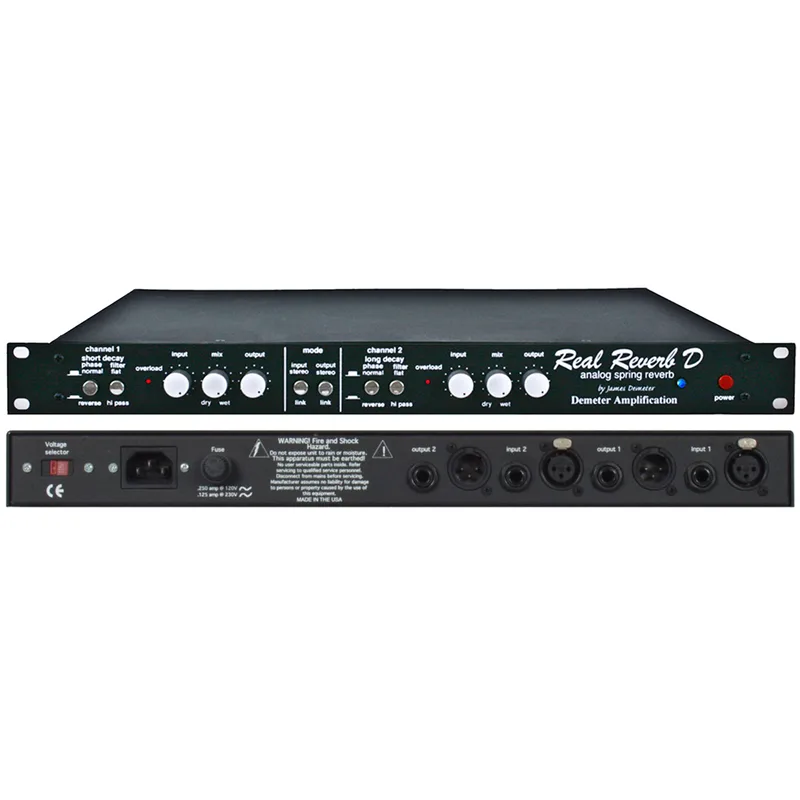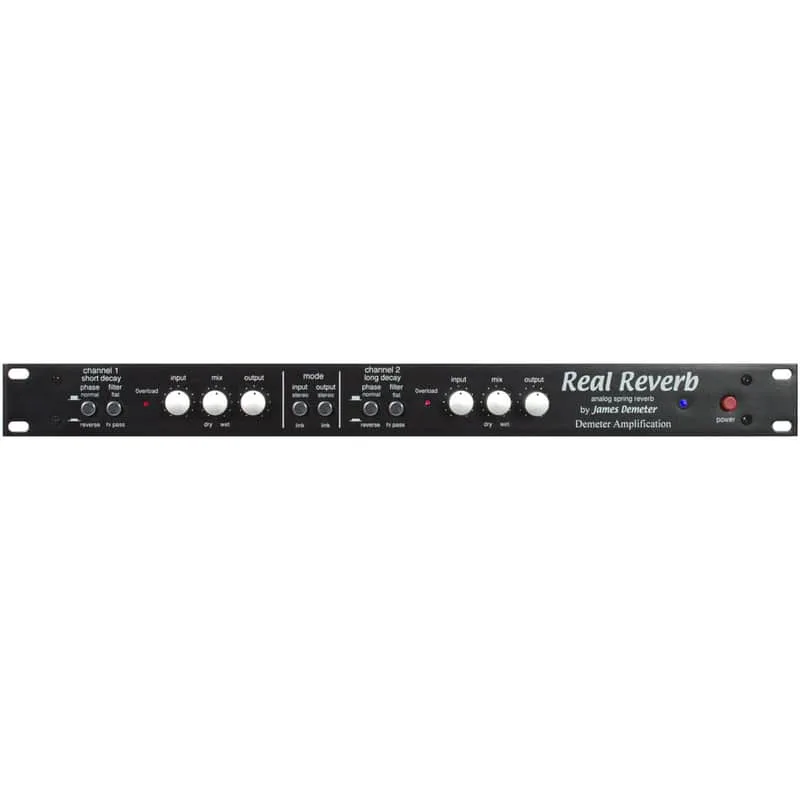

The Demeter RV-1 Real Reverb is a two-channel, all-analog spring reverb in a single rack space, designed by James Demeter of Demeter Amplification12. Instead of digital processing, it drives a pair of Accutronics six-spring reverb tanks, one per channel, each with its own fixed decay time13.
For a player, the appeal is the sound of real springs. A spring reverb produces a very dense, ringy sound reminiscent of the onboard reverb of most guitar amplifiers, and the RV-1 delivers that character with the routing flexibility of a studio rack unit3. It can run as two separate mono reverbs, or the inputs can be tied together so a signal coming into either channel is mixed and sent to both springs for stereo panning1. Demeter's current version of the unit is sold as the Demeter RV-1D Real Spring Reverb, which the maker describes as "Spring reverb for the digital age"4. For a broader look at the effect type, see reverb pedals.
Two channels, two tanks, one rack space
The RV-1's core idea is simple: two independent spring reverb channels in one chassis. Each channel has its own Accutronics tank with its own decay time, giving two separate channels of analog reverb3. The decay times are fixed rather than adjustable: channel 1 runs about 1.5 seconds and channel 2 about 3.5 seconds15. Demeter's product page for the current RV-1D lists the same pairing, 1.5 seconds short and 3.5 seconds long4.
| Channel | Decay time | Character |
|---|---|---|
| Channel 1 | Approximately 1.5 seconds15 | Short, quick decay |
| Channel 2 | Approximately 3.5 seconds5 | Longer, more sustained tail |
The two channels can work in several configurations. Mode switches select mono or stereo inputs and mono or stereo linked outputs3. With the inputs routed or mixed to both channels, the unit produces a stereophonic reverb with left and right outputs3. The Output Link switch goes the other way, mixing the two outputs together for what Musician.com's Barry Rudolph described as an extra thick mono reverb1.
The unit was a limited edition at launch, with an initial run of 50 units2. Reviewers took note of that scarcity: one described it as a limited-edition unit that "should find a place in any studio that needs a quiet analog reverb with personality"2.
The controls
The front panel is straightforward. Each channel gets three knobs: Input, Output, and Wet/Dry mix3. The Mix control governs the ratio of wet-to-dry sound, which matters most when using the Real Reverb as an insert effect1. Input impedance is 10kOhms1.
| Control | What it does |
|---|---|
| Input level (per channel) | Sets input level to maximize headroom; watch the red LED overload indicator, which the manual says should blink a bit at maximum level in and out1 |
| Output (per channel) | Sets the channel's output level3 |
| Mix (per channel) | Governs the ratio of wet-to-dry sound1 |
| Phase switch (both channels) | Flips the phase of the reverb signal output, subtly changing the frequency response of the reverb13 |
| Filter switch (per channel) | High-pass filter rolling off rumble and low frequencies below 100 Hz13 |
| Input Link | Ties the inputs together so signals into either channel are mixed and sent to both springs1 |
| Output Link | Mixes the two outputs together for an extra thick mono reverb1 |
| Mode switches | Select mono or stereo inputs and mono or stereo linked outputs3 |
| Power switch | Front panel3 |
Indicator LEDs show power for the unit and input signal overload for either channel3.
The phase reverse switch deserves a note. Rudolph found it "a clever and unique feature"1, and Music Biz Magazine's Adam Kagan explained its effect: the switches subtly change the frequency response of the reverb3. For players combining the RV-1 with other gear, it is a way to shape the reverb's tonal balance without an EQ.
Connections and power
Audio connections are on the back panel: each channel has electronically balanced 1/4-inch TRS jacks and XLR input and output connectors3. Mix Magazine's Alex Artaud described the I/O as fully balanced XLR and 1/4-inch TRS2, and Pro Audio Review's Russ Long specified inputs on two female XLR or two 1/4-inch TRS connectors and outputs on two male XLR or two 1/4-inch TRS connectors23.
Power comes over an IEC cable, with a selector between 115V or 230V operation2. The fully regulated + or - 18-volt power supply is designed for maximum audio headroom and +28dBv output1. The chassis is a rugged metal enclosure, with components from the custom-built transformer to the high-quality amplifiers chosen for maximum headroom, frequency response, and noise rejection6. Signal-to-noise ratio is greater than 90 dB5.
What reviewers said
The RV-1 drew consistent praise across the studio press. Russ Long, reviewing it in Pro Audio Review in January 2001, praised its quietness and its sound on horns, vocals and guitars, while noting it did not suit drums5. He wrote that it "has a unique sonic characteristic that I have not heard equaled in its digital counterparts"5.
"the Demeter offers the ultimate reverb with a much fatter, smoother, and cleaner sound than any old Fisher Space Expander or Fender reverb."
Adam Kagan in Music Biz Magazine called it "a great choice" at its $699 list price3, and EQ Magazine's Emile Menasche wrote that "Demeter is known for building high-end gear, and the Real Reverb has the feel of quality"6. His review noted two caveats: susceptibility to electromagnetic interference and weak handling of percussion6. Vintage Guitar, reviewing it in August 2003, summed it up as "a stereo, spring reverb that takes up one rack space, is built to last, and creates some of the most lush, authentic reverb you can imagine"7.
Alex Artaud's verdict in Mix Magazine was similarly positive:
"This limited-edition unit is a pure pleasure to work with and should find a place in any studio that needs a quiet analog reverb with personality."
The common thread is that the RV-1 is a quiet, well-built analog spring reverb that works especially well on guitars, vocals and horns, with drums and percussion being its weak spot31. For players who want the spring sound without a rack unit, the reverb pedals page covers the pedalboard alternatives.
Videos
BIG EGO
Questions
Is the Demeter RV-1 analog or digital?
It is all-analog. The RV-1 uses two Accutronics spring reverb tanks rather than digital processing, with a fully regulated plus or minus 18-volt power supply for headroom. Music Biz Magazine's reviewer framed its appeal as a reverb that is not digital and has no digital parameters to adjust.
How long is the decay on each RV-1 channel?
The decay times are fixed. Channel 1 runs about 1.5 seconds and channel 2 about 3.5 seconds, so the short channel suits quick, tight parts and the long channel suits sustained playing. Demeter's product page for the current RV-1D lists the same 1.5-second short and 3.5-second long times.
Does the Demeter RV-1 have XLR connections?
Yes. The back panel carries fully balanced XLR and 1/4-inch TRS connectors for each channel, both inputs and outputs. Pro Audio Review described inputs on two female XLR or two 1/4-inch TRS connectors and outputs on two male XLR or two 1/4-inch TRS connectors.
How many rack spaces does the Demeter RV-1 take?
One. The RV-1 fits in a single rack space, measures 19 by 1.75 by 10 inches, and weighs 17 pounds. Mix Magazine noted it takes up one rackspace and is 10 inches deep.
What does the phase reverse switch do on the RV-1?
It flips the phase of the reverb signal output. Music Biz Magazine's reviewer described the phase reverse switches on both channels as subtly changing the frequency response of the reverb, and Musician.com's Barry Rudolph called the Phase switch a clever and unique feature.
What is the list price of the Demeter RV-1?
$699 US. That figure appears in Musician.com's listing and in reviews from Pro Audio Review (January 2001) and Music Biz Magazine (May 2001), which called the Real Reverb at a $699 list price a great choice.
Sources (7)
- RV-1 | Musician.com | Demeter Amplification, Musician.com
- RV-1 | Mix Magazine (February 2001) | Demeter Amplification, Mix Magazine, 2001-02
- RV-1 | Music Biz Magazine (May 2001) | Demeter Amplification, Music Biz Magazine, 2001-05
- RV-1D Real Spring Reverb, Demeter Amplification
- RV-1 | Pro Audio Review (January 2001) | Demeter Amplification, Pro Audio Review, 2001-01
- RV-1 | EQ Magazine (September 2001) | Demeter Amplification, EQ Magazine (republished on demeteramps.com), 2001-09
- Demeter Fat Conrol, Compulator, and Reverb, Vintage Guitar magazine, 2005-12-01