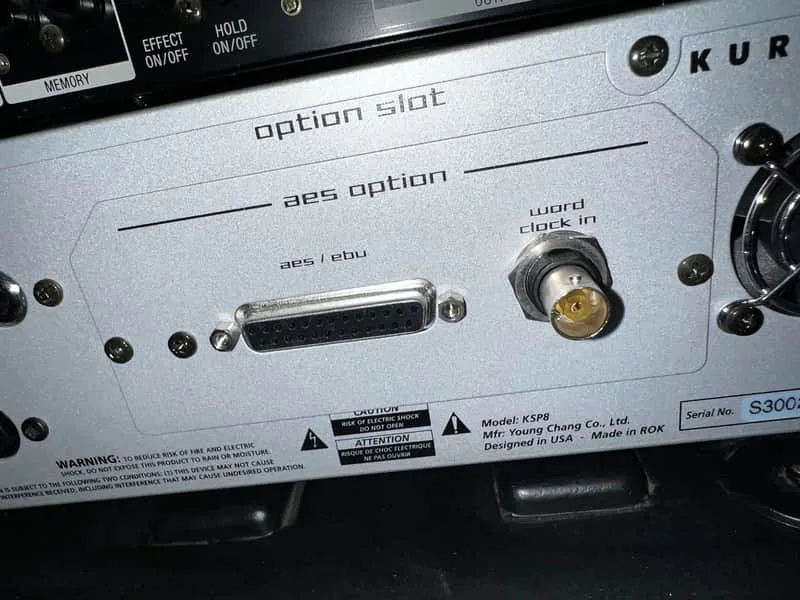


The Kurzweil KSP8 is a multi-bus signal processor: an 8-channel effects system in a 2-space rack chassis, built around the effect algorithms Kurzweil developed for KDFX, the effects system in the Kurzweil K2600 synthesizer1. Where a multi-effects pedal runs one signal through a chain, the KSP8 is designed to take several channels at once and spread its processing across them, which is why Kurzweil positions it for studio and live routing rather than as a stompbox-style unit.
Kurzweil lists the KSP8 as a Legacy Model, so it is no longer in production1.
Buses, algorithms and modulation
The KSP8's architecture is built on processing units and buses. It has 16 available processing units that may be freely shared among up to 8 effect buses, and effect presets link together to form chains on those buses1. In practice this means one unit can serve several sources at once: a vocal chain on one bus, a guitar chain on another, with the 16 units divided however the routing needs them.
The algorithm count is large: 249 DSP algorithms, which Kurzweil describes as expandable1. Modulation depth is equally deep, with up to 36 LFOs and 36 envelope generators, and 72 functions available for combining control sources1. That is far more modulation routing than a pedalboard of individual pedals offers, and it is the kind of control surface that suits a player who wants one effect's parameter driven by another.
Presets, chains and studios
The KSP8 organizes its sounds in three layers, and the factory counts give a sense of the scale1:
| Object | Factory | User locations |
|---|---|---|
| Effect presets | 636 | up to 999 |
| Effect chains | 138 | up to 999 |
| Studios | 14 | up to 999 |
A "studio" is the top-level configuration that holds the bus routing and chains together, so the 14 factory studios are complete starting points rather than individual sounds. User-created objects of all kinds get up to 999 locations1.
Inputs, outputs and digital I/O
The standard analog I/O is four 1/4" TRS balanced jacks, expandable to eight1. Digital I/O over the standard XLR pair runs in AES/EBU or SPDIF formats, at 110 ohms (AES) or 75 ohms (SPDIF) impedance1.
Beyond that, the KSP8 takes one optional I/O card, and the choice matters for anyone buying secondhand1:
- 4 additional channels of analog I/O, or
- 8 channels of digital I/O in Alesis Lightpipe, Tascam TDIF, mLAN (Firewire/IEEE-1394), or AES/EBU formats
Clock sync to ADAT, TDIF, mLan and BNC word clock requires the optional I/O card. The unit syncs to AES/EBU and SPDIF without it1.
Other I/O and control features include MIDI In/Out/Thru ports, a built-in SmartMedia drive supporting cards up to 64Mb for storage, a 240 x 64 CCFL backlit LCD with front panel contrast adjustment, and 4-point multi-stage metering across 8 channels with both graphical and numeric display options1.
Converters and audio specifications
The audio path is 24-bit throughout, with a 24-bit, 128x oversampling A/D converter1. Input word length is up to 24 bits, and output word length is selectable at 16, 20, or 24 bits, with dither options of None, Flat, and 2 types of Shaped dither1.
| Specification | Value |
|---|---|
| Frequency response | 20Hz to 20kHz, +/- 0.15dB |
| Dynamic range | > 110dB unweighted @ 1kHz |
| THD+N | < 0.0015% @ 1kHz, +19dBu |
| Crosstalk | < -100dB @ 1kHz |
| Maximum input level | +22dBu |
| Minimum input level (for 0dBFS) | +4dBu |
| Input impedance | 20K ohms balanced, 10K or 20K ohms unbalanced |
| Output impedance | 100 ohms balanced, 50 ohms unbalanced |
| CMRR | > 60dB @ <= 1kHz, > 40dB @ 1kHz to 20kHz |
Firmware and documentation
Kurzweil's product page for the KSP8 remains the reference point for the unit's documentation. The rack itself is a compact package for an eight-channel processor: 17.12 inches wide (43.50 cm), 15.12 inches deep (38.40 cm), and 3.62 inches tall (9.20 cm), weighing 13.23 lbs (6.00 kg), with MIDI In, Out and Thru ports for connecting it to the rest of a rig1.
Videos
Saint Luminus
Saint Luminus
Saint Luminus
Questions
Is the Kurzweil KSP8 still made?
No. Kurzweil lists the KSP8 as a Legacy Model on its product page, so it is no longer part of the current lineup. Units are found on the secondhand market, and Kurzweil still hosts the manual and OS updates on its site.
What is the latest KSP8 OS version?
The KSP8V190 OS update, dated March 19, 2003, is the OS version Kurzweil publishes on the KSP8 page. It was distributed for installation via SmartMedia card or MIDI. Kurzweil also published KSPOB150 object files on January 19, 2005.
Where can I download the KSP8 manual?
Kurzweil hosts the KSP8 Users Guide as a zip file at https://kurzweil.com/wp-content/uploads/2020/03/KSP8_UG.zip. The guide is dated May 16, 2002 and is about 2.7 MB.
Does the KSP8 have ADAT or Lightpipe I/O?
Not as standard. The KSP8 accepts one optional I/O card that provides either 4 additional channels of analog I/O or 8 channels of digital I/O in Alesis Lightpipe, Tascam TDIF, mLAN (Firewire/IEEE-1394), or AES/EBU formats. Clock sync to ADAT and the other starred formats also requires the optional card.
How many rack spaces is the KSP8?
Two. The KSP8 is housed in a 2-space rack-mountable chassis, measuring 17.12 inches wide, 3.62 inches high, and 15.12 inches deep, and weighing 13.23 lbs.
Sources (1)
- KSP8 - KURZWEIL It's the Sound®, Kurzweil, 2024-08-22