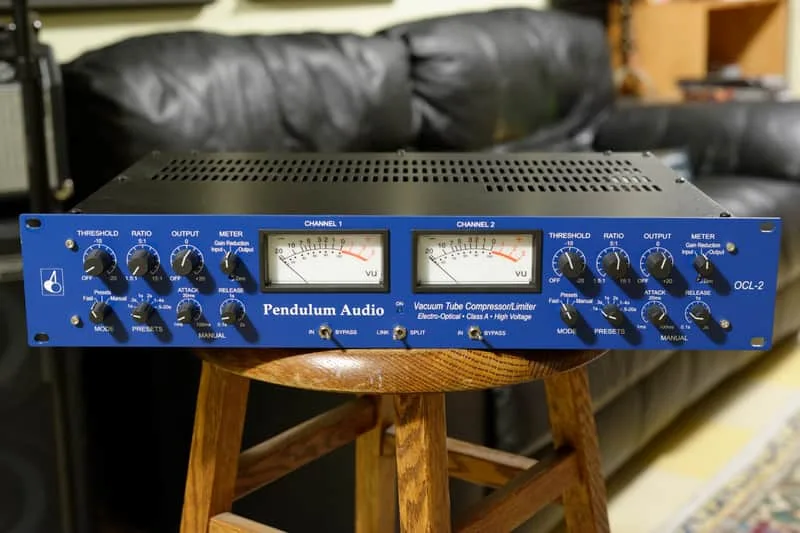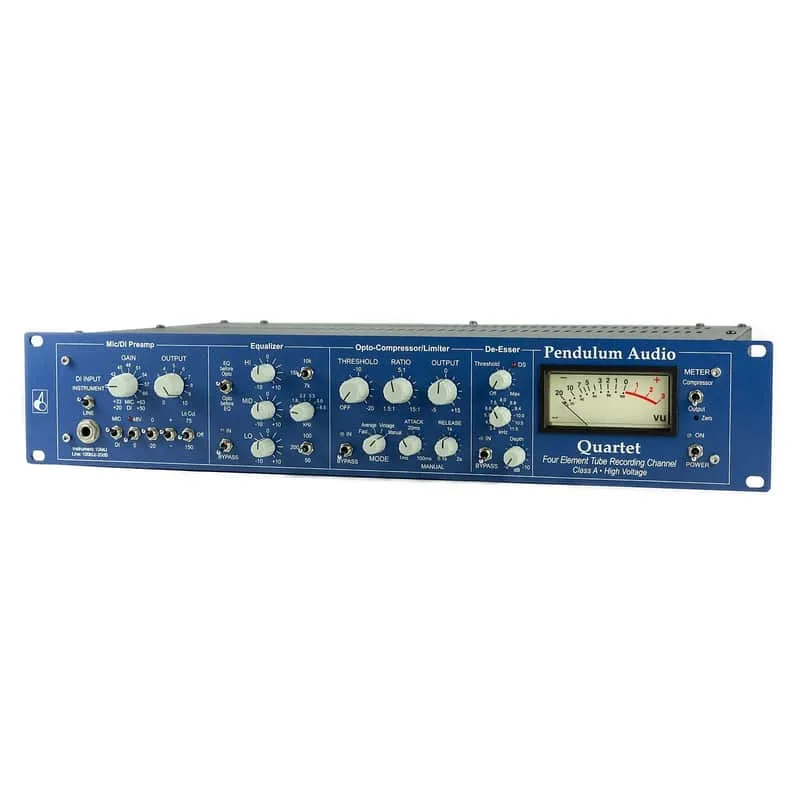
The Pendulum Audio Quartet is a four element tube recording channel in a 2U rack chassis: a mic/DI preamp, an opto-compressor/limiter, an EQ, and a de-esser, all in one signal path. Pendulum Audio describes it as an all-tube, short signal path design with pure class A, high voltage circuitry, built to deliver what the maker calls an open, intimate sound with a level of detail, extremely wide bandwidth, low noise and high headroom1. It is a studio channel strip rather than a stompbox, but its DI inputs and compressor make it relevant to guitar and bass players recording direct.
The Quartet's circuits are borrowed from Pendulum Audio's standalone units: the tube Mic/DI preamp comes from the MDP-1A, and the tube opto-compressor comes from the OCL-2, using the maker's proprietary optoelectronic design1. The original Quartet was designed by Greg Gualtieri, who decided the channel needed a de-esser as one of its four elements12. Pendulum Audio also calls it an award-winning recording channel3.
The four stages
Each element of the Quartet does a different job, and the manual gives the circuit type for each1.
| Stage | Circuit type | Key specs |
|---|---|---|
| Mic/DI preamp | Class A vacuum tube gain stage | Input gain +33 to +63dB in 3dB steps; input impedance 1500Ω transformer balanced and floating1 |
| Opto-compressor | Optical input attenuator and class A vacuum tube gain stage | Ratio 1.5:1 to 15:1; max gain reduction > 30dB1 |
| EQ | Modified Baxandall-style feedback equalizer | Input sensitivity +4dBu; input impedance 10kΩ1 |
| De-esser | Notch filter activated by sibilance detection | 11-position frequency switch, 3.4 to 11.5 kHz1 |
The compressor's ratio control is continuously variable from light compression to limiting, 1.5:1 to 15:11. The de-esser works differently from a full-band compressor: its threshold control determines at what level the notch filter is activated, and a red DS LED flashes on the front panel when de-essing is occurring. The DS Frequency control is an 11-position rotary switch selecting the sibilance detection frequency, from 3.4, 4.5, 5.7, 6.6, 7.5, 8.0, 8.8, 9.4, 10.0, 10.5 or 11.5 kHz1.
Other controls worth knowing:
- 0/-20 pad: the -20 position inserts a 20 dB pad in front of the mic input transformer1
- EQ Before Opto / Opto before EQ: places the EQ stage before or after the opto-compressor in the signal path1
- EQ In/Bypass: a "hard" bypass switch for comparing the processed sound directly with the original source1
Using the stages separately
The Quartet can work two ways. With no patch cables inserted into the rear patch bay, it runs as a normal channel strip with the Pre, EQ and Opto sections in series. Insert patch cables and each element can be used separately, so a studio can pull the preamp, EQ or compressor out on its own for other sources. The Mic/DI, EQ and Compressor/De-Esser can all be patched out and used independently1.
To return to using the Quartet in its stand-alone mode, you unplug the patch cables from the EQ output and Opto/DS input on the rear panel, which makes the Main Output active again1.
Power and connections
The Quartet runs from mains power, not a pedalboard supply: it operates from either 115-120V/60 Hz or 230-240V/50 Hz at 45W, through a 3-prong IEC connector with a voltage selector switch1. Its internal power supplies produce +300Vdc, +6.3Vdc, +12.6Vdc and ±18Vdc rails, fully regulated, with soft-start warm-up and output muting1.
For a guitar or bass player, the DI inputs are the interesting part:
- Front panel 1/4" jack: 10MΩ input impedance, which the manual calls ideal for very high impedance sources such as piezo transducers; it also serves as a 100kΩ line input with a -20dB pad1
- Rear panel 1/4" jack: 1MΩ input impedance, ideal for passive magnetic guitar or bass pickups; also a 100kΩ line input1
- Mic input: female XLR, transformer balanced, pin 2 hot, with +48Vdc phantom power applied to pins 2 and 31
Outputs are a male XLR transformer-balanced output (pin 2 hot) and an unbalanced 1/4" output with tip as the + phase1. The unit uses six vacuum tubes: three ECC83/12AX7A and three 6922/6DJ81.
The Quartet II Mercenary Edition
Pendulum Audio also builds a successor, the Quartet II Mercenary Edition, likewise designed by Greg Gualtieri and likewise a 2U rack unit4. Its four elements differ from the original: a dual transformer Mic/DI preamp, a Passive/Aggressive EQ, a Delta-Mu compressor/limiter, and a peak limiter, so the de-esser of the original is replaced by a peak limiter4.
| Quartet | Quartet II | |
|---|---|---|
| Compressor | Optical, 1.5:1 to 15:11 | Delta-Mu, 1:1 to limiting, program-dependent4 |
| Compressor circuit | Optical input attenuator and class A vacuum tube gain stage1 | Remote-cutoff gain control tube with class A solid-state gain makeup stage4 |
| EQ | Modified Baxandall-style feedback equalizer1 | Inductor-based passive EQ network with all-tube gain makeup stage, with Aggressive mode4 |
| Fourth element | De-esser324 | Peak limiter4 |
| Tubes | (3) ECC83/12AX7A, (3) 6922/6DJ81 | (2) ECC83/12AX7A, (2) 6922/6DJ8, (1) 6ES8/ECC1894 |
| Weight | 14.5 lbs (6.6 kg)1 | 15.0 lb (6.8 kg)4 |
The Quartet II's Delta-Mu compressor offers fast, faster, vintage, average or manual sidechain modes, more than 15dB of gain reduction, less than 0.08% THD+N from 20Hz to 10kHz, and a frequency response of -1.0dB at 15Hz and 75kHz into a 600Ω load4. Its power connection is the same 3-prong IEC type with a detachable cord, and its input and output XLRs are pin 2 hot4. Replacement tubes are available directly from Pendulum Audio, and the manual estimates preamp tube life at several years4.
Both versions share the same 2U enclosure, 19" x 3.5" x 12.5" (48.2 x 8.8 x 31.8 cm), and mount in any standard 19 inch equipment rack14.
Questions
Who designed the Pendulum Audio Quartet?
The Quartet was designed by Greg Gualtieri, who also designed the Quartet II Mercenary Edition. Gualtieri decided the channel needed a de-esser as one of its four elements, which is how the original Quartet got its Mic/DI preamp, opto-compressor, EQ and de-esser layout.
Can the Quartet's stages be used separately?
Yes. The Mic/DI, EQ and Compressor/De-Esser sections can be patched out through the rear patch bay and used independently. With no patch cables inserted, the unit works as a normal channel strip, and unplugging the patch cables from the EQ output and Opto/DS input returns it to stand-alone mode.
Can I plug a guitar directly into the Pendulum Audio Quartet?
Yes. The front panel 1/4 inch DI jack has a 10MΩ input impedance suited to piezo transducers, and the rear jack is 1MΩ, which Pendulum Audio describes as ideal for passive magnetic guitar or bass pickups. Both jacks also work as 100kΩ line inputs.
Does the Quartet provide phantom power?
Yes. The mic input provides +48Vdc phantom power, applied to pins 2 and 3 of the female XLR connector. The input itself is transformer balanced and floating, with pin 2 hot.
What is the compression ratio range on the Quartet?
On the original Quartet's opto-compressor, the ratio is continuously variable from 1.5:1 to 15:1, covering light compression through limiting. The Quartet II's Delta-Mu compressor is program-dependent, ranging from 1:1 up to limiting.
How big and heavy is the Pendulum Audio Quartet?
The Quartet is a 2U rack unit measuring 19 x 3.5 x 12.5 inches (48.2 x 8.8 x 31.8 cm) and weighing 14.5 lbs (6.6 kg). The Quartet II is the same size but slightly heavier at 15.0 lb (6.8 kg).
Sources (4)
- Quartet-Manual-Complete.pdf, Pendulum Audio, Inc.
- DS500-Brochure.pdf, Pendulum Audio, 2001
- DS-500 - Pendulum Audio, Pendulum Audio
- Quartet-II-Manual.pdf, Pendulum Audio, Inc.