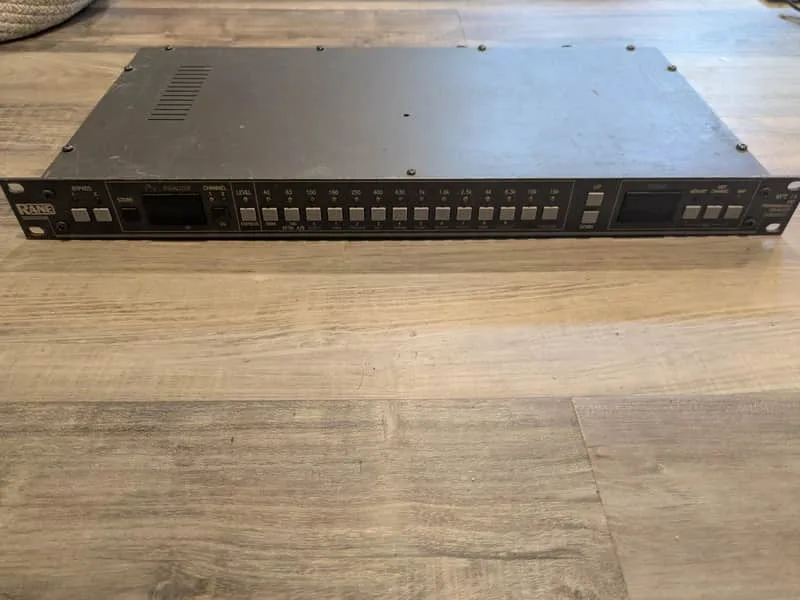
The Rane MPE 14 is a MIDI programmable equalizer made by Rane Corporation. Its front panel includes BYPASS 1 and BYPASS 2 buttons: pressing either button toggles that channel between Bypass and Active modes, with the LED on indicating Bypass, and a bypassed condition cannot be stored1. Each channel also has an OL (overload) indicator, a red LED that illuminates any time the inputs, filters or output reaches 4dB below clipping1.
Memory and how it works
The MPE 14 holds curves in two kinds of memory. Stored Memory is any of the 128 locations provided for curves, and Rane notes that the first up to 32 can be preset at the factory. Working Memory is a scratch-pad location used for changing curves before you put them into Stored Memory, and it is what you hear while editing1.
The STORE button writes an edited curve away: pressing it once prompts for the Stored Memory location, and pressing it again writes the information to Stored Memory. The MEMORY button returns the unit to Normal Operating mode. Its LED flashes when Working Memory differs from Stored Memory, and in EQ Edit mode, pressing and holding it compares the edited Working Memory with the Stored Memory curve, shown with the letter C on the EQUALIZER display1.
The controls
| Control | What it does |
|---|---|
| CHANNEL | Displays the current MIDI Channel assignment; change it with the UP/DOWN buttons or number keys; pressing again returns to Normal Operating mode |
| UP & DOWN buttons | Used to increase or decrease parameters in all operating modes |
| MEMORY | Enters Normal Operating mode; flashing LED shows Working Memory differs from Stored Memory; held in EQ Edit mode, compares edited and stored curves |
| STORE | First press prompts for a Stored Memory location, second press writes the curve there |
| BYPASS 1 & 2 | Pressing either toggles between Bypass and Active modes (LED on = BYPASS); a bypassed condition cannot be stored |
| OL 1 & 2 | Red LEDs that illuminate any time the inputs, filters or output reaches 4dB below clipping |
All control descriptions come from the Rane manual1.
Connections and MIDI
Each channel carries an active balanced 3-pin XLR input (pin 2 +, pin 3 -, pin 1 signal ground, shell chassis ground) and a balanced quarter-inch TRS input (tip +, ring -, sleeve ground). The outputs mirror this: a balanced quarter-inch TRS Channel Output and a 3-pin XLR active balanced Channel Output with the same pin assignments. For unbalanced use, the manual gives the wiring: on TRS, connect hot to tip, ground to sleeve and leave the ring open; on XLR, connect pins 3 and 1 together and drive pin 21.
On MIDI, the MPE 14 has MIDI IN, MIDI OUT and MIDI THRU connectors. The MIDI THRU output contains all the MIDI information exactly as it comes into the MIDI Input, with none of the MPE 14's controls affecting it, and Rane describes it as normally used for daisychaining1.
Power
The MPE 14 runs on AC, not a pedalboard DC supply. Rane's manual states in capitals: "USE ONLY A RANE MODEL RS 1, RAP 10, FRS 8 OR OTHER REMOTE AC POWER SUPPLY APPROVED BY RANE." The unit was supplied with a remote power supply suitable for this input jack1.
The power supply input is designed for an AC supply delivering 18 to 24 volts from a center-tapped transformer capable of supplying at least the current the product demands1.
Questions
How many presets can the Rane MPE 14 store?
The MPE 14 provides 128 Stored Memory locations for equalization curves. Rane notes that the first up to 32 of these can be preset at the factory, leaving the rest free for curves you build yourself and write in with the STORE button.
What is Working Memory on the MPE 14?
Working Memory is a scratch-pad location used for changing curves before you put them into Stored Memory. It is what you hear while editing. The MEMORY button's LED flashes when Working Memory differs from Stored Memory, and in EQ Edit mode you can hold the button to compare the edited curve with the stored one.
Does the MPE 14 have balanced XLR and TRS connections?
Yes. Each channel has an active balanced 3-pin XLR input and output plus a balanced quarter-inch TRS input and output, with pin and tip assignments given in the manual. The manual also explains wiring for unbalanced use: for unbalanced TRS, connect hot to tip, ground to sleeve and leave the ring open.
What power supply does the Rane MPE 14 use?
The MPE 14 takes an AC supply delivering 18 to 24 volts from a center-tapped transformer. Rane specifies using only a Rane model RS 1, RAP 10, FRS 8 or another remote AC power supply approved by Rane, and the unit was supplied with a suitable remote power supply.
Does the MPE 14 have a MIDI THRU?
Yes. The MPE 14 has MIDI IN, MIDI OUT and MIDI THRU connectors. The MIDI THRU output carries all the MIDI information exactly as it comes into the MIDI Input, unaffected by any of the MPE 14's controls, and is normally used for daisychaining units.
What warranty did the MPE 14 come with?
Rane's manual describes the warranty as two years parts and labor.
Sources (1)
- MPE 14 MANUAL, Rane Corporation, 1994-07