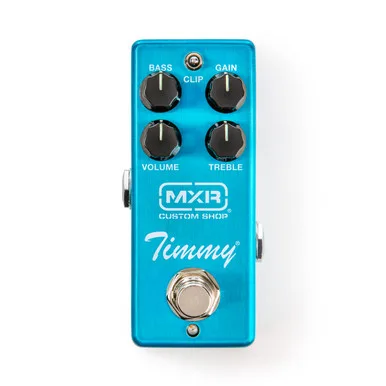
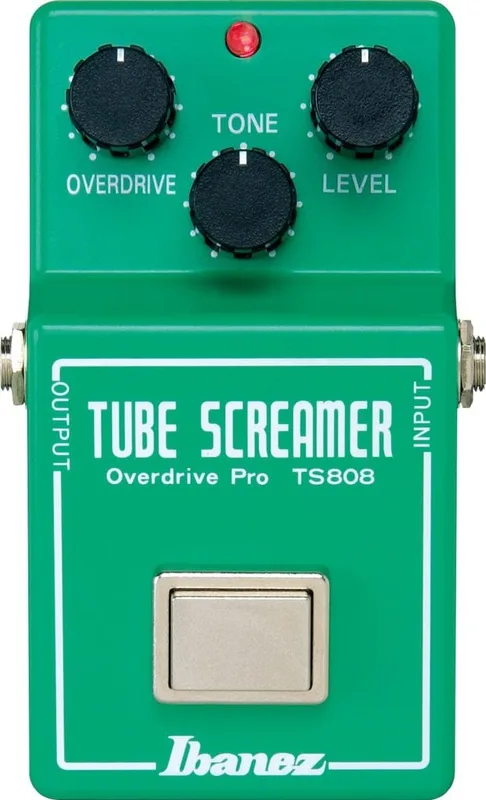
The Timmy is a transparent overdrive circuit designed by veteran pedal builder Paul Cochrane. Unlike a Tube Screamer, which pushes a pronounced midrange hump, the Timmy was built to leave the core sound of your guitar and amp alone and add grind on top of it. Dunlop, which now sells the design as the MXR Timmy, says Cochrane's original is "widely celebrated among high level pros"1.
The circuit's identity rests on three ideas: a flat frequency response with no baked-in midrange boost, passive bass and treble controls that only cut, and a switch that changes how the clipping diodes are arranged. This page covers where the Timmy came from, how those pieces work, and what the MXR mini edition changed.
Where the Timmy came from
The Timmy began as one builder's personal pedal. In a 2020 Dunlop interview, Paul Cochrane explained the origin in his own words3:
"I built the first Tim Overdrive for myself and my specific needs"
Paul Cochrane, Dunlop interview1
That first pedal, the Tim Overdrive, predates the smaller Timmy and set the design language Cochrane followed. The Timmy carried the same approach in a more compact form, and for years it was a hand-built pedal with a waiting list, the kind of product players bought directly from the builder435.
The turning point came in 2020, when Cochrane collaborated with MXR to release the design as a mass-produced mini pedal678. Dunlop's product page describes the MXR Timmy as "based on a design from veteran pedal builder Paul Cochrane"1, which put a circuit that had been hard to get into general retail.
How it works: a flat-response op-amp overdrive
The Timmy is an op-amp overdrive. In this topology, the op-amp does the amplification and a set of clipping diodes shapes the signal into overdrive. Where those diodes sit determines the character: JET Pedals describes the common soft-clipping arrangement as an "op-amp based overdrive circuit with soft clipping diodes inside the feedback loop"9, which rounds the wave gradually for a smoother, lower-gain sound than hard clipping to ground.
What separates the Timmy from most op-amp overdrives is its tonal goal. Jackson Audio, describing the same design philosophy in its ASABI manual, defines the target plainly: an overdrive "completely flat in its frequency response with no mid hump or unnatural artifacts," built "for maximum transparency"10. That is the school the Timmy belongs to. RockBoard's write-up of the MXR CSP027 says the pedal "provides a versatile range of overdrive tones that enhance the natural sound of your guitar and amp setup"2, which is the transparency pitch in manufacturer language: the pedal adds drive without re-voicing the rig.
For a player, the practical difference is this: a midrange-humped overdrive will push a busy mix and thicken a bright amp, while a flat overdrive like the Timmy keeps your amp's basic voice intact and simply adds saturation. That is why the Timmy is often used as an always-on low-gain pedal or a lead boost on top of an already good tone11122.
Controls: cut-only bass and treble
The Timmy's tone controls are the part that catches new players off guard. Madbean's Shortbus build document, which is built on the Timmy circuit, describes the core as "a single overdrive circuit with passive bass and treble tone controls and a pretty unusual 'boost' circuit"13. Two things matter in that description.
First, the controls are passive. They can only remove frequencies, never add them. Most tone knobs on other pedals are active, boosting and cutting around a center point; JHS describes its Charlie Brown V4's Bass, Middle and Treble controls that way, as controls that "boost and cut their selected frequencies"14. Against that convention, a knob that only cuts feels like it works backwards.
Second, because the circuit starts flat, cutting is all most players need. If your amp is dark, you cut bass to tighten it. If it is bright, you cut treble to tame it. The knobs are corrective tools, not tone-shaping EQ, which suits the pedal's transparency goal: the Timmy is not supposed to impose a sound12611.
If a Timmy's tone knobs seem to work in reverse compared with your other pedals, that is the design, not a fault. They are passive cut controls on a flat circuit, so clockwise and counterclockwise simply remove more or less of the bass or treble that is already there.
Clipping options
The Timmy's clipping is switchable. Dunlop says of the MXR edition that "the Clip switch provides three different clipping styles for a multitude of scenarios"1, and RockBoard echoes the same count, describing the pedal as offering "three different clipping options"16.
The underlying idea has a history in the original hand-built versions. Madbean's Shortbus document explains that the D6/D7 diode setup was "adopted from later versions of the Timmy," while the original used "an internal DIP switch or pot pull switch selecting between diode setups of 6 diodes total"13. So the switching concept goes back to Cochrane's own iterations: as the pedal evolved, the diode arrangements changed and the selection mechanism moved around before settling into the form MXR produces today.
Switchable clipping is now a common feature across the overdrive world, and the Timmy helped popularize it. Other makers have taken the idea in their own directions: GUP Tech's Lab Series #36, which is "based on the Paul Cochrane Timmy V3," uses a toggle to choose between two clipping modes, Boost and OD15. GuitarPCB's Tube Screaming Ultra offers a three-way switch between LED clipping, stock diode clipping and pure op-amp clipping16. The Timmy's three-position switch covers similar ground: different diode arrangements clip the wave at different thresholds and with different symmetry, which changes how hard the overdrive feels and how much compression and edge it adds.
The MXR Timmy mini edition
The MXR Timmy, released through the 2020 collaboration6177, is the version most players will encounter today. It packages Cochrane's circuit in MXR's mini enclosure, with the Clip switch and the cut-only Bass and Treble controls carried over12.
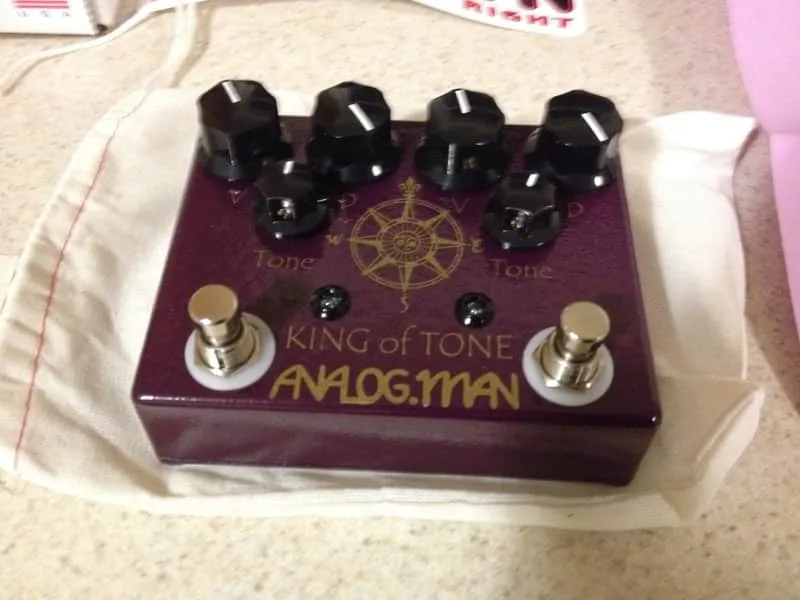
The design's reach extends beyond the physical pedal. Kemper lists the MXR Timmy as the basis of its Kemper Drive effect in the Profiler ecosystem18, and Guitar World notes that newer pedals such as the Timmy OD and Palace OD are "inspired by the MXR Timmy and Analogman King of Tone"19, putting the circuit in the company of the King of Tone as a design other builders reference.
Power and connections
The MXR Timmy is adapter-only. Dunlop's specifications are direct:
- Voltage: 9-volt1
- Adapter: Dunlop ECB003 9-volt adapter or an MXR Brick Series power supply1
- Battery: "This pedal cannot be powered by a battery"1
Because there is no battery option, the MXR Timmy needs a powered pedalboard or a dedicated adapter. Plan a power outlet for it from the start.
Where the Timmy sits among overdrives
The Timmy's place in the overdrive landscape comes from what it refuses to do. It does not boost the midrange like a Tube Screamer, it does not add active EQ coloration, and it does not lock you into one clipping character. RockBoard's summary of the MXR edition, that its Bass and Treble controls are "ingeniously configured" to "enhance the natural sound of your guitar and amp setup"2, is the same pitch Cochrane's original made by word of mouth among pros2. For a player choosing a first low-gain pedal, that makes the Timmy a reference point: a circuit built to be heard through the amp, not instead of it.
Pedals on this page
Questions
Is the Timmy a Tube Screamer clone?
No. The Timmy is its own design, built by Paul Cochrane for his personal needs rather than adapted from the Tube Screamer. Where Tube Screamer-type circuits are known for a midrange hump, the Timmy belongs to the family of flat-response, transparent overdrives, with passive bass and treble controls that cut rather than boost.
What is the difference between the original Timmy and the MXR Timmy?
The original Timmy was Paul Cochrane's hand-built pedal. In 2020 Cochrane collaborated with MXR to release a widely available version in a mini pedal enclosure, based on his design. The MXR edition carries the same core circuit idea, including the three-position clipping switch, in a smaller box sold through normal retail channels.
Why do the Timmy bass and treble knobs work backwards?
Because they are passive cut controls, not active boost controls. The Timmy circuit uses passive bass and treble tone controls, so turning a knob down removes frequencies rather than adding them. Many pedals boost and cut from a center point, which is why the Timmy's direction feels reversed to players used to active EQ.
Does the MXR Timmy take a battery?
No. Dunlop states plainly that the MXR Timmy cannot be powered by a battery. It runs on the Dunlop ECB003 9-volt adapter or an MXR Brick Series power supply, so it needs a spot on a powered pedalboard.
Who plays a Timmy overdrive?
Dunlop describes Cochrane's design as widely celebrated among high level pros, though the company does not name specific artists on its product page. The circuit's reputation among professional players is what brought it to MXR's attention for the 2020 collaboration.
Sources (19)
- MXR® TIMMY® OVERDRIVE, Dunlop (jimdunlop.com)
- CSP027 TIMMY OVERDRIVE by MXR, RockBoard (rockboard.de), 2026
- MXR® TIMMY® OVERDRIVE, Dunlop (lifestyle.jimdunlop.com), 2020-01-24
- 8 cheap but great guitar overdrive pedal alternatives to boutique classics | MusicRadar, MusicRadar, 2020-07-21
- NAMM 2020: MXR Timmy Overdrive - Boutique 'Paul Cochrane' tones for less!, gearnews.com, 2020-01-11
- 11 Best Overdrive Pedals For 2026 (Includes Budget Options), Tone Island, 2026
- The best new effects pedals of NAMM 2020, MusicRadar, 2020-01-24
- Guitar Pedal X, Guitar Pedal X, 2020-01-14
- Lamb Overdrive, JET Pedals
- ASABI User Manual, Jackson Audio
- Jackson Audio and Cory Wong launch the Optimist, MIDI-controllable dual overdrive and EQ that combines a Timmy and a Klon | Guitar.com, Guitar.com
- MXR Timmy review | MusicRadar, MusicRadar, 2020-11-19
- Shortbus.pdf, madbeanpedals.com, 2024-07-20
- CHARLIE BROWN V4, JHS Pedals
- Lab Series #36, GUP Tech (guptech.ca)
- Tube Screaming Ultra, GuitarPCB
- Best overdrive pedals: Find new inspiration, MusicRadar, 2022-05-25
- KEMPER Distortion Effects, Kemper GmbH
- HeadRush Flex Prime review, Guitar World, 2024-12-13