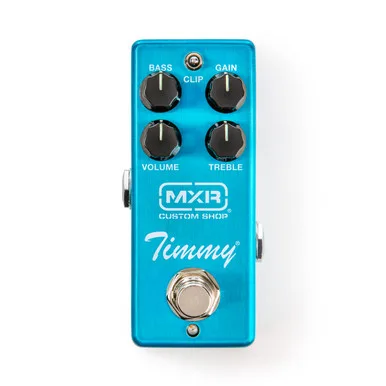


The MXR Timmy is a mini overdrive pedal from MXR's Custom Shop, built around a design licensed from veteran pedal builder Paul Cochrane, whose hand-built Timmy has been widely celebrated among high-level pros since its introduction in 200412. Dunlop describes it as providing "a huge, responsive range of gritty and textured tones that enhance the sound of your rig while preserving its fundamental character"3. MusicRadar calls it "a touch-sensitive overdrive that works with your playing, a neutral dealer of crunch and output between your guitar and amplifier" with no huge coloration to your tone2.
The pedal arrived in 2020 as a partnership between Cochrane and MXR, packing the circuit into an MXR mini housing that frees up pedalboard space435. It carries the model number CSP027 and lists at $159.99 USD as of October 20266, with Guitar World citing a street price of $129.99 / £1397.
The controls
The MXR Timmy has four knobs, Volume, Bass, Gain and Treble, plus a three-way Clip switch7. What sets it apart from most overdrives is how the tone controls behave: both are cut-only, and they sit at different points in the circuit.
| Control | What it does |
|---|---|
| Volume | Sets output level |
| Gain | Wide sweep, from clean boost to thick single notes11 |
| Bass | Cut-only, affects the pre-overdrive signal so low end can be maintained at lower Gain settings3 |
| Treble | Cut-only, cuts high end from the post-overdrive signal to keep dirty settings smooth and musical17 |
| Clip switch | Three-position toggle selecting three clipping styles31213 |
Dunlop says the cut-only approach keeps your signal's character intact while making it easy to dial in a clean boost3. Guitar World's Paul Riario noted the configuration "won't be to everyone's liking but is faithful to the original"7.
Why the knobs work backwards
The bass and treble controls are reversed compared with a normal EQ: you turn them clockwise to cut frequencies and anticlockwise to leave more in2. Guitar World's history of the original Timmy explains that its EQ controls are cuts, "making them function 'backward' to controls that increase the level of an EQ band"14. Guitar Pedal X notes the inverted Bass and Treble controls were an annoyance on the first two generations of the original, and that a later 15th Anniversary V3 edition normalized the knobs1.
Three clipping modes
The Clip switch provides three different clipping styles for a multitude of scenarios, in Dunlop's words3. Reviewers describe the three positions as one asymmetrical and two symmetrical clipping patterns27, each offering varying degrees of saturation, headroom, dynamics and compression7. Sweetwater's demo describes the three options from left to right as light compression, wide open, and compressed11, with Dunlop's own Frankie describing them as an asymmetrical clip, a very open cleaner clip, and a more compressed symmetrical clipping15.
Guitar World's reviewer preferred the middle position, finding it had the most breath, body and touch-responsiveness of the three7. The switch was adopted from the original Timmy's second version5.
Power and specifications
The pedal runs on 9 volts from a Dunlop ECB003 adapter or an MXR Brick Series power supply, and it cannot be powered by a battery3. MusicRadar lists it as 9V adapter only, with the adapter not included2.
| Specification | Value |
|---|---|
| Input impedance | 400 kΩ7 |
| Output impedance | 1 kΩ7 |
| Gain range | 3 dBV to 43 dBV7 |
| Noise floor | -115 dBV7 |
| Current draw | 2.2 mA7 |
| Bypass | True bypass2 |
Under the hood is an LF353 op-amp, a component Dunlop's engineers respect for providing high output, high gain and a hi-fi signal, chosen to help the pedal perform similarly to the original in the smaller enclosure3. Guitar World's Alex Lynham notes the Timmy circuit offered a radically different take on the op-amp overdrive from the dominant Tube Screamer, with a two-band EQ and a low-pass and bass cut filter that together make a surprisingly powerful EQ section16.
From Paul Cochrane's Timmy to the licensed MXR version
Paul Cochrane introduced the original Timmy in 2004, hand-building the pedals himself211. The original went through versions: a second version added the three-way clipping switch, and a 15th Anniversary V3 edition normalized the knobs and slightly changed the clipping1. In 2020, Cochrane partnered with MXR to launch the mini version4, an officially licensed production with the designer's involvement17. On his YouTube channel, Josh Scott of JHS Pedals confirmed that "Paul Cochran's involved. Mike's involved."17
Guitar.com reported the pedal as budget-friendly and extremely pedalboard-friendly thanks to its slimmed-down construction12, and MusicRadar noted the $129.99 launch price made a new version of one of the most usable gain pedals available to far more players18. Guitar Pedal X compared the MXR Mini Timmy with the V2, finding them supposed to be nigh identical but with slight timbre and texture differences due to parts variances1.
What reviewers said
MusicRadar's verdict: "Smaller, more affordable, more available and just as musical as Paul Cochrane's originals, Timmy remains one of the first names that come to mind when you think of transparent overdrive"2. Tone Island calls it famed for its transparent overdrive and extremely well-built13, and Delicious Audio included it in its list of best overdrive pedals5.
Guitar World's Paul Riario found the clean-to-overdrive switching "as seamless as switching from clean to a mild gain channel from a tube amp," with a gradual gain-bump into light compression and a very pleasing natural breakup, plus more dynamic presence than a regular overdrive, a clear top-end chime and midrange warmth7. His reasons to buy were its versatility for shaping tone, small footprint and good value; his reason to avoid was the cut-only bass and treble7.
Sweetwater's Don Carr demoed the pedal, noting it carries the same controls as Paul's original Timmy in MXR's mini housing, with both EQ controls cut-only to preserve your amp tone, and a gain sweep from clean boost to thick single notes for medium-gain overdrive tones11.
Josh Scott covered the pedal's history and licensing on the JHS Pedals channel, including the 2022 release context and Cochrane's involvement in the MXR version17.
Who uses it
Guitar World's overdrive buying guide lists the MXR Timmy as used by Billy Gibbons, Brad Whitford of Aerosmith, and Justin Vernon of Bon Iver19.
Videos
Premier Guitar
jimdunlopusa
News
Questions
Can the MXR Timmy run on a battery?
No. Dunlop states plainly that the pedal cannot be powered by a battery. It runs on a 9-volt adapter, specifically the Dunlop ECB003 or an MXR Brick Series power supply, neither of which is included in the box.
Is the MXR Timmy true bypass?
Yes. MusicRadar lists true bypass in its review, and Guitar World's spec sheet describes it as true hardwire bypass. Sweetwater's demo video also confirms true bypass switching, so the pedal passes your signal untouched when disengaged.
Why do the Timmy's bass and treble knobs work backwards?
The EQ controls are cuts, not boosts, so they function backward compared with controls that raise the level of an EQ band. Turning them clockwise cuts frequencies and anticlockwise leaves more in. This is faithful to Paul Cochrane's original design, where the inverted controls appeared on the first two generations.
What op-amp is in the MXR Timmy?
The LF353. Dunlop says its engineers chose this component because it provides high output, high gain, and a hi-fi signal, and it helps the pedal perform similarly to the original in the smaller enclosure.
Is the MXR Timmy the same as the original Paul Cochrane Timmy?
It is an officially licensed version made with Cochrane's involvement, using the same control set and the three-way clipping switch from the original's second version. MusicRadar found it smaller, more affordable, more available and just as musical as the originals, though Guitar Pedal X noted slight timbre and texture differences from parts variances.
Can the MXR Timmy be used as a clean boost?
Yes. Dunlop says the cut-only tone controls make it easy to dial in a clean boost, and Sweetwater's demo describes the gain control's wide sweep running from clean boost to thick single notes. Guitar World also lists it among boost options with more extensive tone-shaping.
Sources (19)
- Guitar Pedal X, Guitar Pedal X, 2024-06-20
- MXR Timmy review, MusicRadar, 2020-11-19
- MXR® TIMMY® OVERDRIVE, Dunlop (jimdunlop.com)
- Paul Cochrane teases a new Tim overdrive: “With luck I'm hoping it'll be ready by the end of winter”, Guitar.com, 2021-12-06
- MXR Timmy Overdrive, Delicious Audio, 2022-10-11
- MXR® TIMMY® OVERDRIVE, Jim Dunlop (jimdunlop.com)
- MXR Timmy Overdrive review, Guitar World, 2020-11-19
- CSP027 TIMMY OVERDRIVE by MXR, RockBoard (rockboard.de), 2026
- MXR® TIMMY® OVERDRIVE, Dunlop (lifestyle.jimdunlop.com), 2020-01-24
- Best mini-pedals for guitarists: top space-saving stomps, Guitar World, 2020-09-25
- MXR Timmy Overdrive Mini Pedal Demo, Sweetwater, 2020-04-11
- NAMM 2020: MXR puts out ‘Timmy’ tones for cheap, Guitar.com, 2020-01-14
- 11 Best Overdrive Pedals For 2026 (Includes Budget Options), Tone Island, 2026
- Paul Cochrane Timmy: history of the classic overdrive pedal, Guitar World, 2020-04-03
- MXR Timmy Overdrive Pedal at Winter NAMM 2020, Sweetwater (YouTube), 2020-01-18
- Best pedals for blues: overdrives, reverbs and more, Guitar World, 2022-06-24
- How The MXR Duke Of Tone and Timmy Pedals Are A Big Deal For Boutique Pedals, JHS Pedals (YouTube channel), 2022-09-19
- NAMM 2020: MXR has made a Timmy mini overdrive pedal with Paul Cochrane, MusicRadar, 2020-01-14
- Best overdrive pedals 2026: mid-hump to transparent tone, Guitar World, 2022-06-07