News
Guitar Pedals 101: A Quick and Dirty Guide to Reverb Pedals
When you’re just getting into guitar effects pedals (or, sometimes, even when you’re already an old hand), the sheer number of different effects types can drown you in a sea of confusion. Our Guitar Pedals 101 series is here to help you navigate through the storm and reach your own personal pedal nirvana. Today we’re looking at one of the best tools for adding more dimension to your sound: reverb pedals. Imagine that you’re standing in the middle of a vast cave. You have your trusty guitar with you; you plug it into an amp and strum a chord. The sound of that chord you just played will bounce around and reverberate within the cave, making it last quite a bit longer than if you played it in the middle of a large, open field. Those reverberations make up the reverb effect. Reverb is produced whenever soundwaves bounce off of surfaces in a room, causing a large number of soundwaves to be reflected back to you so quickly that your ears can’t process each of them as individual sounds. Think of it as a series of super-fast echoes layered on top of one another. We actually hear reverb every day, but our brains have become really good at automatically tuning out the reverb and interpreting it as background noise. This is how you can still hold a conversation with someone even when you’re in the middle of a crowded party. The effect, however, becomes more magnified in larger rooms; the larger the room, the larger the potential reverb.
The History of Reverb
Reverb is quite possibly the oldest trick in the guitar signal processing book. In the late ‘40s, musicians and sound engineers who wanted to add some reverb to a song were limited mainly to controlling the room where a live performance was being recorded. Music historians generally point to the Harmonicats’ “Peg O’ My Heart” as the first time reverb was creatively used on a record. Sound engineers then started working on a way to add reverb to a dry recording. The first approach here was to record a song in an acoustically deadened room then play it through a loudspeaker in a separate room designed to create reverberations. Things became a bit more high-tech in 1957 when a German company called EMT introduced the plate reverb, a vibrating sheet of metal housed in a box that let musicians simulate a reverb effect in any studio. Despite the debut of the plate reverb, musicians still didn’t have a practical way of recreating the reverb effect during live performances. EMT’s plate reverbs may have been portable, but they still weighed upwards of 200kg. This changed in the early ‘60s when amplifier manufacturers such as Fender licensed a spring reverb unit originally used in old Hammond organs and incorporated it into their line of amplifiers. Two prominent examples are the Twin Reverb from 1962 and the Vibroverb from 1963. Spring reverbs were readily available and very portable, making them a great boon for budget-limited studios of the time. In the 1970s, recording studios had started to dabble in digital reverb effects, with EMT once again leaping to the forefront during this time. These were typically rack-mounted effects that digitally emulated different types of reverb effects. Portability was out of the question here, and the price was quite prohibitive, too; the EMT 250, the world’s first digital reverb, cost a whopping $15,000. The Lexicon 224 digital reverb, which was released two years later, was a bit more affordable, costing just around half the price of an EMT 250. Still, it wasn’t exactly something the average musician could buy and use. It wasn’t until the ‘80s that consumer-level reverb pedals hit the market. Morley was one among those who started the reverb stompbox trend with the analog Rock’N Verb from 1980, and in 1987, Boss came out with the world’s first portable digital reverb pedal, the RV-2. Fast forward to today, where the sheer number of both analog and digital reverb stompboxes on the market—plus the advent of user-customizable plugins for the latter—can let even the average garage guitar god can enjoy the exact sweet shimmering sound they want.
Common Types of Reverb Effects
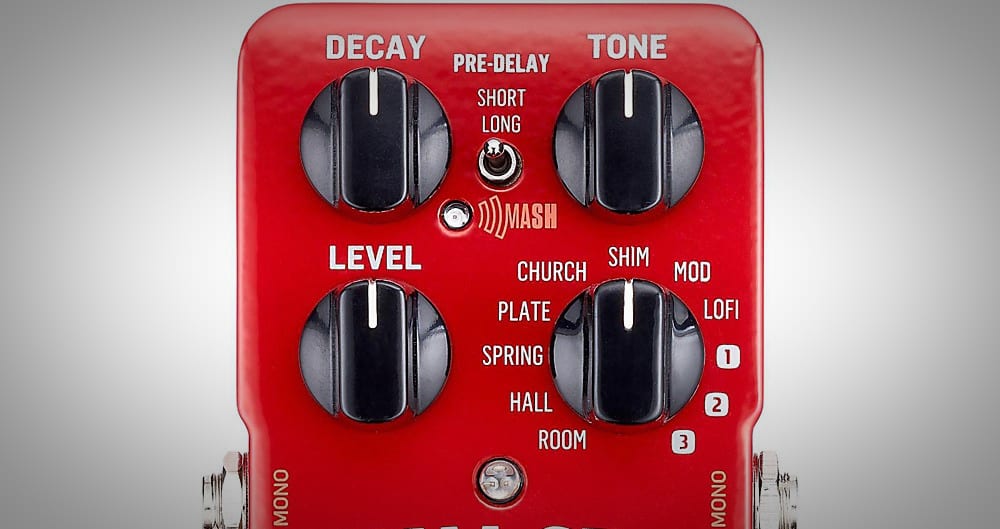
Spring - There’s a good chance you’ve already used a spring reverb even if you haven’t touched a reverb pedal before, as most amps with an onboard reverb usually feature a spring reverb. It’s called as such because old-timey sound engineers literally used a big metal spring to create the effect. Just as its name implies, a spring reverb is “springy;” due to the nature and construction of a spring, it features unique frequency variations that can result in uniquely slinky, wobbly, and pulsating tones. Plate - You guessed it: plate reverb gets its name from a thin metal plate that sound engineers bounced sounds off of in decades past. If you need to make your signal sound “shiny” and give it an extra bit of brightness, you should try running it through a plate reverb. Plate reverbs can create a much higher and uniform echo density from the start of the reverb effect until it ends, giving your sound a signature smooth reverb tail. The even echo distribution also makes plate reverbs very usable with other types of reverb. Room - Both the spring and plate reverb types can be classified under the mechanical, hardware-based reverb category. Conversely, room reverb (and its close cousin, hall reverb, which we’ll talk about later) is based on an actual physical space. Remember the cave scenario from earlier? It’s like that. Room reverb traditionally sounds small; after all, most rooms aren’t generally enormous. Room reverb also features the inherent sonic imperfections of a room, making it sound more natural and compelling. They’re great at making something sound intimate, as if whoever is listening is standing right next to you. Hall - Unlike rooms, concert halls are designed specifically for maximum sonic pleasure and propagation. The hall reverb follows this closely, ditching the intimate, natural imperfections of the room reverb and giving your sound a layer of pro-level quality. Hall reverbs are designed to sound as tonally even as possible. They also last longer than room reverbs, ranging in length from one to three seconds. Orchestral instruments usually get a lot of mileage out of hall reverbs, and if you want to sound like you’re on a big stage in a specially designed music hall or theater, then this is the reverb type for you. Shimmer - Shimmer reverb effects are a relatively more modern creation compared to the four types we talked about above. The effect is basically created by running a signal through a reverb effect, then feeding it into a pitch-shifter, and shifting it up by an octave. The pitch-shifted signal is then fed back into the reverb. This results in an epic, shimmering sound that brings to mind a host of angels singing in unison. U2’s The Edge loves this effect.
Parameters to Play With
Today’s reverb pedals run the gamut from simple to so insanely over-complicated that they should come with a thousand-page user manual. Still, there are a few simple parameters that can give you full control over your reverb sound. Mix - Also called the effect ratio, effect level, or just plain level, the mix parameter controls the difference in volume between the direct, “dry” signal (the one without the reverb effect) and the reflected “wet” signal (the one with the reverb effect applied). This parameter can make your instrument sound closer or further away; a higher amount of the dry signal will make your instrument sound closer to the listener. Conversely, a higher amount of wet signal in the mix will make your instrument sound further away from the listener. Pre-Delay - This parameter dictates the length of time between the start of the direct “dry” signal and the early reverberations of the “wet” signal. Reverb pedals use it to simulate the size of the space that contains your instrument, the surface reflecting the sound, and the listener. The pre-delay parameter can help in clearing up complex reverb patterns floating in the mix. A long pre-delay setting, for example, can help make your vocals more understandable by moving the reverb tail out of the way. Decay Time - Also known as the reverberation time, this parameter controls how long it takes for the reflected sound to decay or die off until you can’t hear it anymore. The decay parameter works as an easy way to control the size of the space you’re trying to simulate with your reverb effect. The reverb in small rooms has a much shorter decay time while the reverb in larger rooms and halls lasts much longer. Tone - The most ubiquitous parameter on any pedal, alongside the level pot. The tone parameter can play a big role in reverb pedals, as higher frequencies tend to be absorbed faster compared to low frequencies. This can result in your instrument sounding much darker and warmer than it’s supposed to sound. A reverb pedal with a dedicated tone pot can help you compensate for this to create a more accurate reverb effect.
Recommended Reverb Pedals
Strymon BigSky
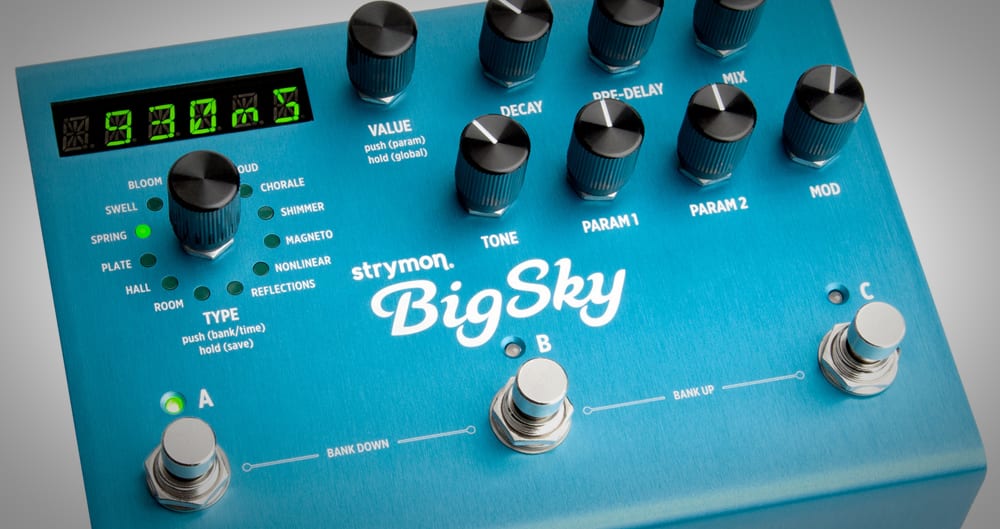
The Strymon BigSky’s frankly staggering price (the list price is $479, but it can go for upwards of $600 online!) reflects the staggering amount of power that it packs inside its classy blue enclosure. It comes with 12 studio-quality reverb effects that Strymon calls “reverb machines.” You get the classic Spring, Plate, Room, Hall, and Shimmer effects we listed above, plus Swell, Bloom, Cloud, Chorale, Magneto, Nonlinear, and Reflections. Controlling these 12 effects is a full complement of seven parameter knobs: Decay, Pre-Delay, Mix, Tone, Mod, Param 1, and Param 2. The latter two pots serve as multi-purpose knobs that control specific parameters for specific reverb machines. Three separate footswitches not only activate or deactivate your desired effect, but they also give you access to 300 preset, press-and-hold Infinite Sustain, and a Freeze function. It also comes with a switchable cab filter, an expression pedal control jack, and full MIDI support. As for the BigSky’s sound, you can make it sound as natural or unnatural as you want it to be. Strymon didn’t just load the BigSky up with reverb effects up the wazoo, they also made sure that you can use it to recreate completely convincing analog sounds as well as far-out futuristic ambient sounds. Yeah, you have to kinda pay through the nose to get all of that, but it’s hands down the best and most versatile reverb pedal you can find right now.
TC Electronic Hall of Fame Mini
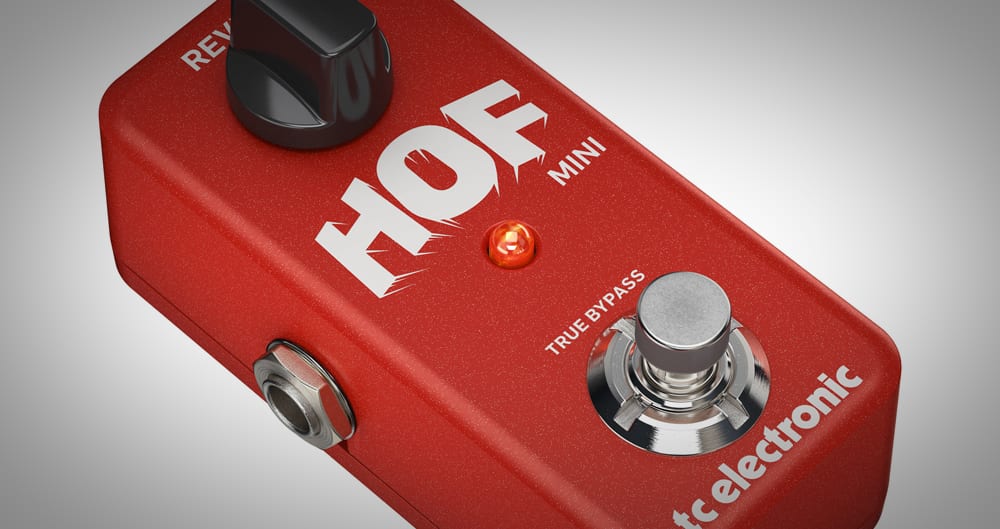
On the extreme opposite end of the spectrum from the BigSky is the Hall of Fame Mini from TC Electronic. The Hall of Fame Mini is about 1/6th the size and price of the BigSky, plus it only has one control pot compared to the latter’s seven. Don’t let the size and lone “Reverb” control knob fool you, though; the Hall of Fame Mini packs quite a versatile punch. It takes a bit of doing, but you can basically load it up with any kind of reverb effect you can think of via TC Electronic’s TonePrint tech. The Hall of Fame Mini comes pre-loaded with TC Electronic’s signature hall reverb, but you don’t have to stick to that effect for the rest of the Hall of Fame Mini’s life. You can choose any type of reverb effect, even an artist’s signature reverb sound, from TC Electronic’s TonePrint library or create your own with the TonePrint app then send it to the Hall of Fame Mini via USB. You can even change the loaded reverb effect between songs during a gig by using your phone. When it comes to bang for your buck, few pedals come even close to the Hall of Fame Mini. Protip: If you have a few extra bucks lying around, you might also want to take a look at the Hall of Fame Mini’s big brother, the Hall of Fame. It features 11 onboard reverb effects, three of which can be customized via TonePrint, plus a unique Mash footswitch that functions as a built-in expression pedal.
Boss RV-6
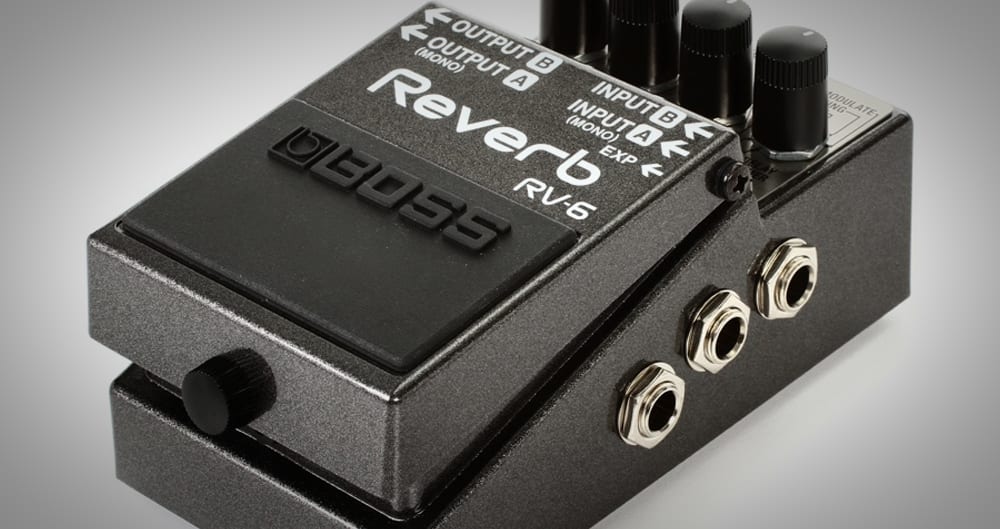
Boss has been making great reverb pedals for decades. You might remember the RV-2 that we mentioned in the history section, which was the first digital compact reverb stomp ever made. The Boss RV-6 reverb guitar effects pedal is the latest incarnation of RV-2. The RV-6 features eight different onboard reverb effects: Modulate, Spring, Plate, Hall, Room, Dynamic, Shimmer, and +Delay. The latter adds a delay to the reverb effect to give your sound more added dimension; it’s especially useful for solos. It also follows Boss’s typically intuitive pedal control scheme. You get an E. Level pot for controlling the dry and wet signal mix, a Tone knob, and a Time control for setting longer or shorter delays. It also features dual input and output jacks to allow for both mono and stereo operation. Finally, the RV-6 can also be controlled via an expression pedal. Sound-wise, the RV-6 is proof positive that the pedal engineers at Boss haven’t been resting on their laurels when it comes to reverb pedals. The level of quality that this stomp packs is quite comparable to those you can usually find only in high-end studio rack units. The RV-6 offers high-quality, high-definition reverb at an affordable, mid-range price point. A good choice for any musician who wants to incorporate some reverb into their sound.
Joyo JF-317 Space Verb
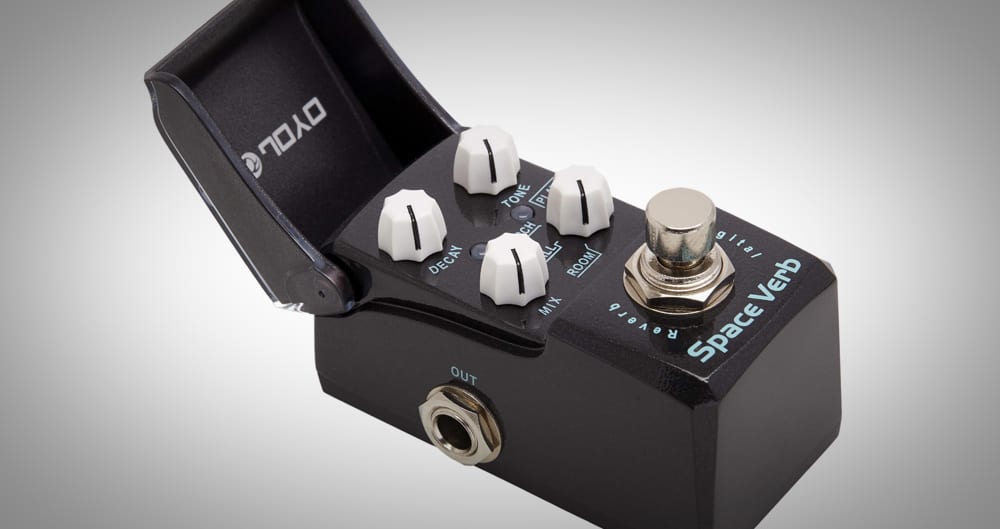
The sheer amount of reverb pedals available on the market today means that there’s a pedal out there that will fit your needs and your budget. Yes, even if you’re living the full “starving artist” lifestyle, musicians who are on a shoestring budget can still get a very good reverb pedal nowadays. Case in point: the JF-317 Space Verb from budget guitar effects pedal maker Joyo. The Space Verb is Joyo’s first ever reverb pedal, and they’ve pretty much hit it out of the park with this one. It’s tiny—even smaller than the TC Electronic Hall of Fame Mini—but it packs quite a punch and features four different reverb effects: Room, Hall, Church, and Plate. You can also squeeze out quite a range of versatility via the Space Verb’s intuitive three-knob control scheme. You get dedicated Decay, Tone, and Mix pots, all of which can be protected from stray stomps via a flip cover. Reverbs are usually set and forget effects, anyway, so having that little cover there to keep your foot from accidentally messing up your settings is very welcome. The Space Verb is also very cheap, but it manages to conjure up reverb sounds that belie its budget-friendly price tag. The full metal construction is pretty durable and can withstand the rigors of constant onstage use, but we’d still recommend using it when you’re just practicing or fiddling around instead. With all that taken into consideration, the Space Verb is a good contender for being the perfect first reverb pedal for beginners or for those who just want to experiment with their sound.