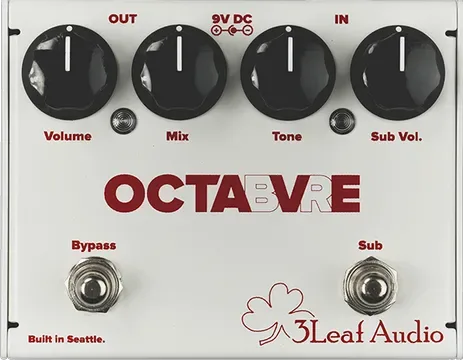


The 3 Leaf Audio Octabvre MKII is an analog octaver pedal, a stompbox that generates harmonically rich sub octaves below what you play. It is built on the tonal blueprint of the older Boss OC-2 octave pedals, and RockBoard's PedalPedia describes it, in both MKI and MKII form, as giving you "the sound of the classic OC-2, gritty 808, and the Mutron Octave all in one pedal"1. It is a dual-mode octaver: two footswitches give you two distinct sub octave voices, and a toggle switch selects between two voicings of the circuit.
It sold direct for $259 as of January 20172.
Two footswitch voices
The MKII is really two sub octave pedals in one box, and each side has its own character12.
- Left footswitch: engages a super-fast tracking, warm sub octave, with controls for the dry/wet mix level and the overall output level2.
- Right footswitch: engages a vintage, sub-octave only, OC-2 style tone, with a tone knob that adjusts high and mid frequency presence2.
Bass Musician Magazine's reviewer Jake Wolf described the right side as "vintage 'sub-octave only' OC-2 heaven: big, dirty, synthy grit with loads of bottom"2. The maker also notes you can click the second footswitch to solo your sub octave sound1.
The idea for that second footswitch came from watching bassist Tim Lefebvre at work. Designer Spencer Doren saw Lefebvre bend down mid-song to turn off the dry knob on his own OC-2, and reasoned that "a 2nd footswitch that cut the dry signal would let him use the octaver effect more effectively"2. That observation became the MKII's defining feature.
The controls and the Tim Tuning switch
Alongside the two footswitches, the MKII carries a toggle switch that chooses between the pedal's original voicing and the popular "Tim Tuning" voicing1. The Tim Tuning is a sound based on the mods Tim Lefebvre did to his own Octabvre1, and according to Spencer it is more true to the OC-2 tone2.
Wolf compared the two positions in his review:
Jake Wolf of Bass Musician Magazine found the Tim Tuning position to be a little deeper and purer sounding, with less gritty mids than the switch's other position2.
So a player who wants the grittier, mid-heavy character of the original voicing keeps the toggle one way, and a player chasing the cleaner, deeper OC-2 flavor flips it the other12.
From the Boss OC-2 to the MKII
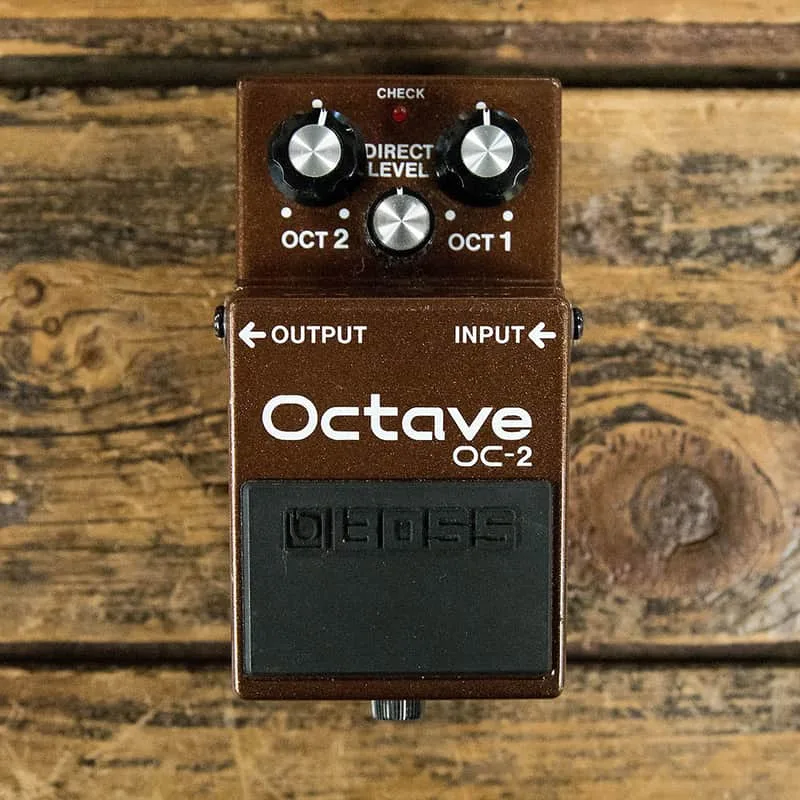
The Octabvre's lineage runs straight back to the Boss OC-2. The OC-2 is a basic octaver that can produce two extra voices in addition to the original signal3. It was produced from 1982, with the label changing early in 1984 from "Octaver" to "Octave"3. It found favor with bassists: it was used live by Sonny T.3
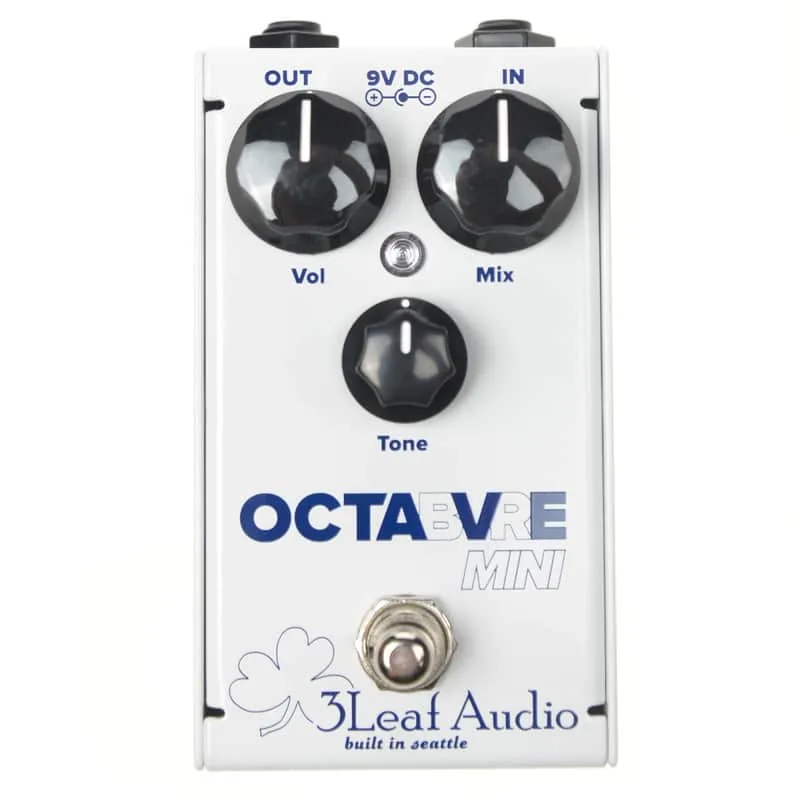
3 Leaf Audio took that tonal blueprint and built the Octabvre around it2. The MKI established the core sound, and the MKII added the voicing toggle and the second footswitch1. The family later grew again with the Octabvre Mini, a more affordable version with fewer features that offers only one voicing, a modified version of the Tim Tuning setting2. The Mini pares its controls down to Volume, Mix, and Tone knobs4, and its circuit starts with the Tim-tuning mod from the original, taken further with a reworked tone knob that runs from OC-2-inspired thump to sub fuzz4.
| Version | Voicings | Footswitches | Controls |
|---|---|---|---|
| Octabvre MKI | Original | One | Core Octabvre controls1 |
| Octabvre MKII | Original and Tim Tuning, via toggle1 | Two, second solos the sub octave1 | Mix and output level, tone knob2 |
| Octabvre Mini | One, a modified Tim Tuning2 | One | Volume, Mix, Tone4 |
What reviewers said
Reviewers have been positive about both the build and the tracking. Wolf opened his Bass Musician Magazine review of the MKII by writing that "the build quality and componentry is superb," calling the enclosures heavy duty and solid feeling, with switches and knobs that are smooth and sturdy2.
On the tracking question, the Premier Guitar review of the Octabvre Mini, which shares the family's circuit approach, was direct5:
"I would argue that the Octabvre Mini out-tracks the old Boss box."
The same reviewer noted that the Mini "does provide the tone-blending options of the first incarnation for really fattening up your bass sound"5, which speaks to the line's shared purpose: thickening a bass tone with sub octave content while keeping the dry signal under your control.
Videos
3 LEAF AUDIO
goran delac
The Bass Hang
Questions
What is the Tim Tuning switch on the Octabvre MKII?
It is a toggle switch that chooses between the pedal's original voicing and the Tim Tuning voicing, a sound based on the mods bassist Tim Lefebvre made to his own Octabvre. According to Spencer Doren, the Tim Tuning position is more true to the Boss OC-2 tone, and Bass Musician Magazine's reviewer found it a little deeper and purer sounding, with less gritty mids than the other position.
What power does the Octabvre MKII need?
The Octabvre MKII runs on 9V DC with a center negative plug, and draws 25mA. That is standard pedalboard power supply territory, the same requirement as the smaller Octabvre Mini.
What is the difference between the Octabvre MKI and MKII?
Both versions give you the same core sound, which 3 Leaf Audio describes as the classic OC-2, gritty 808, and the Mutron Octave all in one pedal. The MKII adds a toggle switch for choosing between the original voicing and the Tim Tuning voicing, plus a second footswitch that solos the sub octave sound.
What does the second footswitch do on the Octabvre MKII?
The left footswitch engages a fast tracking, warm sub octave with dry/wet mix and output level controls. The second, right footswitch gives a vintage sub-octave only, OC-2 style tone with a tone knob for high and mid frequency presence, effectively cutting the dry signal the way Tim Lefebvre used to do by hand on his OC-2.
Sources (5)
- Octabvre MKII by 3 Leaf Audio, RockBoard PedalPedia, 2026
- Review - 3 Leaf Audio Octabvre, Wonderlove and Doom Pedals - Bass Musician Magazine, The Face of Bass, Bass Musician Magazine, 2017-01-01
- TONEHOME, TONEHOME, 1984
- Octabvre Mini by 3 Leaf Audio, RockBoard PedalPedia, 2026
- 3Leaf Audio Octabvre Mini Review, Premier Guitar, 2016-08-31
 Tim Lefebvre
 Ian Allison