

The Boss OC-2 is an analog octave pedal that adds notes one and two octaves below whatever you play, alongside your original signal. Boss launched it in 1982 as the Octaver, and it became a fixture on professional pedalboards over a 23-year production run, remaining what Boss's own history calls a benchmark for octave effects123. Guitar World's Paul Riario calls its straightforward sub-octave pitch-shifting "the perennial 'thickening agent' for so many guitarists and bassists"4.
It is a monophonic pedal: it tracks one note at a time, which suits single-note basslines and low riffs rather than chords. Boss describes it as legendary among bassists for its ability to create synth-like sub-bass tones, produced with an all-analog circuit and a unique method of phase inversion5.
What it does: one and two octaves below
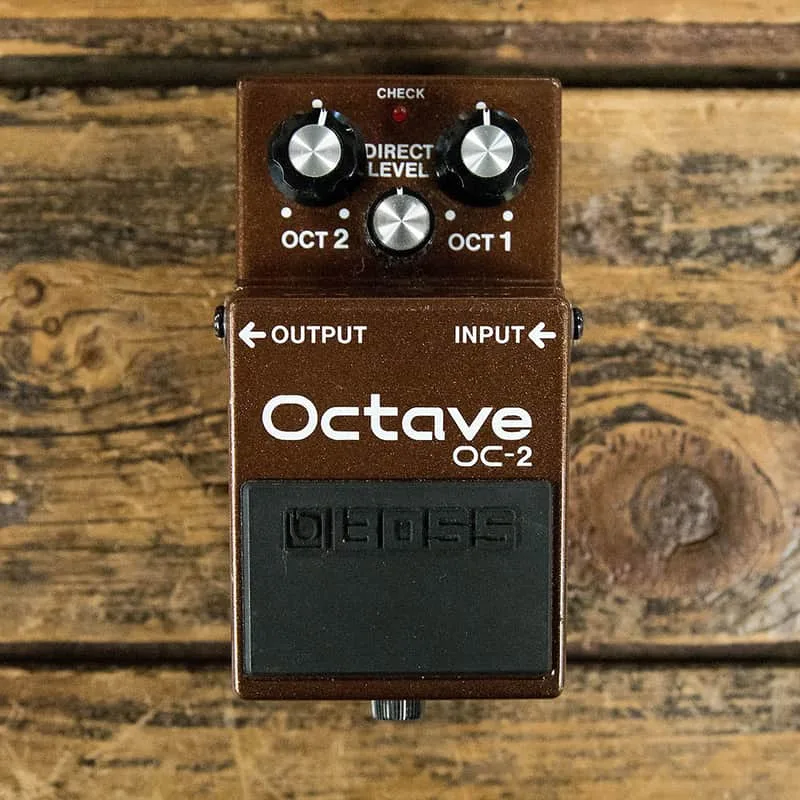
The OC-2 produces two extra voices in addition to the original signal: the first is one octave below, the second two octaves below3. Each octave's level is adjusted independently, so you can blend a subtle sub layer under your dry tone or kill the dry signal entirely and play with only the octave-down voices3.
Because it is analog and monophonic, the tracking is touch-responsive5. Tim Mahoney of Sublime told Premier Guitar what he values in it: "it only tracks one or two octaves below the original signal, and it's simple, clean, and pure"9. TONEHOME notes it is an advantage to use a compressor in front of the OC-2 to limit the spectrum of frequencies it has to work with, which helps the tracking stay stable3.
The controls: Oct 1, Oct 2 and Direct
The pedal has three knobs, and that is the whole interface.
| Control | What it does |
|---|---|
| Oct 1 | Sets the amount of one octave below added to the note you are playing10 |
| Oct 2 | Sets the amount of two octaves below added to the note you are playing10 |
| Direct Level | Blends in as much or as little of your dry, unprocessed signal as you want10 |
One documented starting point comes from Prince's rig: Oct 2 at 5:00, Direct at 12:00 and Oct 1 at 4:0011. Roy Mitchell-Cárdenas of Mutemath, speaking to JHS Pedals, described his approach in similar terms: "I do have a little bit of the direct sound in [the BOSS OC-2], which is just a normal bass sound"12.
Inside the circuit: analog phase inversion and JFET switching
The OC-2's octave-down voices come from an all-analog circuit using a method of phase inversion that Boss describes as unique, which is what gives the pedal its touch-responsive character5. Champion Leccy's technical analysis of the circuit found that the filter section is a set of low pass filters, each a series resistor followed by a capacitor to ground, placed before the CMOS ICs13. The pedal "has a bunch of filtering in it to get the clean (though fun and wobbly) octave down," which is why a popular synth mod bypasses that filtering for a rawer sound14.
The circuit also uses JFET switching, and the Boss schematic omits the first JFET buffer, which was taken out along with the switching15. Two transistors in the circuit, the 2SK30s at Q7 and Q8, can be replaced with 2N5457 JFETs for DIY builds, and Champion Leccy's author judged that a J201 would probably be equally effective13.
History and versions: Octaver, Octave, Japan and Taiwan
The original pedal, named the Octaver, was produced from 19826. Sources disagree on how long it stayed in production: TONEHOME lists a 1982 to 1984 run for the Octaver name3, while Boss's own material gives the OC-2 Octave a 1982 to 2005 run, a 23-year production span172. Pedal of the Day reports the name changed to Octave in 1984, when production moved from Japan to Taiwan6.
- Made in Japan: the earlier version, a lighter shade of brown, with what Pedal of the Day's reviewer judged to be better build quality6
- Made in Taiwan: the later version, a darker shade of brown introduced about a year after launch3
- Collectability: old Boss pedals have a reputation among collectors for special elements that cannot be replaced by anything modern10
Juan Alderete, interviewed by Stompbox Book, has pointed out that the two models came from different factories with different brown colors, and that he does not think that was by accident16.
"The OC-2 is the only octaver I use in the studio and live. There's just no beating it, in my opinion."
What replaced it, and the OC-5's Vintage mode
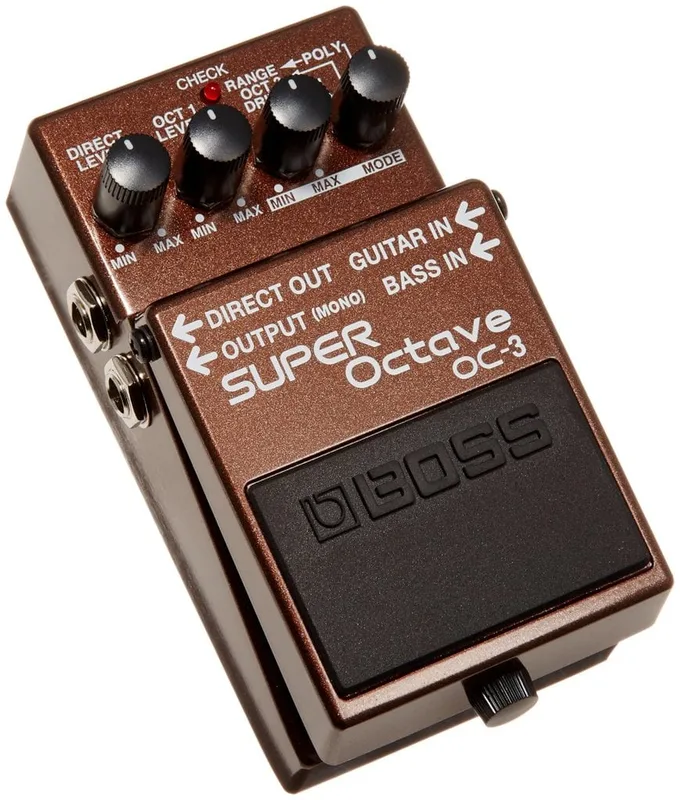
The OC-3 SUPER Octave followed the OC-2, and beyond its groundbreaking Poly mode with adjustable range it also furnished players with an OC-2-style mode for both guitar and bass, plus a Drive mode17.
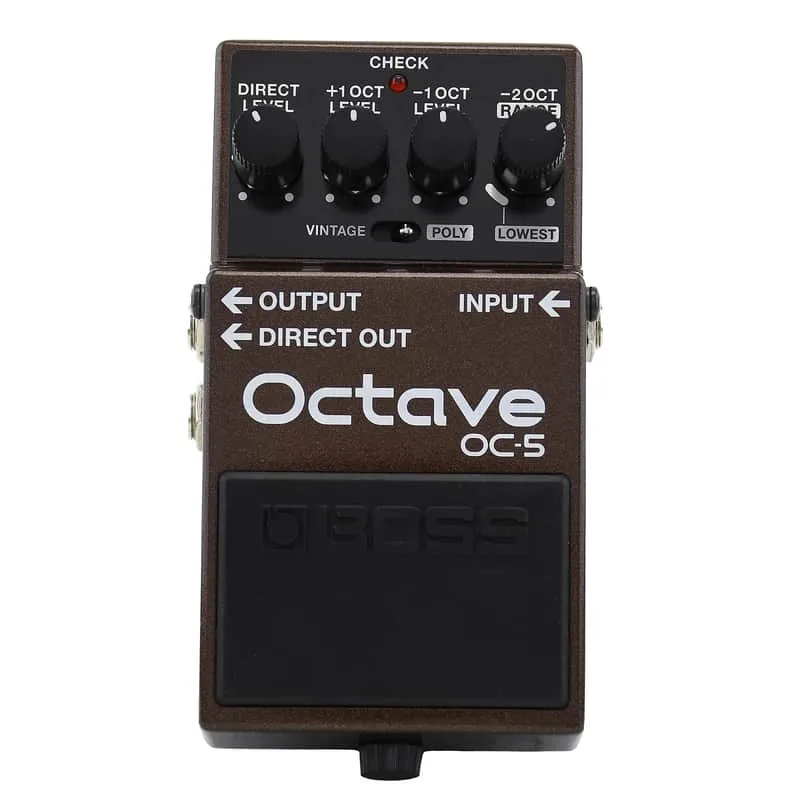
In 2020 the Boss OC-5 put a modern spin on the OC-2 from 198218719. Its Vintage mode engages the classic monophonic bass sound of the '80s-era mono OC-2, where the -2OCT/RANGE knob adjusts the two octaves below volume, with the option to blend in an octave up via the +1 Oct control420. Guitar.com's reviewer, comparing the two, described the OC-5 alongside "the very vintage (and analogue) OC-2 Octaver from 1982"2117, while Guitar Pedal X's Stefan Karlsson wrote that he personally prefers the OC-5 to the OC-22122.
Who uses it
- Prince used the OC-2 from 1982 onward, including both the original Octaver and later Octave versions11
- James Walbourne of the Pretenders and His Lordship formerly used one: "I also used to use an OC-2 Octave because I wanted to sound like Neil Young"23
- Tim Mahoney of Sublime names it among his top five oddball pedals9
- Bassists at large: Guitar World calls the brown box, launched in 1982, still a reference tone for a huge number of bassists seeking their own sub-octave sound19, and Boss's history notes guitarists also used it to fatten riffs and mimic basslines17
Videos
Reverb
Janek Gwizdala
The Bass Channel
Questions
Is the Boss OC-2 still made?
No. Boss lists the OC-2 Octave with a 1982 to 2005 run, and Premier Guitar describes it as discontinued. Original units are found on the used market, and vintage Japanese-made examples still fetch high prices according to Guitar World's buying guide.
What replaced the Boss OC-2?
The OC-3 SUPER Octave followed, adding a Poly mode with adjustable range plus an OC-2-style mode and a Drive mode. In 2020 the OC-5 arrived with a Vintage mode that Boss and reviewers describe as recreating the classic monophonic sound of the '80s-era mono OC-2.
What is the difference between the Made in Japan and Made in Taiwan OC-2?
The two versions came from different factories and wear different shades of brown. Pedal of the Day's reviewer found the Made in Japan version a lighter brown with a better build quality, and Juan Alderete has noted the two models came from different factories with different brown colors. Vintage Japanese units still fetch high prices.
Is the Boss OC-2 polyphonic?
No. It is a monophonic analog octaver that tracks one note at a time, one or two octaves below the original signal. Polyphony arrived with the later digital OC-3, though Guitar World notes some purists claimed its digital circuitry never sounded as good as the original.
What are good settings for a Boss OC-2?
Start with the three knobs at noon and raise Oct 1 for one octave down, Oct 2 for two octaves down, and Direct for your dry signal. Prince ran Oct 2 at 5:00, Direct at 12:00 and Oct 1 at 4:00. TONEHOME also suggests a compressor in front to limit the frequencies the pedal has to track.
Is there an OC-2 schematic?
Yes. Two schematics circulate in the DIY community, one from Stellan Lehrberg and one from Harald Sabro's site, and Champion Leccy has published the Sabro version. Builders note the Boss schematic omits the first JFET buffer and the JFET switching.
Sources (23)
- The PX-1 Plugout FX: Timeless BOSS Pedals Reborn, BOSS (articles.boss.info), 2025-06-06
- The PX-1 Plugout FX: Timeless BOSS Pedals Reborn, articles.boss.info, 2025-06-06
- TONEHOME, TONEHOME, 2003
- Boss OC-5 Octave review, Guitar World, 2021-03-09
- BOSS - PX-1 | Plugout FX, BOSS (boss.info)
- Boss OC-2 Octave, Pedal of the Day, 2014-11-04
- BOSS - XS Series Pitch Pedals, BOSS (boss.info)
- Boss OC-2 Octave, Pedal of the Day, 2025-04-06
- Tim Mahoney’s Top Five Oddball Pedals, Premier Guitar, 2014-10-20
- Boss OC-2 Octave, Pedal of the Day, 2015-08-30
- Boss OC-2 Octave, Guitarcloud, 2026
- HOW TO USE GUITAR PEDALS FOR BASS (W/ ROY MITCHELL CARDENAS, JHS Pedals
- The Rotund Robot (2), Champion Leccy, 2018-01-02
- sausage fingers (1), Champion Leccy, 2018-01-26
- The Rotund Robot (3), Champion Leccy, 2018-01-15
- Juan Alderete, Stompbox Book (stompboxbook.com), 2019-09-22
- Shifting With the Times: The History of BOSS Pitch Pedals, articles.boss.info, 2025-12-17
- Boss launches the OC-5, its latest compact octave pedal, Guitar.com, 2020-09-17
- Best octave pedals for bass 2026: Pitch-shift your playing with our pick of essential pedalboard additions, Guitar World, 2026-06-03
- Boss updates its classic octave circuit with the new OC-5 pedal, Guitar World, 2020-09-17
- Boss OC-5 review: what makes a great octave pedal?, Guitar.com, 2025-12-26
- Guitar Pedal X, Guitar Pedal X, 2025-08-28
- Reverberations: James Walbourne of Pretenders and His Lordship, BOSS (articles.boss.info), 2026-02-06
 Tim Mahoney
 Tim Lefebvre