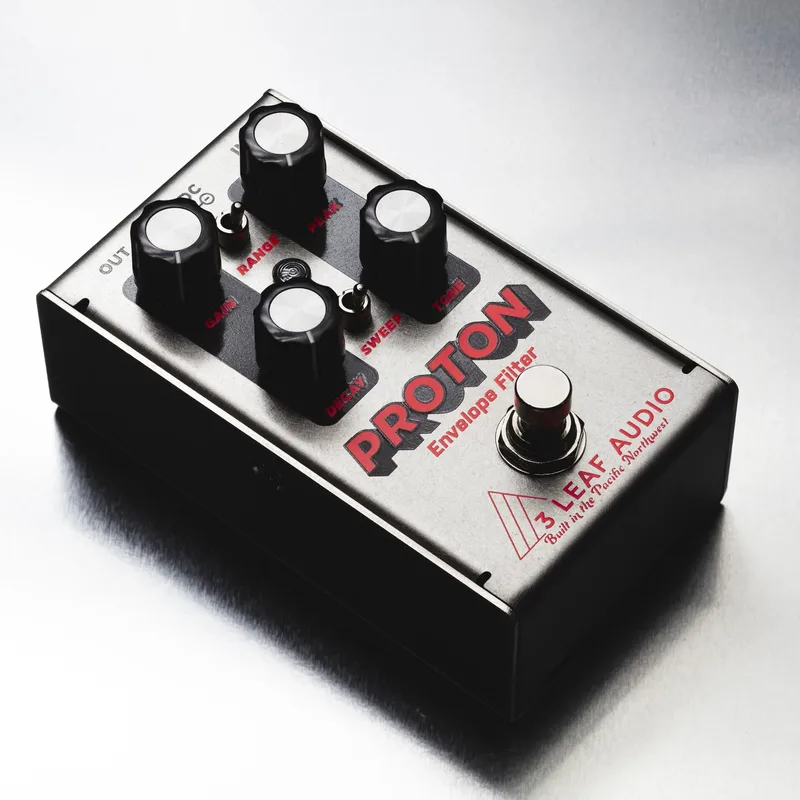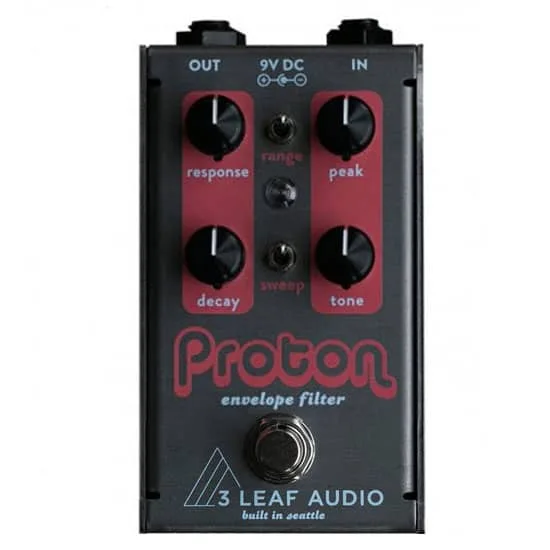


The 3 Leaf Audio Proton Envelope Filter is an optically controlled analog envelope filter, a pedal built around one job: the rhythmic auto-wah sound used by both guitarists and bassists. It is a redesigned second version, following the first iteration released almost ten years earlier, and the new circuit was built to offer better tone and a more musical response, with a greatly expanded range that can reach the classic 1970s filter sounds and well beyond1.
What it does
An envelope filter opens and closes a filter in response to how hard you play, which is what produces the auto-wah effect: notes swell and quack rhythmically without any rocking pedal under your foot. 3 Leaf Audio describes the Proton as a rather simple pedal born to do one thing, that rhythmic auto-wah sound, and the analog, optically controlled design is the heart of how it gets there1. For more on the type, see Filter Pedals.
The controls
Four knobs allow for deep control of the pedal's response, from sensitivity to decay of the filter and resonance1.
| Control | What it does |
|---|---|
| Sensitivity | Sets how the filter responds to your playing dynamics1 |
| Decay | Controls the decay of the filter1 |
| Resonance | Shapes the filter's resonance1 |
| Tone | Reworked for the second version, covering every soundscape from cocked wah to laser beams1 |
| Range switch | New for the second version, allows for much deeper filter sweeps1 |
The Range switch is the headline addition for players who found the first Proton's sweeps too shallow: it extends how far the filter travels, which is part of how the redesigned pedal reaches beyond the classic 1970s sounds1.
The second version versus the first
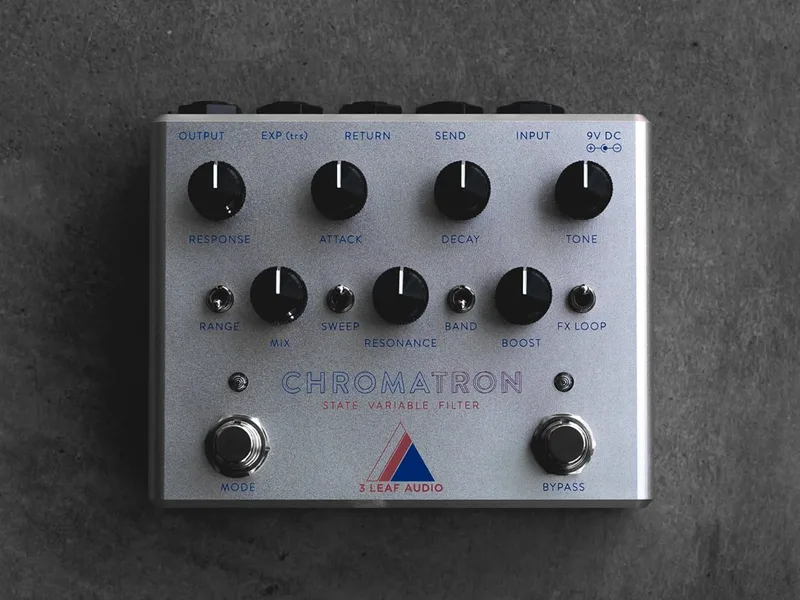
The first Proton was released almost ten years before the redesigned version, and the newer circuit is a complete redesign rather than a tweak. It has a new detector circuit based on the one in the 3 Leaf Audio Chromatron, the maker's other filter-based design1.
"The circuit has been completely redesigned to offer better tone and a more musical response."
Alongside the new detector circuit and Range switch, the reworked tone knob and the expanded range are what separate the second version from the original. Players comparing the two on the used market should look for the redesigned version's deeper sweep capability as the practical difference1.
Videos
Prymaxe
Mike Hermans
Zachary Rizer
Questions
What does the Range switch do on the Proton?
The Range switch is new to the redesigned Proton and allows for much deeper filter sweeps. In practice it extends how far the filter can travel as it responds to your playing, which is part of how the pedal reaches from classic 1970s filter tones to more extreme sounds. It works alongside the four knobs, which cover sensitivity, decay of the filter and resonance.
What is an optically controlled envelope filter?
An optically controlled envelope filter is an analog design in which the envelope, the circuit that tracks how hard you play, controls the filter through optical components rather than other means. 3 Leaf Audio describes the Proton this way, and the approach is credited on the pedal with better tone and a more musical response in its redesigned second version.
How is the new Proton different from the first version?
The second Proton arrived almost ten years after the first iteration and is a complete redesign. It has a new detector circuit based on the one in 3 Leaf Audio's Chromatron, a reworked tone knob, and a new Range switch for deeper filter sweeps. The maker says the redesign offers better tone and a more musical response with greatly expanded range.
Is the Proton an auto-wah?
Yes. 3 Leaf Audio describes the Proton as a rather simple pedal born to do one thing: the rhythmic auto-wah sound used by both guitarists and bassists. It is an envelope filter, the circuit family that produces the auto-wah effect, and it is analog rather than digital.
Sources (1)
- 3 Leaf Audio Proton Envelope Filter, Delicious Audio, 2021-01-05