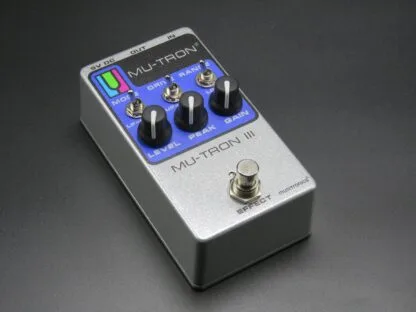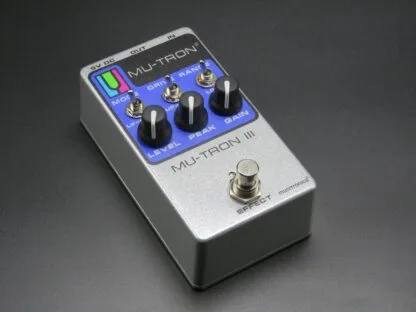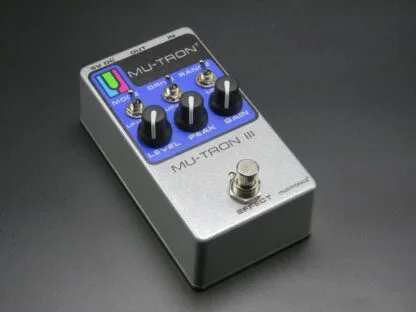


The Mu-Tron III Vintage Silver is an analog envelope filter, the effect type players often call an auto wah, made by Musitronics under the Mu-Tron name. It is a modern reissue of the original Mu-Tron III, the pedal that defined the envelope filter in the 1970s: Musitronics calls it "a modern day reincarnation of the legendary MU-TRON III. With the same circuit and a modern" build1. Where the original went out of production by 1979/'802, the Vintage Silver puts that circuit back in a current pedalboard-sized box at a list price of $279.001.
An envelope filter listens to how hard you pick and sweeps a filter in response, so your attack, not a foot rocker, drives the effect. Musitronics says the Vintage Silver suits "guitar, bass, clavinet, orsynths" and "will help you get the vintage funk out"1.
The circuit: optical, analog, and true to the original
The heart of the design is optical. Premier Guitar notes the Mu-Tron III "uses an optical circuit"3, and the original units were built around the vintage Hamamatsu 0805a photo-coupler4. In an optical envelope filter, the input signal's level drives a light source, and a light-dependent element sets the filter's cutoff, which is what gives the Mu-Tron its characteristic sweep.
The Vintage Silver keeps the same circuit as the original1 but adds what Musitronics calls a "modular optical design which allows for consistency across units"1. In practice that means the optical element is a module rather than a hand-matched discrete part, so two pedals should respond more alike than two 1970s units would.
The controls
The control set follows the original layout, with three knobs and a mode switch:
| Control | What it does |
|---|---|
| Up and Down drive | Sets how the envelope responds to your attack, in both sweep directions1 |
| Frequency | Controls the range of frequency manipulation1 |
| Peak | Can be used as resonance or damper control1 |
| Mode switch | Selects Low pass, Band pass, or High pass filtering1 |
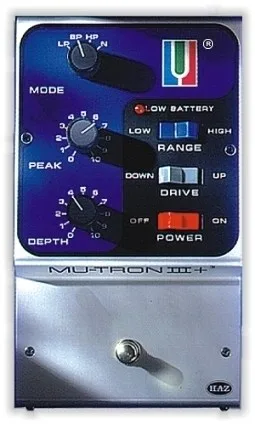
On the original Mu-Tron III, the Peak control governed the volume of the cutoff frequency5, and the mode selection was originally a rotary switch with three positions6. The Up and Down drive controls are what let you tune the sensitivity: Up mode sweeps the filter upward as you play harder, Down mode sweeps it down, and the drive settings determine how much attack it takes to move the filter.
Bypass: bleed or active
The Vintage Silver offers two bypass modes, set by an internal control: "Bleed" or "Active"1. In bleed bypass mode the pedal acts as a clean boost when bypassed1, so the effect can stay in the chain with a level bump available at all times. Active bypass is the conventional alternative. This is an internal setting, so it is a set-and-forget choice rather than something you flip mid-gig.
The bypass mode is selected on an internal control, not a front-panel switch. Decide whether you want the clean-boost bleed behavior before you finalize your pedalboard layout1.
Power and connections
The pedal runs on 9V to 12V DC with a negative center tip, drawing 30 mA, and uses a 100 mA power port1. That is well within any standard isolated pedalboard supply. Connection is simple: one 1/4" input jack and one 1/4" output jack1. At 4.75" x 2.5" x 2.25" and 1 lb, it fits a normal pedalboard without dominating it1.
The maker lists a California Proposition 65 warning: the product can expose you to chemicals including lead, known to the State of California to cause cancer and birth defects or other reproductive harm1.
Where it came from
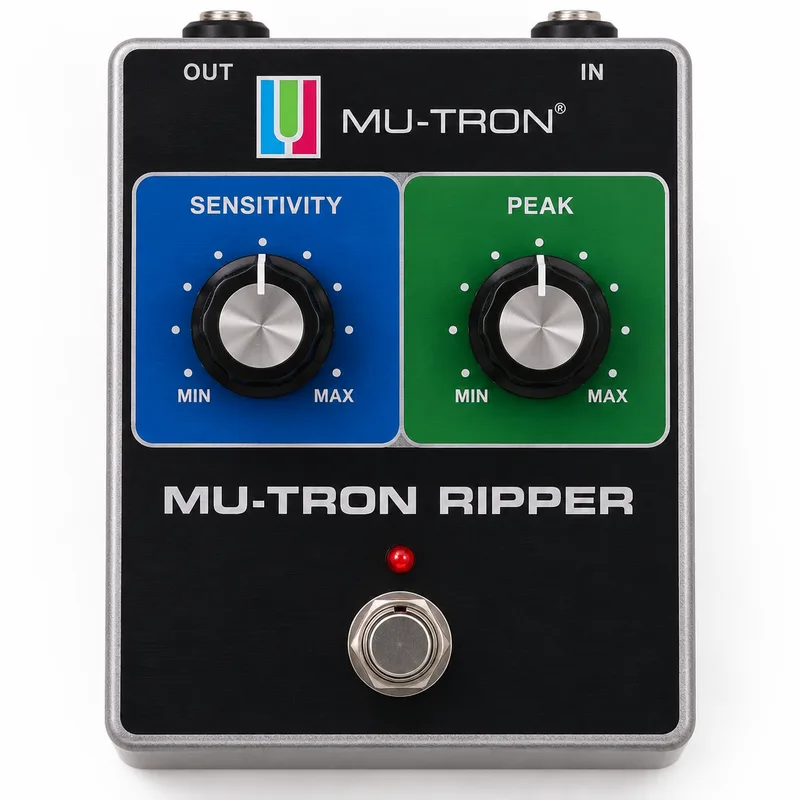
The original Mu-Tron III, built by Musitronics in the 1970s, was discontinued by 1979/'802. The Vintage Silver is part of the current Mu-Tron lineup, made in the US1, and sits alongside the company's other filter pedals, including the Mu-Tron III Envelope Filter, the Mu-Tron Micro-Tron III, and the Mu-Tron Ripper. For a broader look at the category, see filter pedals.
Videos
Soultron
The SoCal Riff Ranch
Low-End Reviews - Bass Pedals and Gear
Questions
Is the Mu-Tron III Vintage Silver analog or digital?
It is an analog envelope filter. Musitronics describes it as a modern reincarnation of the original Mu-Tron III with the same circuit, and the original design used an optical photo-coupler rather than digital processing.
Does the Mu-Tron III Vintage Silver use the same circuit as the original?
Yes. Musitronics states the Vintage Silver is a modern day reincarnation of the legendary Mu-Tron III with the same circuit, updated with a modular optical design that allows for consistency across units.
Can the Mu-Tron III Vintage Silver be used with bass?
Yes. The maker says the Mu-Tron III works for guitar, bass, clavinet, or synths, and will help players get the vintage funk out of any of them.
What is bleed bypass on the Mu-Tron III?
Bleed is one of two bypass modes, selectable via an internal control. In bleed bypass mode the pedal acts as a clean boost when bypassed; the alternative is active bypass.
What power supply does the Mu-Tron III Vintage Silver need?
It runs on 9V to 12V DC with a negative center tip, drawing 30 mA. The maker specifies a 100 mA power port, so a standard pedalboard supply covers it.
Where is the Mu-Tron III Vintage Silver made?
It is made in the US by Musitronics, the company behind the Mu-Tron brand, and carries a 1 year limited warranty.
Sources (6)
- Mu-Tron III Vintage Silver, Musitronics Mu-Tron (mu-tron.com)
- Mu-FX Tru-Tron 3X, Vintage Guitar magazine, 2015-09-04
- Analog Man Envelope Filter Review, Premier Guitar, 2015-11-09
- Mu-Tron Opto-Mod Modules for Micro-Tron IV, Musitronics Mu-Tron
- Mu-Tron III, Musitronics Mu-Tron
- Guitar FX Layouts: Mutron III, Guitar FX Layouts (tagboardeffects.blogspot.com), 2014-06-19