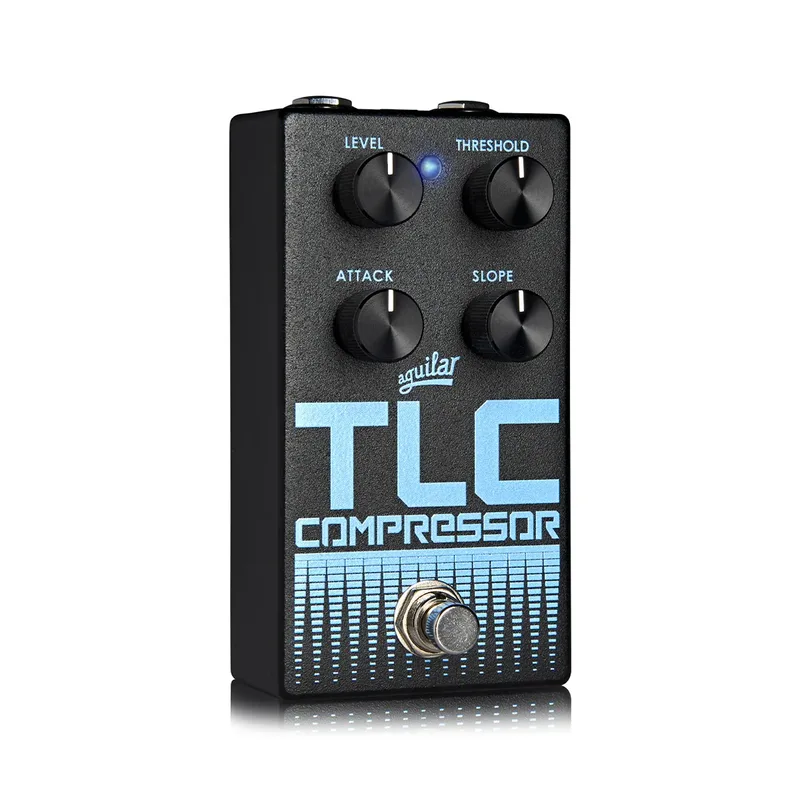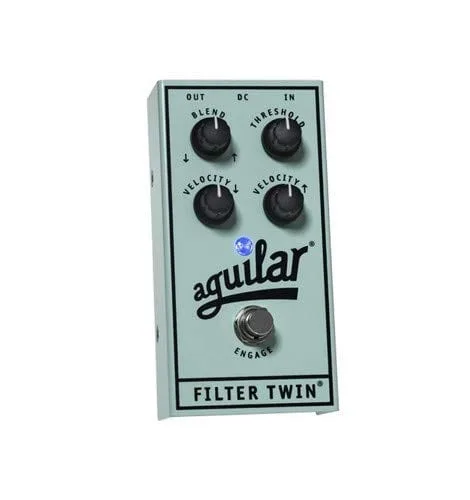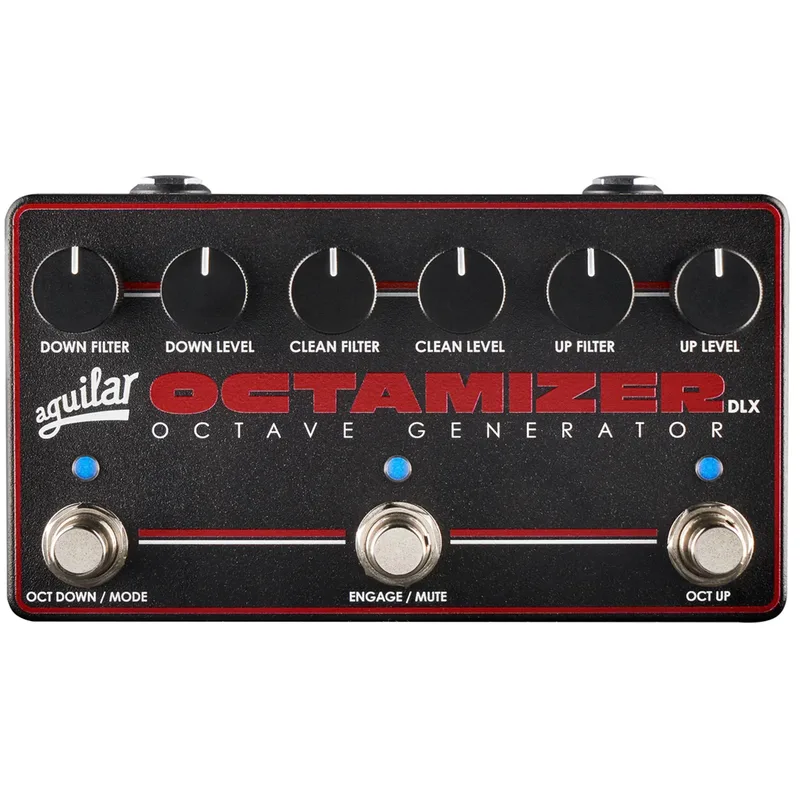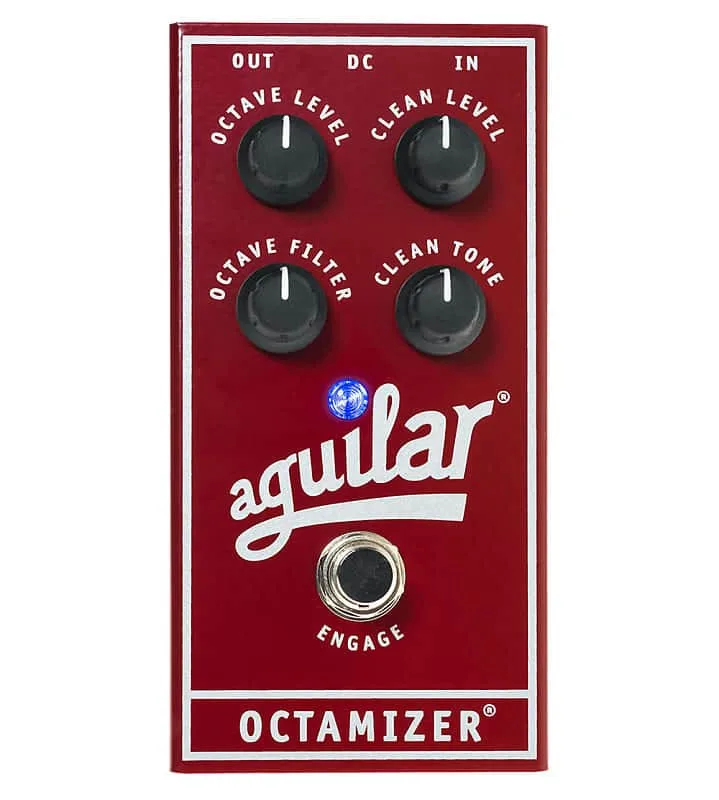


The Aguilar Octamizer is an all-analog octave pedal for bass that creates a wide range of musical sounds an octave below your bass signal1. Made by Aguilar Amplification, it sits in the company's pedal line alongside the TLC compressor and the Filter Twin envelope pedal. Aguilar says it delivers tones from deep and smooth sub-bass sounds to edgy and aggressive synth-like tones1.
The pedal is a clean-blend octave-down design: your original note and a generated note one octave below it each get their own volume control, so you can dial in anything from a subtle thickening to a full sub-octave layer under your clean tone1.
The controls: clean and octave levels, tilt EQ and octave filter
The Octamizer's control set is built around two ideas: shape the clean signal and the octave signal independently, then blend them to taste.
| Control | What it does |
|---|---|
| Clean level | Sets the level of your clean instrument sound1 |
| Octave level | Sets the level of the effected sound one octave below the original signal1 |
| Clean EQ (CLEAN TONE) | A full spectrum tilt EQ: boost treble while cutting bass, or boost bass while cutting treble12 |
| Octave filter | A multi-pole low-pass filter, 3-pole LPF sweeping 80 Hz to 800 Hz, that shapes the octave sound2 |
The tilt EQ is the distinguishing control. Rather than a conventional bass and treble pair, one knob pivots the whole clean spectrum in one direction or the other1. On the octave side, the low-pass filter lets you darken the generated note so it sits under the clean signal as a smooth sub-bass, or open it up for edgier, synth-like tones12. A single footswitch toggles the effect on and off2.
Bass Gear Magazine's review of the Octamizer II, the second-generation version, lists the same architecture: level controls for octave and clean sounds, a full spectrum tilt EQ for the clean sound, and a sweepable multi-pole low-pass filter for the octave sound2.
Power and specifications
Aguilar's product page states the pedal is powered by a universal 9-volt power supply only, with the supply not included1. Bass Gear Magazine's Octamizer II review instead lists power from an internal 9V battery or an external PSU through a standard 2.1mm 9V DC input socket2. The two sources disagree on battery power, so check which version you are buying if running it off a supply matters to you.
Aguilar's own page says power supply only, no battery1. If you build pedalboards around a single 9V daisy chain, note the 2.1mm DC jack the review describes is the standard "pedal power" fitting2.
Specifications from the Bass Gear Magazine review of the Octamizer II2:
| Spec | Value |
|---|---|
| Circuit topology | Analog |
| Octave filter | 3-pole LPF, 80 Hz to 800 Hz |
| Clean tone EQ | Wide band tilt EQ, +/- 20 dB |
| Input impedance | 1MΩ |
| Current draw | 6mA |
| SNR ratio | >100 dBu (A weighted) |
| Housing | Heavy duty steel |
| Dimensions | 93mm x 38mm x 45mm including knobs |
| Price at review | $199.99 USD (February 2024) |
How it compares to the Octamizer DLX
In January 2026 Aguilar introduced the Octamizer DLX, described in the announcement as an expanded evolution of the long-running Octamizer bass octave pedal3. The DLX keeps the familiar control set of Octave Volume, Octave Filter, Clean Level and Clean EQ, but adds new flexibility3:
- The clean signal can be fully muted for pure sub-octave tones3
- Two distinct filter modes expand the sonic range3
- A B mode on the octave, which Aguilar's Peter demonstrated in Premier Guitar's NAMM 2026 video: "the first thing we did is we added a B mode to the octave. So, now this is the classic octimizer. This is the B mode. And it gets a little more synthy, a little more growly."4
So the original Octamizer remains the simpler, all-analog clean-blend octave, while the DLX adds voices and muting on top of that foundation.
What reviewers said
Bass Gear Magazine's reviewer found a lot to like in the analog character:
"Aguilar nails the warm, synth-like quality that we all know and love from classic analogue octave pedals. It's thick, smothering, and oh-so funky."
On tracking, the same review found the response quick, attributing it to the proprietary detector circuit, while being clear about the limits of the format: analog octave circuits cannot do polyphony and will start to struggle tracking the lowest notes on the bass neck compared with a top-tier digital pedal, a limitation the reviewer framed as by design rather than a fault of the Octamizer2. The review's summary called it "a robust, great-sounding octave pedal that does well at fattening up bass tones with rich organic effects"2.
A Pedal of the Day review of the original bright red version took a different angle, reporting on how it handled an instrument it was not built for: "I loved how well it sounded when paired with a guitar"5. The pedal is geared toward bass, but that reviewer's experience suggests it is usable with guitar, with the usual analog-octave caveat about single notes tracking better than chords.
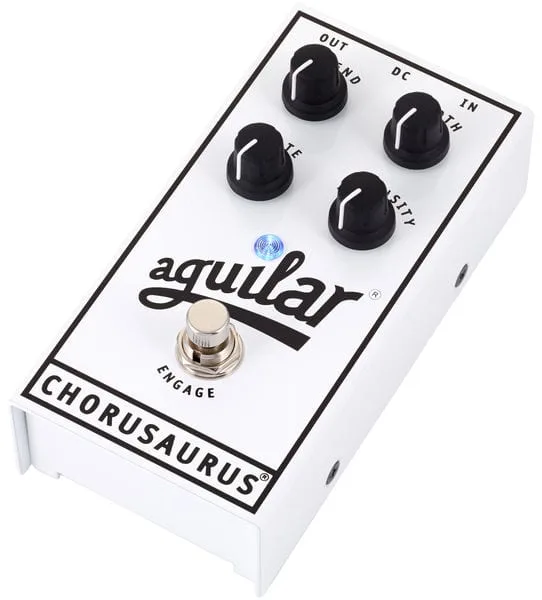
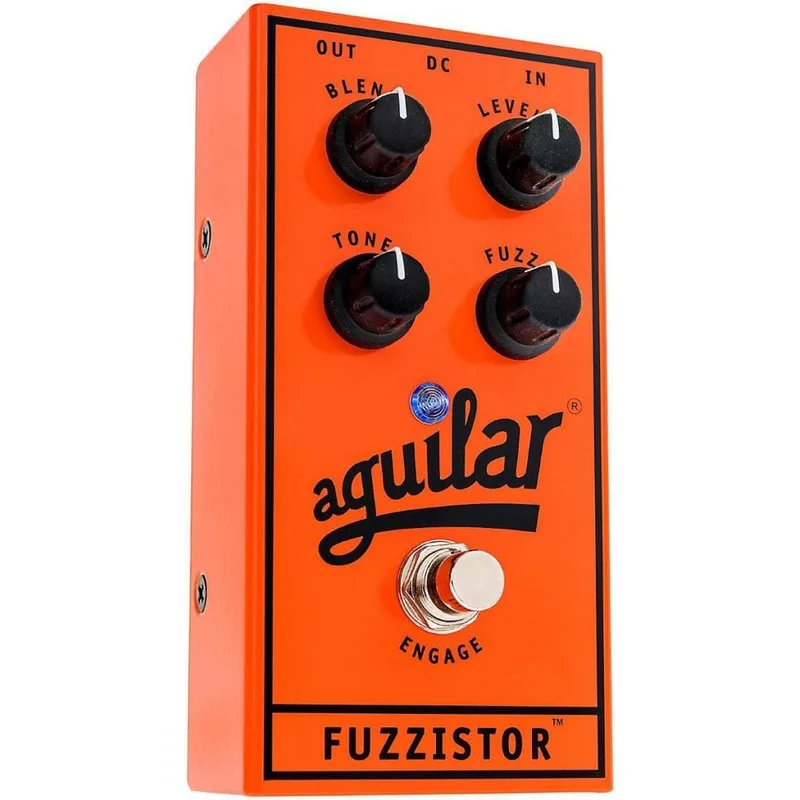
For players comparing octave options, the Octamizer's pitch is the analog one: a clean blend, a tilt EQ and a sweepable octave filter in a steel box, against the polyphonic tracking of digital alternatives the reviewer references2. Related Aguilar bass pedals on Tonebox include the AGRO, the Chorusaurus and the Fuzzistor, or browse all bass pedals and octave and pitch pedals.
Videos
Aguilar Amplification
Aguilar Amplification
BassTheWorld.com
Questions
Does the Aguilar Octamizer take a battery?
Aguilar's own product page says no: the pedal is powered by a universal 9-volt power supply only, and the supply is not included. Bass Gear Magazine's review of the Octamizer II lists an internal 9V battery or an external PSU through a 2.1mm DC jack, so the two sources disagree. If you want battery power, confirm with the seller which version you are getting.
Can the Octamizer II track chords?
No. Bass Gear Magazine's reviewer found the tracking fast and responsive thanks to a proprietary detector circuit, but noted that all analog octave circuits have limitations by design: they cannot do polyphony and will start to struggle tracking the lowest notes on the bass neck compared with a top-tier digital pedal. Play single notes for the best results.
Does the Octamizer II work on guitar?
It is designed for bass, but a Pedal of the Day review of the original Octamizer reported loving how well it sounded paired with a guitar. Analog octave pedals generally track best on single lower-register notes, so expect the strongest results on the lower strings rather than full chords.
How is the Octamizer II different from the Octamizer DLX?
The DLX, announced in January 2026, is an expanded evolution of the long-running Octamizer. It keeps the familiar control set of Octave Volume, Octave Filter, Clean Level and Clean EQ, but adds a B mode on the octave that Aguilar describes as more synthy and growly, lets you fully mute the clean signal for pure sub-octave tones, and adds a second filter mode.
Sources (5)
- Octamizer Analog Bass Octave Pedal, Aguilar Shop (aguilaramp.com)
- Bassic Review, Bass Gear Magazine, 2024-02-12
- New Gear: Aguilar Introduces the Octamizer DLX, Bass Musician Magazine, 2026-01-22
- Aguilar Tone Hammer 210 Combo, TLC Compressor, and Octamizer Octave Generator I NAMM 2026, Premier Guitar, 2026-01-23
- Aguilar Octamizer Analog Octave, pedal-of-the-day.com, 2016-02-03