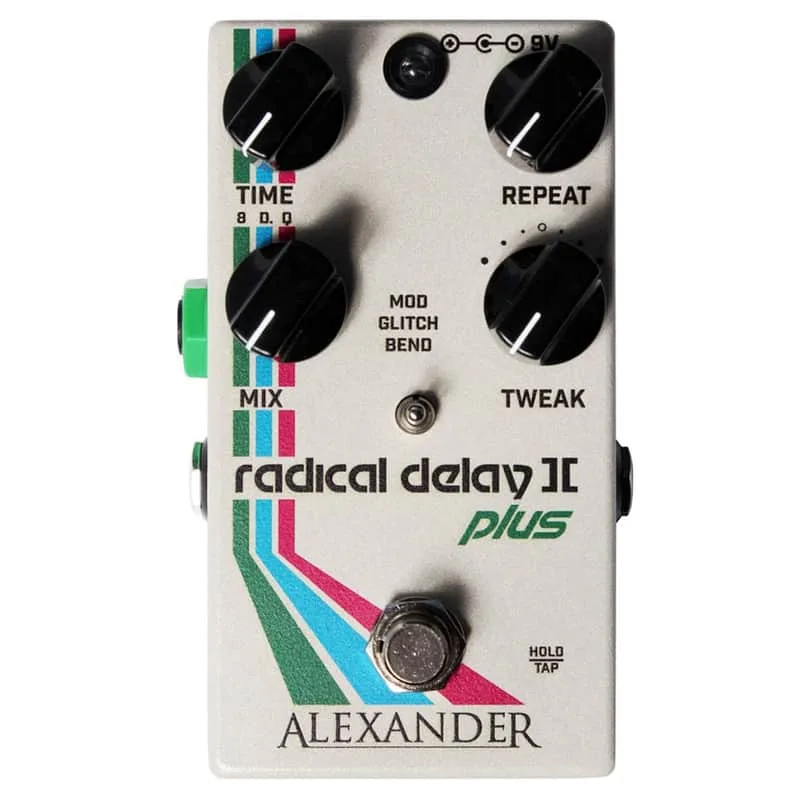


The Alexander Pedals Radical Delay II+ is a compact delay pedal from Alexander Pedals with three distinct modes: Mod, Glitch and Bend. The sound is built on what RockBoard describes as "an extremely clear and harmonic digital Delay in the '80s style," and Pedal of the Day heard the same character, calling it a delay pedal with pitch shifting and arcade-inspired effects that "brings you the sounds and odd tones" of the 1980s12.
What sets it apart from a basic digital delay is that each mode revoices the repeats rather than just changing the delay time. Mod is a crystal clear digital delay that adds Vibrato or Chorus modulation via the Tweak knob, Glitch adds random modulations and ghost notes to the echoes, and Bend pitch-shifts each repeat up or down an octave depending on the Tweak setting21.
The three modes
| Mode | What it does to the repeats | Tweak knob's role |
|---|---|---|
| Mod | Clear, transparent repeats with modulation | Left adds vibrato, right adds chorus12 |
| Glitch | Random modulations and ghost notes | Sets the intensity of the glitch effects12 |
| Bend | Each repeat shifts one octave up or down | Sets the shift direction12 |
RockBoard describes Mod mode as delivering "particularly transparent repetitions, which are complemented by a rich chorus or a fast vibrato" depending on where the Tweak control sits1. Pedal of the Day's take was similar: "Mod is a crystal clear digital delay, that uses the Tweak knob to add in Vibrato (to the left) or Chorus (to the right)"2.
Glitch mode is the pedal's oddball. RockBoard says it "adds random modulations and ghost notes to the central Echo effect," with the Tweak potentiometer again controlling how far it goes1. Pedal of the Day put it more bluntly: "Glitch does just what you'd think, adding in crazy glitchiness and pitch-shifting to the repeats"2.
Bend mode is the pitch-shifting mode, and the answer for players who want octave-shifted repeats. RockBoard: "the Bend mode shifts the Echoes one octave up or down"1. Pedal of the Day confirmed that "each repeat" moves up or down an octave depending on the Tweak setting2. That is a full octave, not a subtle detune, which fits the pedal's arcade-inspired personality.
The controls
The control set is small: four knobs and a footswitch.
- Mix: sets the delay level2
- Time: sets the delay time2
- Repeat: sets the number of repeats2
- Tweak: changes function with the mode, as in the table above12
Pedal of the Day noted that "Mix, Time and Repeat set their respective parameters as you'd expect," so the first three knobs behave like any conventional delay, and Tweak is the one that carries the mode-specific behavior2.
Tap tempo
The Radical Delay II+ has tap tempo without a second footswitch. RockBoard describes the Tap Tempo mode as "activated by holding down the footswitch," and used to enter the delay time and set the rhythmic subdivision of the echoes1. Pedal of the Day highlighted "the ability to change the Bypass switch into a Tap Tempo switch, without trying to cram another footswitch onto a small" enclosure2. Players who prefer a dedicated tap pedal can plug one into the red side jack2.
Power
The pedal runs on 9V DC, center negative, drawing 70mA1. At that current draw it is well beyond what a standard battery or a low-current daisy chain position is meant for, so plan on a proper 9V supply.
RockBoard's spec listing carries an analog entry under circuit type while describing the pedal's sound as a digital delay in the '80s style, and Pedal of the Day calls it a digital delay, so the listings disagree on that one field12.
What reviewers said
Pedal of the Day reviewed the pedal on 10 January 2019 and came away positive about both the pedal and the builder:
"Another inventive creation from the Alexander Pedals crew, we're definitely wanting to get some more of [their gear] in the shop2."
"This is one fun delay, people"2
Alexander Pedals, on the Radical Delay II+
The same review summed up the three modes as giving "massive opportunity to paint and unique and enjoyable soundscape, each presenting a strange and" distinctive character2.
Videos
ProGuitarShopDemos
PedalNerds - Nathan Shafer
Dennis Kayzer
Questions
What does the Tweak knob do on the Radical Delay II Plus?
The Tweak knob changes job with each mode. In Mod mode it blends in vibrato as you turn it left and chorus as you turn it right. In Bend mode it sets whether repeats shift up or down an octave. In Glitch mode it sets the intensity of the random modulations and ghost notes.
Does the Radical Delay II Plus have tap tempo?
Yes. You hold down the footswitch to enter Tap Tempo mode, tap in the delay time, and choose the rhythmic subdivision of the echoes. The bypass switch converts to a tap tempo switch, so no extra footswitch is needed, and an external tap pedal can be plugged into a red side jack.
What is Glitch mode on the Radical Delay II Plus?
Glitch mode adds random modulations and ghost notes to the delay repeats. Pedal of the Day described it as adding crazy glitchiness and pitch shifting to the repeats. The Tweak knob controls how intense those random effects are.
Can the Radical Delay II Plus shift repeats up an octave?
Yes. In Bend mode each repeat is pitch shifted up or down a full octave, with the Tweak knob deciding the direction. It is not a subtle detune: the repeats move a whole octave, which suits the pedal's 1980s arcade-inspired character.
Is the Radical Delay II Plus analog or digital?
It is a digital delay. Both RockBoard and Pedal of the Day describe its repeats as clear digital delay in a 1980s style, though RockBoard's spec listing also carries an analog circuit type entry, so the listings disagree on that one field.
Sources (2)
- Radical Delay II+ by Alexander Pedals, RockBoard (www.rockboard.de), 2026
- Alexander Pedals Radical Delay II Plus, Pedal of the Day, 2019-01-10