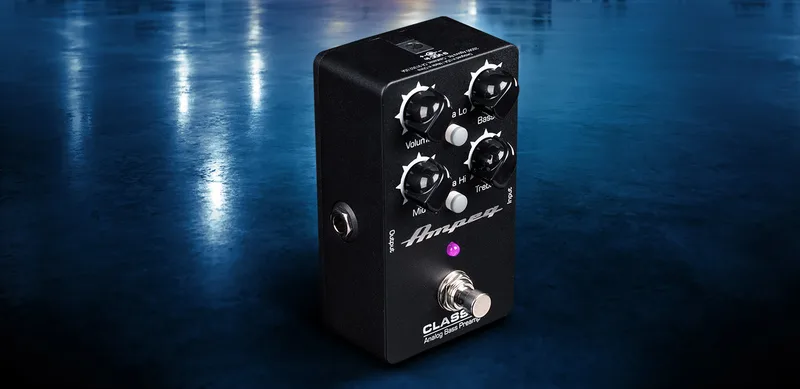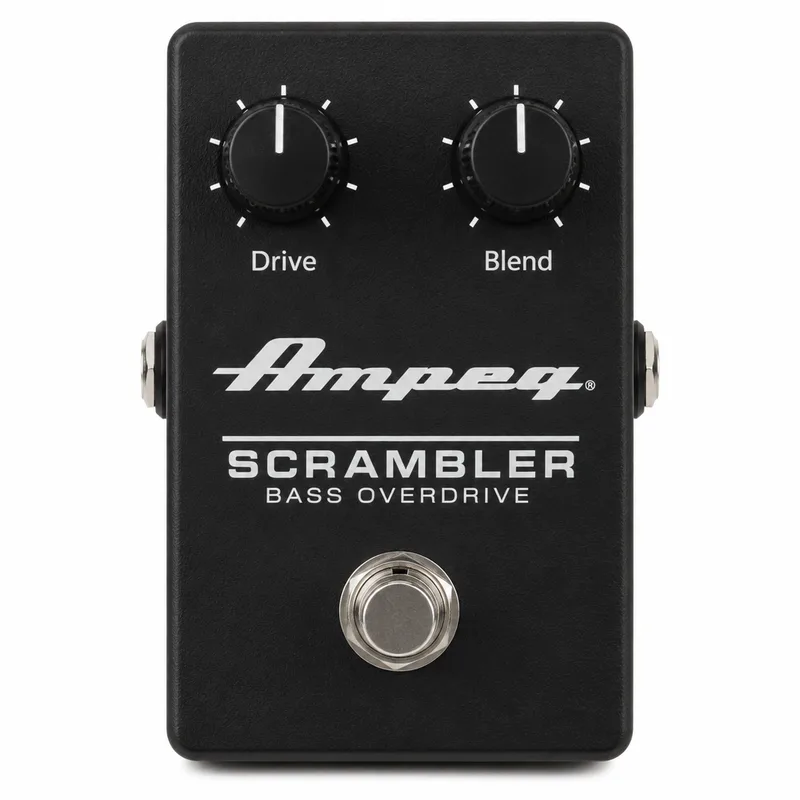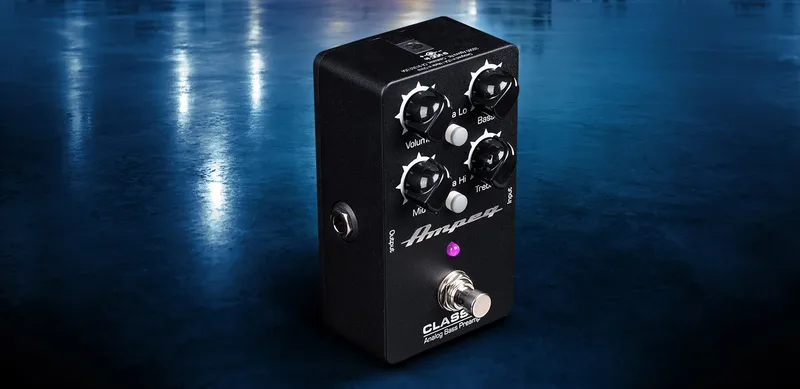


The Ampeg Classic Bass Preamp is a bass preamp pedal that puts the key tones of an array of classic Ampeg amps into a stompbox, in the words of Ampeg's own product page1. Where a full amp head carries the whole preamp and power amp, this pedal carries just the preamp and EQ section, so you can shape an Ampeg-style voice in front of any amp, or send it straight to a desk or interface. It is an all-analog, true-bypass design, announced at NAMM in January 2017 alongside the Scrambler Bass Overdrive, with both pedals due in April that year2.
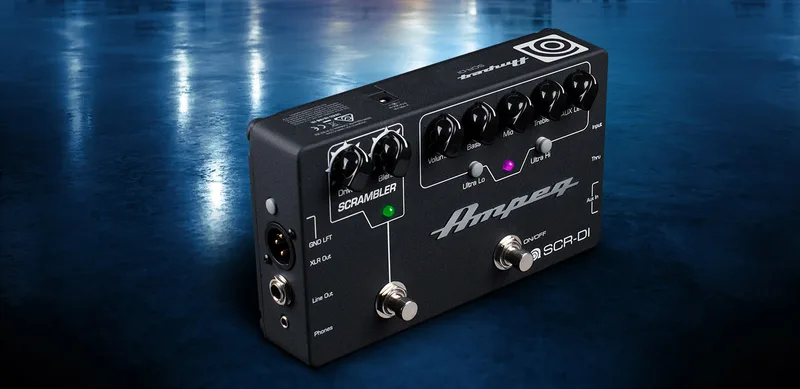
The pedal is one of a pair that split up an earlier Ampeg product. Both the Classic and the Scrambler share the same circuits as Ampeg's BA combos and the SCR-DI Bass DI, just separated into different chassis3. MusicRadar reported at launch that the two pedals were derived from the existing SCR-DI Bass DI2. So if you have played an Ampeg BA combo or the SCR-DI, the Classic's preamp voice will be familiar territory.
What it does: Ampeg bass tone in a pedal
The circuit is built around the classic Ampeg preamp tone stack, which Guitar World's review identifies as based on the Baxandall design, with an added midrange filter and the Ultra-Lo and Ultra-Hi buttons originally found on the all-tube SVT head5. In a Baxandall tone stack, the bass and treble controls interact around a fixed center point, which is part of why Ampeg EQ curves behave the way they do. Ampeg's own description of the 3-band tone stack and accompanying Ultra-Hi and Ultra-Lo circuits calls them "effective and efficient partners in dialing up" Ampeg tone1.
Guitar World's reviewer found the pedal "captures the basic essence and EQ personality of the classic Ampeg preamp," with EQ circuits "appropriately voiced with the same gentle but effective curves associated with the Ampeg pre overall voicing and EQ"5.
Bass Gear Magazine's Jacob Schmidt tested it into a non-Ampeg rig and reported the preamp's character came through anyway3:
"I dialed down the grit a bit on the GK and was pleasantly surprised to hear an SVT coming out of my cab."3
That is the practical case for a preamp pedal like this: it voices your signal before it reaches whatever amp or interface you are using, rather than depending on the amp being an Ampeg.
The controls: three-band EQ, Ultra-Hi and Ultra-Lo
The front panel is deliberately simple. Performer Mag's Chris Devine found "the controls are quite simple; a three band EQ and volume knobs do exactly what's expected of them"6. The preamp section allows for a hefty +18 dB of gain3, so there is plenty of level on tap for pushing the front of an amp. The pedal is engaged using a standard footswitch, with a purple LED showing when the preamp is active43.
| Control | What it does |
|---|---|
| Volume | Sets overall output level, with up to +18 dB of gain available3 |
| Bass | Bass band of the three-band EQ |
| Mid | +5 / -11 dB at 500 Hz3 |
| Treble | +10 / -10 dB at 4 kHz3 |
| Ultra-Lo switch | +2 dB at 40 Hz and -10 dB at 500 Hz3 |
| Ultra-Hi switch | +7 dB at 8 kHz3 |
The two Ultra buttons are the SVT heritage. The Ultra-Lo button boosts the very bottom while cutting lower mids at 500 Hz, which thins the middle as it fattens the low end. The Ultra-Hi button lifts 8 kHz for finger attack and string definition. Devine found "the ultra-low, and ultra-hi really add an extra depth in the low and high ends, respectively"63. Gearnews noted at launch that the three-band EQ alone is likely more than enough for most players4.
Inside the enclosure there is also a -15dB pad jumper3. If the preamp's gain is overdriving whatever follows it, the pad cuts the output level down, which is a set-and-forget adjustment rather than a front-panel control.
Power: 9V to 12V, 100mA
The Classic runs on a 9V to 12V DC power input, center negative, drawing 100mA3. Guitar World lists it as powering from 9 volts via an AC adapter or battery, with the battery not included5, and Bass Gear Magazine confirms an internal compartment for a 9V battery if you would rather not use a standard 9V supply3.
At 100mA, this pedal draws more current than a simple analog boost or drive, so check your power supply's per-output rating. A small daisy chain built for low-draw analog pedals may not have the headroom for it.
Input impedance is 1MΩ5, which is the same ballpark as a typical amp input and means passive basses see a normal load. The enclosure is die cast zinc with rubber feet, measuring 4.5" D x 2.6" L x 2.2" H and weighing 0.6 lb, with a 1-year nontransferable warranty3. Ampeg describes the construction as road-ready and all-metal1.
Where it came from and what reviewers said
Ampeg's launch plans for the Classic Bass Preamp had it arriving in April alongside the Scrambler Bass Overdrive4. By the time of Bass Gear Magazine's review in February 2018, the pricing was $139.99 list and $99.99 street3, and Performer Mag's review in September 2017 put it at $996.
Devine's verdict in Performer Mag was about value: "And for $99, it's a heck of a lot cheaper than a vintage rig"6. Guitar World's review framed the pair as Ampeg bringing a few of its distinctive circuits to the mid-priced stompbox market5. The reviews agree on the essentials: simple controls, familiar Ampeg EQ curves, and a genuine SVT-flavored voice that survives being run into other brands of amp.
Videos
Sweetwater
Ampeg
Ampeg
Questions
Does the Ampeg Classic Bass Preamp take a battery?
Yes. The pedal has an internal compartment for a 9V battery, so you can run it without a power supply, though the battery is not included. It also runs on a standard 9V to 12V DC center negative power input drawing 100mA, which is the practical choice for a pedalboard.
Is the Ampeg Classic Bass Preamp true bypass?
Yes. Ampeg describes it as an all-analog circuit with true bypass switching to preserve your tone, and Bass Gear Magazine's review confirms the Classic Bass Preamp has a true bypass switch. When the pedal is off, your signal passes through without the circuit in the way.
What is the internal pad jumper on the Ampeg Classic?
Inside the enclosure there is a -15dB pad jumper. It lets you cut the pedal's output level by 15dB, which is useful when the preamp's up to +18dB of gain is pushing whatever comes after it in your chain too hard.
Where is the Ampeg Classic Bass Preamp made?
It is made in China, in a die cast zinc enclosure with rubber feet, by Loud Technologies Inc., the company behind the Ampeg brand. Ampeg describes the construction as road-ready and all-metal.
Sources (6)
- Ampeg | Pedal Series :: Preamps and Effects, Ampeg
- NAMM 2017: Ampeg announce Classic pedal bass preamp, and Scrambler bass overdrive, MusicRadar, 2017-01-23
- Bassic Review, Bass Gear Magazine, 2018-02-14
- Ampeg debuts two familiar-looking pedals, gearnews.com, 2017-01-23
- Ampeg Classic Analog Bass Preamp and Scrambler Bass Overdrive review, Guitar World, 2020-01-08
- Ampeg Classic Analog Bass Preamp Review, Performer Mag, 2017-09-27