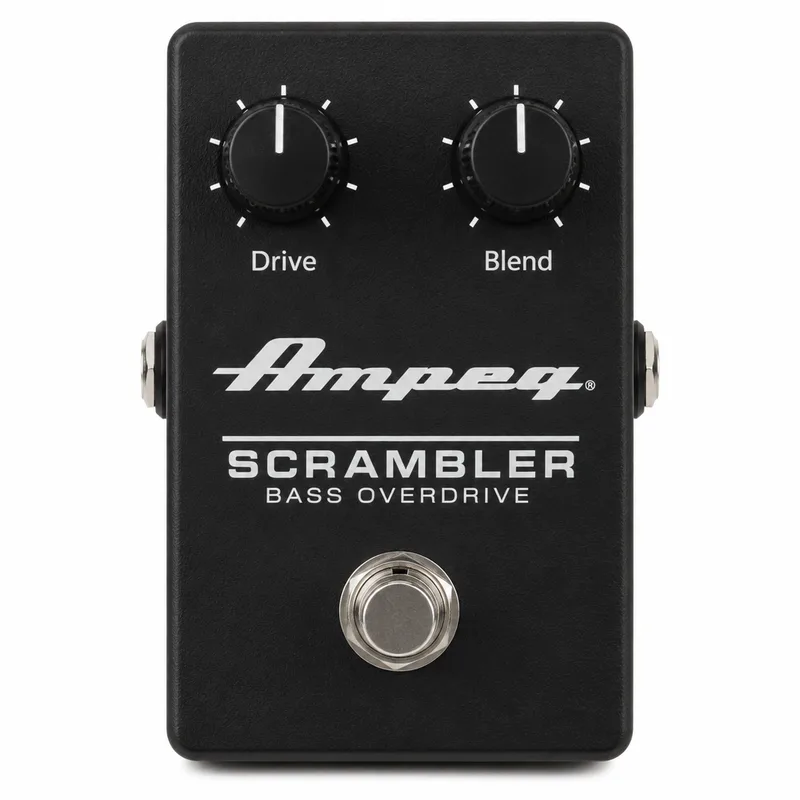


The Ampeg Scrambler Bass Overdrive is a compact bass overdrive pedal that, in Ampeg's own words, "infuses your sound with authentic Ampeg grit, grind, and sag"1. Where many overdrives were designed with guitar in mind and leave bass players fighting to keep their low end, the Scrambler is built around a clean blend: you mix your untouched signal back in against the driven one, so the fundamental stays present while the drive adds harmonics on top. Ampeg describes the range as "overdrive tones from subtle to screaming"1.
The pedal arrived in 2017 as part of a pair of Ampeg bass stompboxes, and it is closely related to the company's SCR-DI pedal, which had shipped two years earlier. It is an all-analog design with true bypass switching, four knobs, and a street price around $100 when reviewed12.
Tube-style Ampeg grind for bass
The pitch of the pedal is Ampeg's amplifier character in a stompbox. Ampeg says the Scrambler delivers the company's grit, grind and sag, the qualities players associate with its bass heads, and that separate Drive and Blend (wet/dry) controls "make it easy to dial in your ideal sound"1. The blend is the feature that matters most to bassists: as Performer Mag's reviewer Chris Devine put it, "the blend is like a mix control, balancing between the overdriven and unaffected tone," which helps maintain clarity as you add drive4.
Gearnews, covering the pedal's announcement, framed the blend as part of a wider trend, noting the pedal "uses the increasingly popular idea of blending in 'unprocessed' signal to get the tone you like"3. For a player comparing this against a plain distortion or fuzz box with no clean path, that wet/dry mix is the practical difference: you can push the drive hard while your dry low end keeps the note body intact.
Because of "its largely un-filtered bass content and clean blend control," Aion FX considers the Scrambler "particularly good for bass guitar," which fits a company known primarily for bass equipment5. It is a bass pedal first, not a guitar overdrive repurposed.
The controls
The control set is four knobs, which Premier Guitar described as "a quartet of knobs for volume, treble, drive, and blend"6.
| Control | What it does |
|---|---|
| Drive | Sets the distortion amount. On the original 1960s Scrambler, this parameter was called "texture"2 |
| Blend | Sets the ratio of clean to distorted tone, a feature retained from the original Scrambler2 |
| Treble | Emphasizes the impact the distortion circuit has on high-frequency response2 |
| Volume | Sets the output level6 |
The Drive and Blend pairing is the core of the pedal: Drive decides how hard the circuit is pushed, and Blend decides how much of that driven signal you actually hear. Treble then shapes the top end of the effected signal, which Ampeg suggests using for "a touch of highs" before blending12.
Build-wise, Premier Guitar found the Scrambler "comes packaged in a roadworthy all-metal chassis with a sleek, flat-black finish," with "a durable-feeling footswitch and sturdy construction," and noted the white control lettering "could be helpful for dimly lit stages"6. Power comes from 9 volts, either an AC adapter or a battery, with the battery not included2.
History: from the late-'60s Scrambler to the SCR-DI
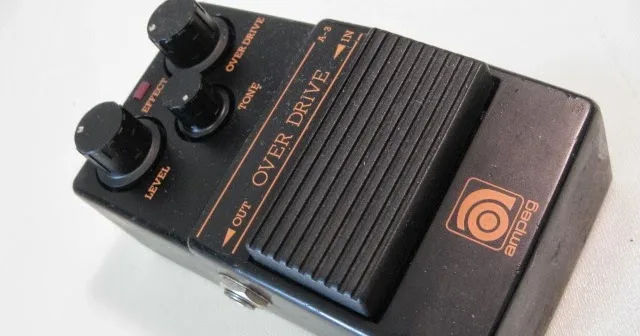
The Scrambler name goes back a long way. In the late 1960s, around the same time Ampeg was developing its SVT amplifier, the company released the original Scrambler, which Aion FX describes as "an exceptionally rare octave-up fuzz pedal originally released in 1969"57. Delicious Audio's history of the pedal places it in that same late-1960s window7. It was a fuzz, not an overdrive, and it is now a rare collector's piece.
The name has since been reused more than once:
- 1969: The original Scrambler ships, an octave-up fuzz5.
- 2005: Ampeg reissues the Scrambler in a vintage-style enclosure5.
- Early 2015: Ampeg releases the SCR-DI Bass DI, combining a preamp, EQ and a new Bass Scrambler overdrive circuit in one unit68.
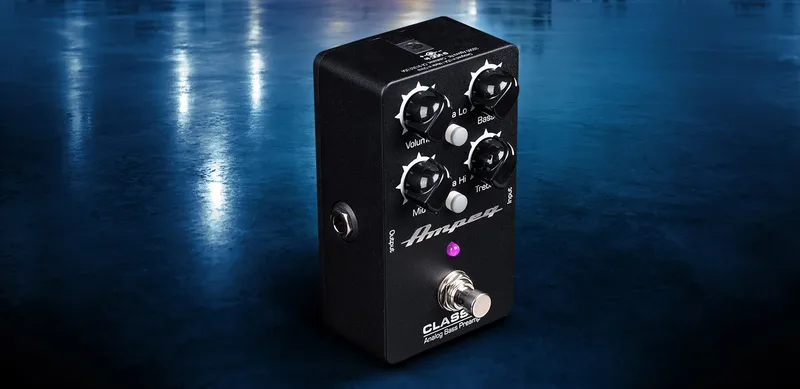
- January 2017: At NAMM, Ampeg announces the Classic analog bass preamp and the Scrambler Bass Overdrive as separate pedals, both derived from the SCR-DI and due in April39.
- 2017 reissue: Aion FX notes the 2017 version came "in a modernized enclosure and including a treble control and output volume, and marketed as a 'bass overdrive' with no mention of fuzz"5.
Guitar World's review is blunt about the lineage: the Scrambler name and circuit "dates back to the late '60s," but "the new design does not much resemble the original"2. Aion FX goes further, saying the modern reissues "have received mixed reviews and are not regarded to sound like either the old ones or the 2005 reissues, so it is likely that the resemblance is in name only"5. A player chasing vintage Scrambler fuzz tones should know up front that this is a different animal.
The Scrambler and the SCR-DI
The 2017 pedal is best understood as a spinoff of the SCR-DI. Premier Guitar describes how Ampeg "made the move to effectively cut the SCR-DI pedal in half by offering the more compact (and more affordable)" standalone pedals63. MusicRadar's NAMM coverage likewise describes both new pedals as "derived from its existing SCR-DI Bass DI"9.
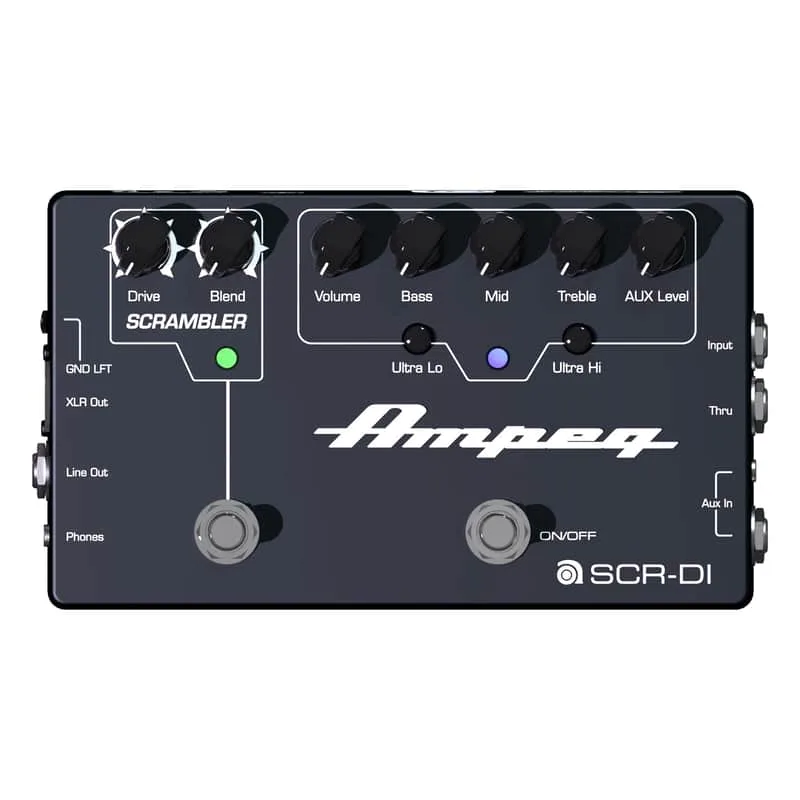
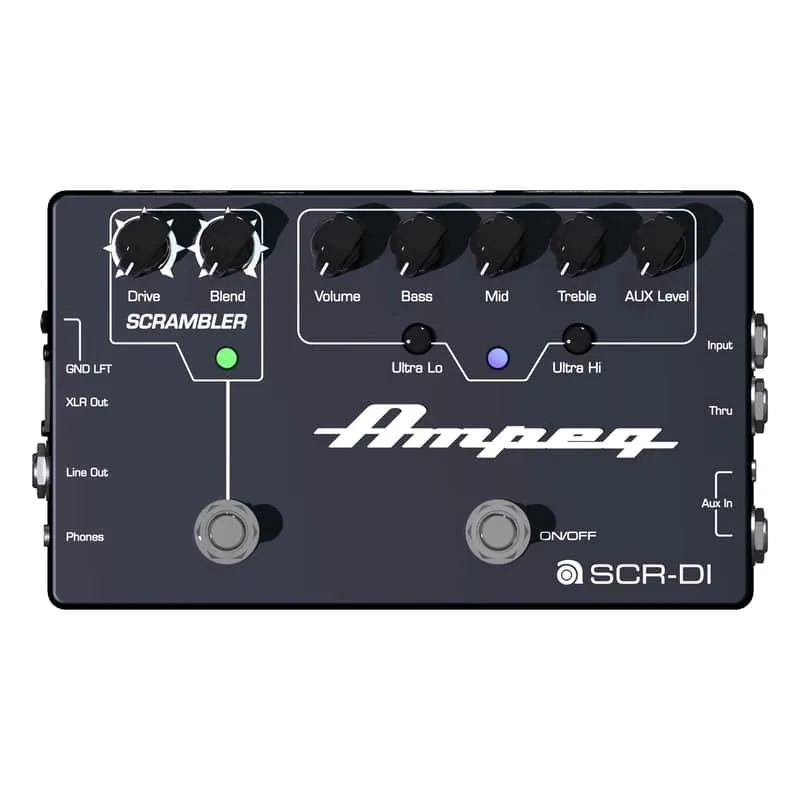
The SCR-DI itself, announced in January 2015, is a bigger machine: MusicRadar's press coverage called it "an all-use/any situation direct that combines an Ampeg preamp, EQ and an overdrive stomp box," with a 3-band EQ featuring Ampeg's Ultra-Hi and Ultra-Lo circuits, DI connection options for driving a bass rig and feeding front-of-house, plus a dedicated headphone out and aux in for playing along with backing tracks8. Its overdrive section was described at launch as "a completely new Bass Scrambler overdrive circuit, specifically tailored to deliver true SVT grit, grind and sag"8.
So the choice between them is straightforward: the SCR-DI is a full DI and preamp solution with practice-friendly extras, while the Scrambler Bass Overdrive is just the drive stage in a small bass pedal format for your board698.
What reviewers said
Published reviews of the Scrambler Bass Overdrive were largely positive, with one caveat about its vintage credentials245.
- Guitar World found "the new Scrambler has a unique and harmonically rich sound" and called it "a superb addition for the price" for players who like sound-mangling distortion pedals overall2.
- Performer Mag's reviewer Chris Devine was unreservedly positive in his verdict on the pedal4.
- Premier Guitar noted the pedal "spread like wildfire throughout the bass community" after release, and praised the build quality and the white lettering for dark stages6.
- Aion FX, writing about the Scrambler line's history, offers the counterpoint: the modern versions are "not regarded to sound like either the old ones or the 2005 reissues," so the vintage name should not be read as a vintage sound5.
"the new Scrambler has a unique and harmonically rich sound"
Taken together, the reviews describe a well-built, affordable bass overdrive with a genuinely useful blend control, whose only contested point is how much it owes to the 1969 original25.
Videos
Sweetwater
Ampeg
Ampeg
Questions
Is the Ampeg Scrambler true bypass?
Yes. Ampeg lists the Scrambler Bass Overdrive as all-analog circuitry with true bypass switching, so with the pedal off your signal passes through without processing. Reviewers have also confirmed true bypass switching on the unit.
Does the Ampeg Scrambler run on a battery?
Yes. It runs on 9 volts from either an AC adapter or a nine-volt battery, though the battery is not included with the pedal. If you plan to gig with it, factor in an adapter or a spare battery.
What is the difference between the Ampeg Scrambler and the SCR-DI?
The Scrambler Bass Overdrive is effectively the overdrive half of the SCR-DI, without that pedal's preamp and EQ sections. The SCR-DI also adds DI connection options, a headphone out and an aux in, while the Scrambler is a compact stompbox focused on overdrive alone.
Where is the Ampeg Scrambler made?
The Scrambler Bass Overdrive is made in China, according to Guitar World's review. It ships in a roadworthy all-metal chassis with a flat-black finish and white control lettering.
Can you use the Ampeg Scrambler on guitar?
It is voiced for bass. Because of its largely unfiltered bass content and clean blend control, Aion FX notes it is particularly good for bass guitar, which fits a company known primarily for bass equipment. Nothing stops you trying it on guitar, but it was not designed for that.
Sources (9)
- Ampeg | Pedal Series :: Preamps and Effects, Ampeg
- Ampeg Classic Analog Bass Preamp and Scrambler Bass Overdrive review, Guitar World, 2020-01-08
- Ampeg debuts two familiar-looking pedals, gearnews.com, 2017-01-23
- Ampeg Scrambler Bass Overdrive Pedal Review, Performer Mag, 2017-09-26
- Aperture Octave Fuzz / Ampeg® Scrambler, Aion FX, 2021-07-02
- Ampeg Scrambler Bass Overdrive Review, Premier Guitar, 2017-09-10
- Seminal, Vintage Pedals: Ampeg's Scrambler, Delicious Audio, 2016-09-28
- NAMM 2015: Ampeg releases the SCR-DI Bass DI with Scrambler Overdrive, MusicRadar, 2015-01-23
- NAMM 2017: Ampeg announce Classic pedal bass preamp, and Scrambler bass overdrive, MusicRadar, 2017-01-23