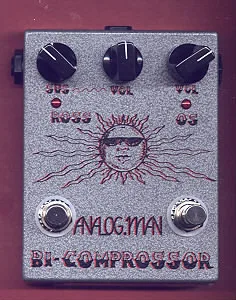


The Analog Man Mini BiComp is a dual compressor pedal: two complete effects in one enclosure, each with its own footswitch, LED and controls. The left side is the compROSSor, based on an improved version of the Ross compressor, and the right side is the Juicer, based on the Dan Armstrong Orange Squeezer1. Each side is independent and can be used separately or together; when both are on, the order is Juicer first1.
Analog Man's Mike Piera described the full-size version of the same idea in a 2019 guitar.com interview as "the Bi-Comp (CompROSSor and Dan Armstrong-inspired Juicer compressors in one box)"2. The Mini BiComp is the compact version of that concept, and it is the smaller sibling of the Analog Man Bi-Comprossor, with the Analog Man Comprossor and Analog Man Juicer also available as separate pedals.
Two compressors in one enclosure
The Mini BiComp puts two different compressor voices on one pedalboard footprint. The compROSSor side is built with NOS (new old stock) 2SC1849 Matsushita transistors, the same type used in the original Ross compressor and early script logo MXR DynaComps3. Analog Man uses higher quality capacitors than the original for improved sound, and the circuit board is double-sided with ground planes everywhere possible to minimize noise1.
The Juicer side uses New Old Stock 2N5437 transistors, 1N100 diodes (which the manual calls rare) and a JRC4558D chip, along with high quality Panasonic capacitors1.
The knobs, LEDs and footswitches
The control layout is simple on the surface, with the two sides sharing the front panel34:
| Control | Side | What it does |
|---|---|---|
| VOLume knob (left) | compROSSor | Sets the volume; can boost the signal somewhat to drive an amp further into distortion3 |
| SUStain knob (middle) | compROSSor | Sets the amount of sustain and compression; higher settings swell volume louder and compress the attack more3 |
| VOLume knob (right) | Juicer | Sets the Juicer volume; can also boost the signal to drive an amp3 |
| MIX knob or trim pot (optional) | compROSSor | All the way up is standard Ross compression; turn it down to add non-compressed sound, and 3:00 is a nice setting1 |
| ATTACK knob or trim pot (optional) | compROSSor | Standard setting half way up, identical to the vintage Ross pedal1 |
Two LEDs show the state of each side: yellow for the Juicer and red for the compROSSor1. Two 3PDT stomp switches handle bypass, the right switch for the Juicer and the left for the compROSSor1.
Starting in 2003, Analog Man used a correct taper reverse log pot for the sustain knob, so the position of the pot needed to get a given amount of sustain matches an original Ross or DynaComp3.
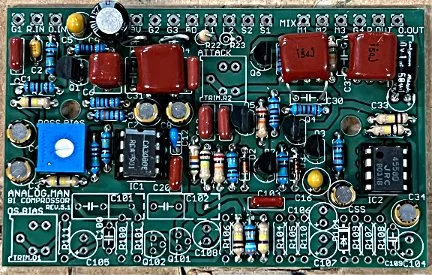
Internal trim pots
Inside the pedal there are trim pots for setup rather than everyday tweaking43:
- ATTACK trim pot: the standard setting is half way up, which is identical to the vintage Ross pedal. Counter-clockwise squashes the attack more (a faster attack time); clockwise gives more attack than the stock Ross pedal1.
- ROSS BIAS trim pot (labeled ROSS BIAS 2K): does not affect the sound except when set incorrectly; set it to the halfway point4.
- OS BIAS trim pot (Juicer side, bottom left of the board): set it by turning it up most of the way, hitting open strings, turning it counter-clockwise until the sound cuts out, then slowly back clockwise until the sound returns. The manual calls this "the only tricky adjustment"4.
The Ross and Orange Squeezer circuits
The two sides come from two of the most copied compressor designs of the 1970s142.
The compROSSor side is based on an improved version of the Ross compressor. Analog Man describes the Ross circuit as quite similar to an MXR DynaComp but improved to make the sustain more solid and less "wavering and seasick sounding"3. The compROSSor has more sustain and a cleaner sound than the Juicer1.
The Juicer side is based on the Dan Armstrong Orange Squeezer. Analog Man describes the original as legendary for its smooth compression and "squashing" tone, as used on many Steely Dan, Doobie Brothers, Dire Straits and other classic albums3. In the maker's words, the attack of each note is compressed and the decay is brought up somewhat like a tube amp's natural sag, adding a bit of grit for what the manual calls a nice soulful sound1.
"The original Orange Squeezer is legendary for its smooth compression and 'squashing' tone as used on many Steely Dan, Doobie Brothers, Dire Straits, and other classic albums"
Power: 9V, under 10mA
The Mini BiComp runs on a 9V alkaline internal battery or a 9V DC negative center adaptor through a Boss style power jack; AC power must not be used, and 12V to 15V DC adaptors also work1. The battery is disconnected when the input cord is removed, the standard arrangement for saving battery life1.
Current draw is low: under 10mA with both effects on and just under 4mA with both LEDs off, so a battery lasts over 40 hours with both effects running1. That draw is easy on most pedalboard power supplies.
The manual notes the Juicer side may be a bit noisy with some AC adaptors, and recommends a quality adaptor or battery4. The center of the power plug is negative on the normal Boss style adaptors1.
Videos
Reverb
Stéphane's Guitars & Covers
Coastal Tone
Questions
Is the Analog Man Mini BiComp true bypass?
Yes. Analog Man's manual states the Mini BiComp has true bypass on both effects, so each side is out of the signal path completely when switched off. Each effect has its own 3PDT stomp switch, the right one for the Juicer and the left one for the compROSSor.
Which side comes first when both effects are on?
The Juicer comes first. The manual states that each side is independent and can be used separately or together, and that the order of the pedals, if used together, is Juicer first, feeding into the compROSSor side.
What is the difference between the compROSSor and the Juicer?
The compROSSor is based on an improved Ross compressor circuit, similar to an MXR DynaComp but with more solid, less wavering sustain. The Juicer is based on the Dan Armstrong Orange Squeezer, with a smoother, squashing tone and a bit of grit. Analog Man says the compROSSor has more sustain and a cleaner sound than the Juicer.
Does the Mini BiComp have an attack control?
Not as a standard knob. The compROSSor side has an ATTACK trim pot, whose standard setting of half way up is identical to the vintage Ross pedal. Analog Man also offers optional mix and attack knobs, so a pedal can be ordered with them on the outside instead of as internal trim pots.
Sources (4)
- MiniBi-CompManual2020.pdf, Analog Man Guitar Effects, 2020-11
- "We don’t have our pedals on shelves ready to ship": Analog Man's Mike Piera on his customer-driven approach, guitar.com, 2019-08-13
- Analog Man Mini BiComp Manual, Analog Man Guitar Effects
- Analog Man Bi-CompROSSor Manual October-2001, analogman.com, 2005-02