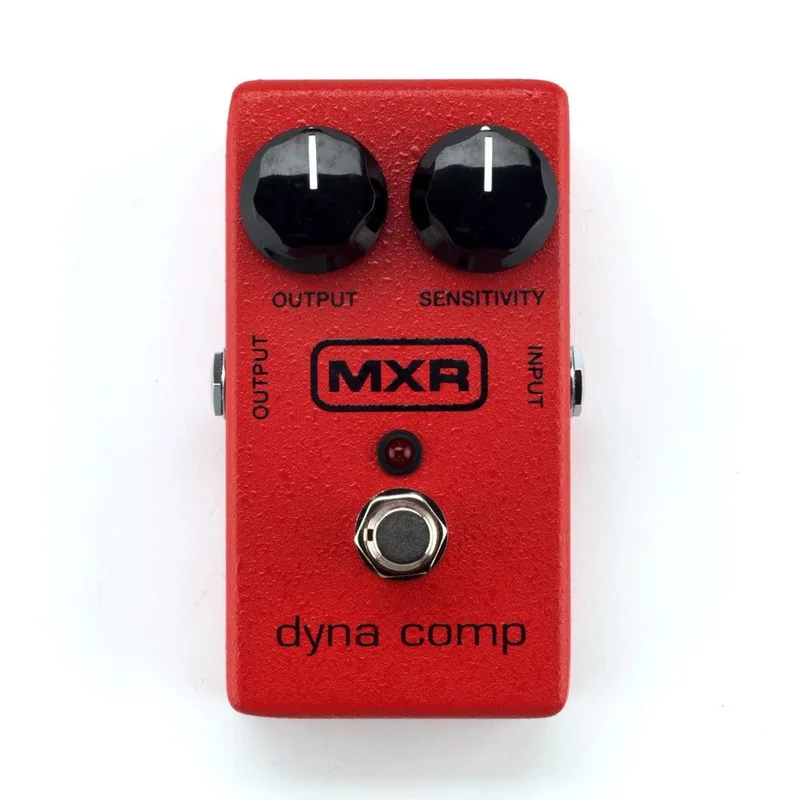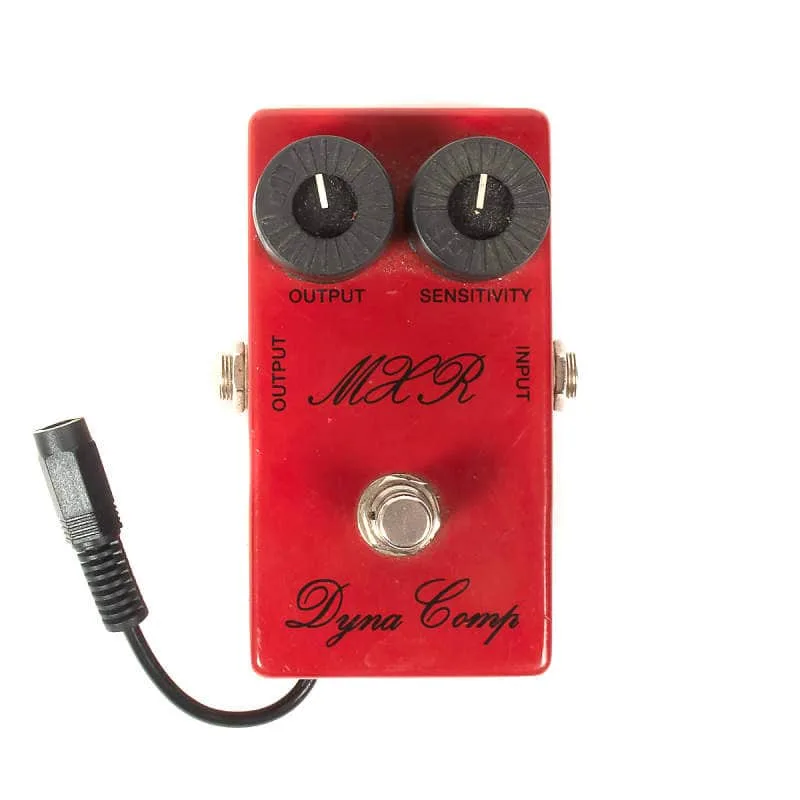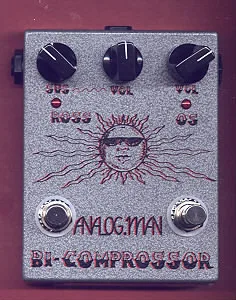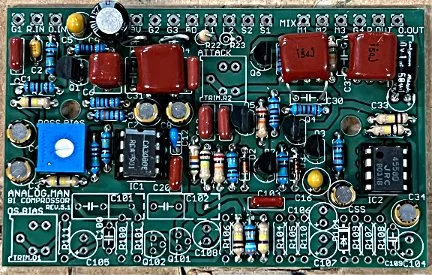


The Analog Man Comprossor (often written CompROSSor, a nod to the Ross compressor it descends from) is a compressor pedal made by Analog Man, hand-built in the USA on USA-made circuit boards1. Analog Man describes it plainly: "This product is based on an improved version of the Ross compressor"2. That puts it in a well-known family: the Ross compressor itself grew out of the MXR Dyna Comp circuit, so a player who knows the squishy, sustaining sound of those 1970s pedals knows the territory.
What the Comprossor does for your sound is what any compressor pedal does: it evens out the volume between your loud and quiet notes and raises sustain, so notes hold longer and single-note lines sit more evenly in a mix. The Comprossor keeps the character of the vintage Ross and Dyna Comp circuits but adds true bypass, an Attack control and a Mix control that the originals never had2.
An improved Ross compressor
The lineage runs in a straight line. The Ross compressor was based on the MXR Dyna Comp circuit, "making a few small updates to the Dyna Comp circuit in the process, mostly related to power filtering and noise reduction," in the words of Aion FX, whose independent analysis notes that the Ross "has better power supply filtering and thus lower noise, but is otherwise very similar to the Dyna Comp"3. The Dyna Comp's compression comes from a CA3080 chip, identified as U1 in a circuit analysis of that pedal4.
Analog Man's own manual puts the Comprossor's place in that line like this:
"It has better power supply filtering and thus lower noise, but is otherwise very similar to the Dyna Comp"3
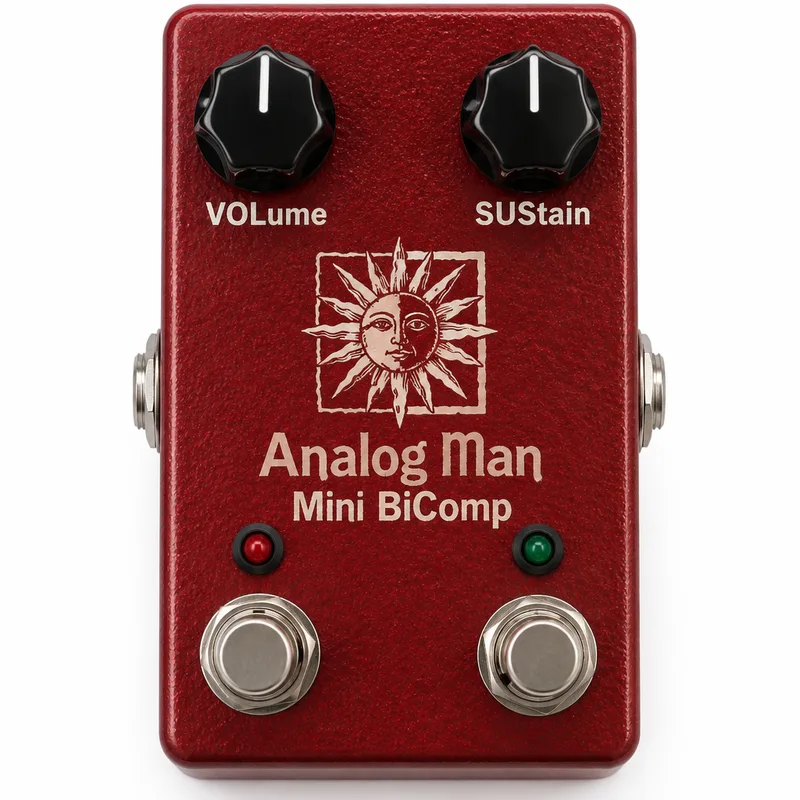
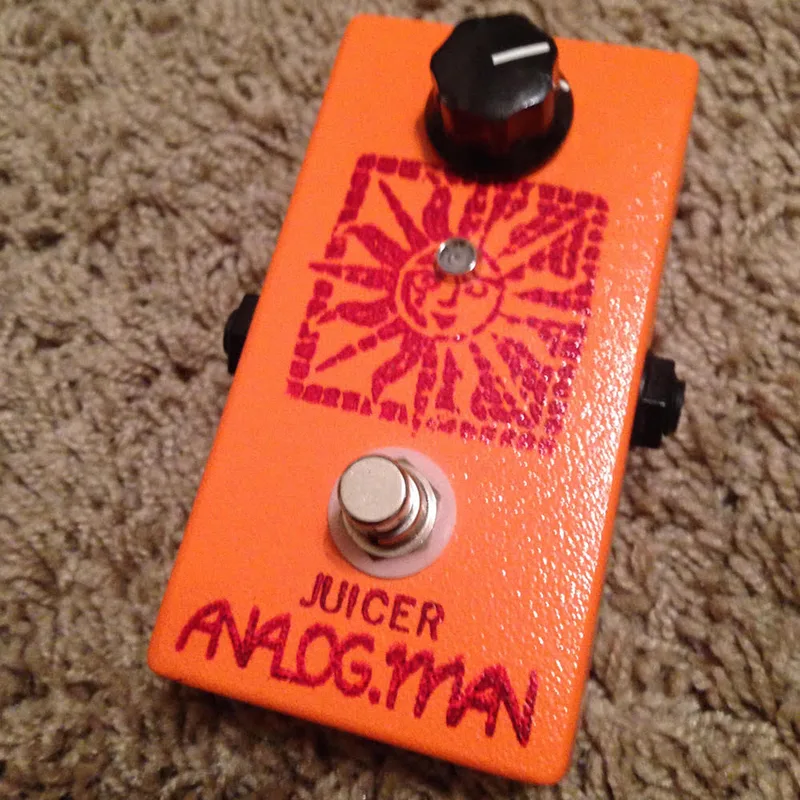
The same idea appears in the 2020 manual for the compROSSor side of the Mini BiComp: quite similar to a Dyna Comp but improved for a more solid, less wavering sustain, with more sustain and a cleaner sound than Analog Man's Juicer5. The chip is the same as the vintage units: "It uses NOS CA3080E compander chip as in Dynacomp and Ross"2. NOS means new old stock, original parts made long ago and never used, which matters because that chip is no longer in production.
On the build side, the pedal uses Re'an UK made high quality input and output jacks to isolate mechanical noise2.
Controls and how to set them
The two knobs on the face of the pedal work like the vintage originals, and the two extra controls are where the Comprossor goes beyond a Ross2.
| Control | What it does |
|---|---|
| SUSTAIN | Sets the amount of sustain and compression; higher settings swell volume more and compress the attack more25 |
| LEVEL | Sets the volume; can boost the signal somewhat to drive an amp further into distortion2 |
| ATTACK | Trim pot inside, or an optional external knob. The standard setting, identical to the vintage Ross and Dyna Comp pedals, is halfway up2 |
| MIX | Trim pot inside, or an optional external knob; all the way up is standard Ross compression, turn it down to add non-compressed sound25 |
| BIAS | Internal trim pot labeled 2K on the left central area of the board; does not affect the sound except when set incorrectly. Set it to the halfway point, basically horizontal2 |
The Mix control is the pedal's route to a subtler compression than a vintage Ross can manage. Analog Man's Mini BiComp manual explains it: "All the way up is standard Ross compression. Turn it down to add non-compressed sound, 3:00 is a nice setting"5. Blending uncompressed signal back in keeps more of your picking dynamics while the compressed side does the sustaining.
One behavior worth knowing before you gig with it, from Analog Man's own manual:
The manual's control notes cover the SUSTAIN knob: turning it up sets the amount of sustain and compression2.
The LEVEL knob sets the volume, and the manual notes it can be used to boost the signal somewhat to drive an amp further into distortion2.
Humbuckers and volume loss
The most common question players have with this circuit is covered directly in Analog Man's manuals, in the same words across editions675:
The ATTACK control is a trim pot inside, or an optional external ATTACK knob, on pedals built with it2.
The standard ATTACK setting is halfway up, which Analog Man says is identical to the setting of the vintage ROSS and DYNACOMP pedals2. The control itself is a trim pot inside, or an optional external ATTACK knob2.
Power, bypass and jacks
The Comprossor runs on a 9V alkaline battery or a 9V DC center negative adaptor through a Boss style jack2. The manual is emphatic about polarity: AC power will destroy the pedal, so only a DC center negative supply belongs in that jack2. The battery disconnects when the input cord is removed or the power plug is inserted, the same arrangement as a Boss pedal, so unplugging the input cord preserves battery life2.
Bypass is true bypass, switched by a 3PDT stomp switch with a status LED2. Current draw is modest: about 10mA when the effect is on and under 4mA when off2, so it is easy on a pedalboard power supply. The jacks are Re'an UK made high quality input and output jacks, chosen to isolate mechanical noise2.
Use only a 9V DC center negative adaptor. The manual warns that AC power will blow up the pedal2.
Versions and players
The Comprossor has been through revisions, including REV4 and REV51. The first batch was built in the smaller MXR distortion+ sized box before the pedal moved to its later enclosure1. Analog Man also makes the compROSSor circuit available in dual form: the Bi-Comprossor and the smaller Mini BiComp, which pairs it with a second compressor circuit5.
Analog Man's product page documents two players adopting the pedal. Mark Goldenberg, who plays lead guitar for Jackson Browne, got a Comprossor in 2009 and put it straight into his live rig1. Jon Carin got the REV5 Comprossor in early 2016 while touring with David Gilmour, and used it on stage at Madison Square Garden alongside his King of Tone pedal1.
Videos
vela75
analog mike
analog mike
Questions
Is the Analog Man Comprossor true bypass?
Yes. Analog Man's manual lists true bypass as the first feature, switched by a 3PDT stomp switch with a status LED. When the pedal is off it draws under 4mA, and about 10mA when on. Power comes from a 9V battery or a 9V DC center negative adaptor, Boss style.
What is the difference between the Comprossor and an MXR Dyna Comp?
The circuits are closely related. The Ross compressor that the Comprossor is based on was itself derived from the Dyna Comp, with updates mostly related to power filtering and noise reduction. Analog Man describes the Comprossor as quite similar to a Dyna Comp but improved so the sustain is more solid and less wavering, and the pedal adds true bypass, an Attack control and a Mix control.
What chip does the Comprossor use?
It uses an NOS CA3080E compander chip, the same chip as the vintage MXR Dyna Comp and Ross compressors. NOS means new old stock: original chips made years ago but never used, sourced because the part is no longer manufactured.
How do I stop the Comprossor losing volume with humbuckers?
Analog Man's manuals say to turn the ATTACK pot up. Humbuckers and other powerful pickups can get squashed and lose volume with the standard attack setting; raising the attack gives less squashing of the strong humbucker sound, and the manual says the pedal then works great with almost any guitar.
Sources (7)
- Analog Man Compressor Pedal Page, Analog Man (www.analogman.com), 2022
- ComprossorManual2020.pdf, Analog Man, 2020-11
- Aurora Compressor / Sustainer, Aion FX, 2018-06-30
- MXR Dyna Comp Analysis, GuitarPCB
- MiniBi-CompManual2020.pdf, Analog Man Guitar Effects, 2020-11
- Analog Man Bi-CompROSSor Manual October-2001, Analog Man
- Analog Man Bi-CompROSSor Manual October-2001/compross-small.pdf), Analog Man guitar effects