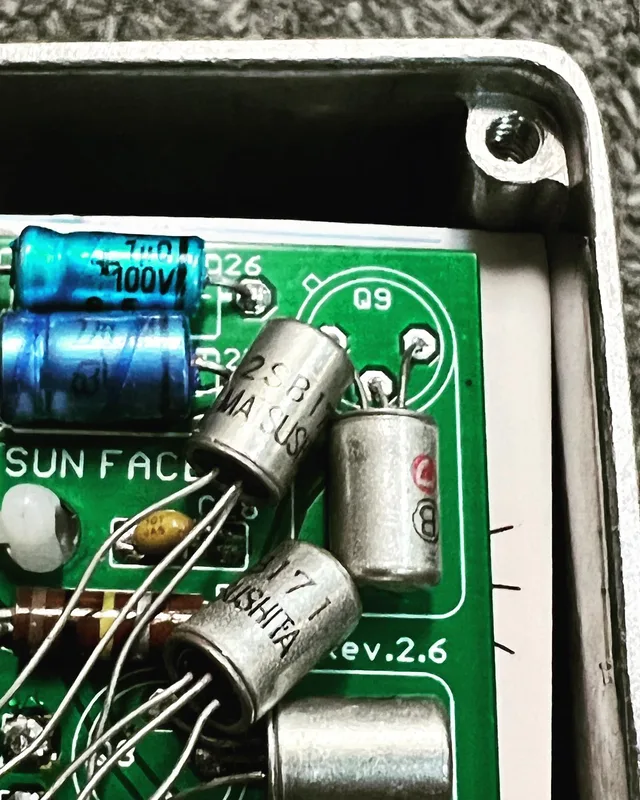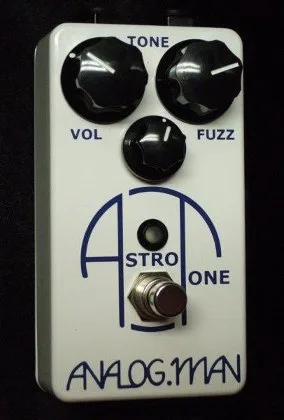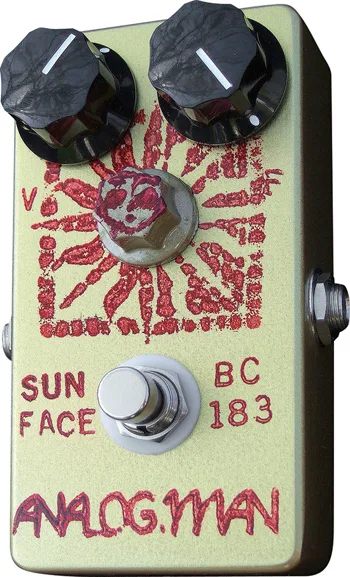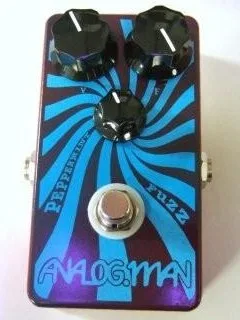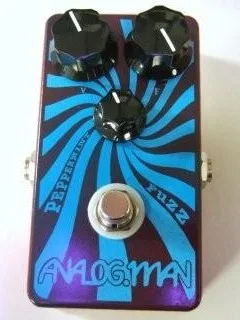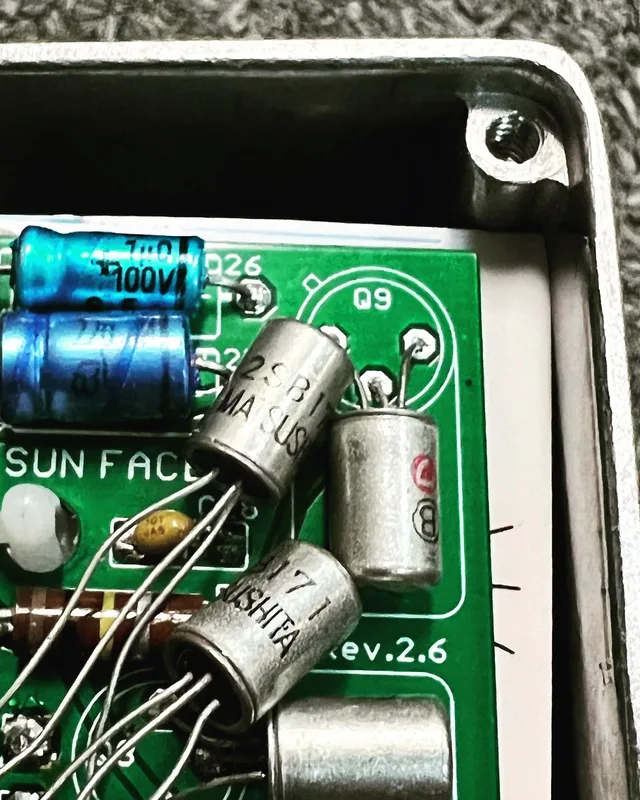


The Analog Man Silicon Sun Face is a fuzz pedal built on the 1969 and later silicon Fuzz Face circuit, with what Analog Man describes as "a few tweaks to make it easier to use and sound better"1. It uses BC108 silicon transistors2 and keeps the two-knob Fuzz Face layout, adding an internal Clean Trimmer knob and a bias control so a player can shape the fuzz beyond what the original offered.
Analog Man built the Sun Face line after years of modifying other people's Fuzz Faces. The company modified Dunlop reissues and Arbiter UK reissues to early germanium specs, changing transistors, resistors and capacitors as needed, and started selling its own Sun Face pedal on that work2. The silicon version follows the later Fuzz Face circuit instead. Premier Guitar has called the Sun Face an iconic fuzz, naming Analog Man among the "legends" of the Fuzz Face world3.
Controls and how to use them
The Silicon Sun Face keeps the Fuzz Face's two external knobs and adds internal controls. Analog Man's manual walks through each one1.
| Control | What it does |
|---|---|
| Fuzz knob | Analog Man's normal setting is high; the guitar's volume knob or the Clean Trimmer controls the fuzz amount. Turning it down a bit reduces noise. |
| Volume knob | Sets the output level. |
| Clean Trimmer knob | The white knob on the circuit board, turnable with your fingers. Works like your guitar's volume control, interactively cleaning up the fuzz. |
| BIAS trim pot / SUNDIAL knob | Sets the bias of the fuzz. On pedals with the SUNDIAL, the trim pot sets the voltage range of the sundial. |
The Clean Trimmer is the main tweak over an original Fuzz Face. Analog Man's normal setting is full down, counterclockwise, for full fuzz availability. When the knob is turned all the way counterclockwise it is completely out of the circuit, as if it were not even there, and the circuit is then identical to an original 1969 and later Fuzz Face1.
The bias control sets the operating point of the fuzz. Analog Man puts the sweet spot at about 5 volts on the high transistor at about 70 degrees temperature, and advises not setting it much over 6 or 7 volts2. At 4.5 to 5 volts the pedal is the same circuit as the original silicon Fuzz Faces1. Turning the bias down produces a stuttering, weak fuzz sound, which Analog Man notes can sometimes be useful1.
To check the bias with a voltmeter, the manual gives this procedure1:
- Plug a cable into the input jack to operate the pedal.
- Put the voltmeter's negative lead to ground; one of the screw holes on the case will work.
- Put the positive lead to the high transistor leg closest to the bias trimpot.
Power and connections
The Silicon Sun Face runs on an internal battery, and the battery is disconnected when the input cord is removed, with the input on the right of the pedal1. A power jack and LED are optional on the current version1. Analog Man's earlier manual shipped the pedal with no power jack or LED at all, on the grounds that "these can be detrimental to the ultimate fuzz face"5.
Analog Man recommends non-alkaline batteries in this pedal, saying they sound better than an alkaline1.
Because the pedal has a negative ground, it can share power with normal pedals, unlike positive-ground germanium Fuzz Face builds. Analog Man still recommends isolated power. When a power jack is fitted, it is a standard polarity jack, center negative1.
Where it goes in your signal chain
Analog Man is explicit that the Sun Face should not have any non-true-bypass effects in front of it. Otherwise, the cleanup function will not work well and the tone will be bright and harsh1. This is the same behavior players expect from Fuzz Face circuits: the fuzz responds to the guitar's volume control, and a buffer ahead of the pedal breaks that interaction. The Sun Face belongs first in the chain, with the guitar's volume knob or the Clean Trimmer used to clean up the fuzz.
The true bypass on/off switch means no loss of tone when the pedal is off, the same as the original Fuzz Face1.
Circuit lineage and versions
The Silicon Sun Face is one of several Sun Face variants. Analog Man also offers the Analog Man Sun Face in germanium form, and the company modified Fuzz Faces to early germanium specs for a long time before selling the Sun Face at all2. The silicon version uses BC108 transistors, which Analog Man began offering after making a number of silicon Sun Faces with them2.
The circuit board is Analog Man's own USA-made board, made small enough to fit in almost any enclosure, with shielding and plated through-holes to meet military specs4. The tagboardeffects blog, which published a layout of the Sun Face circuit, quoted Analog Man's description of the board when it reproduced the circuit for builders4.
The practical difference between the silicon and germanium versions is temperature behavior. The bias adjustment allows the silicon pedal to work well at any temperature, and because silicon is not affected by heat like germanium, Analog Man says the setting never really needs to be changed5. A germanium Fuzz Face's bias drifts with temperature, which is why those pedals often carry an external bias knob; the silicon circuit holds its setting.
Videos
G-System Videos
Clark
Questions
Is the Analog Man Silicon Sun Face true bypass?
Yes. The Silicon Sun Face uses a true bypass on/off switch, which Analog Man says gives no loss of tone when the pedal is off, the same as the original Fuzz Face. Analog Man also warns that non-true-bypass effects placed before it will stop the cleanup function working well and will make the tone bright and harsh.
What transistors does the Silicon Sun Face use?
The Silicon Sun Face uses BC108 silicon transistors. Analog Man notes that because silicon is not affected by heat the way germanium is, the bias adjustment lets the pedal work well at any temperature, so the setting rarely needs to be changed once it is set.
What does the Clean Trimmer knob do?
The Clean Trimmer is the white knob on the circuit board, turnable with your fingers. It works like your guitar's volume control, interactively cleaning up the fuzz. Turned fully counterclockwise it is completely out of the circuit, and the pedal is then identical to an original 1969 and later silicon Fuzz Face.
Does the Sun Face have a power jack?
The power jack and LED are optional. Analog Man's earlier manual left them out entirely, saying they can be detrimental to the ultimate fuzz face, while the current manual offers them as options. Without a jack, the pedal runs on its internal battery, which disconnects when the input cord is removed.
Can I run a Sun Face on the same power supply as other pedals?
The Silicon Sun Face has a negative ground, so unlike positive-ground germanium Fuzz Face builds it can share power with normal pedals. Analog Man still recommends isolated power. The jack, when fitted, is standard polarity, center negative.
Why shouldn't other pedals come before a Sun Face?
Analog Man says the pedal should not have any non-true-bypass effects in front of it. A buffered or non-true-bypass pedal ahead of the Sun Face prevents the fuzz from cleaning up properly with your guitar's volume knob and makes the tone bright and harsh. It belongs first in the chain.
What is the difference between the Silicon and Germanium Sun Face?
The Silicon Sun Face uses BC108 silicon transistors on the 1969 and later Fuzz Face circuit, while the Germanium Sun Face follows the earlier germanium specs. Silicon is not affected by heat like germanium, so the bias adjustment lets the silicon version work well at any temperature without needing to be reset.
Sources (5)
- SFManual-Silicon, Analog Man, 2026-08
- Microsoft Word, Analog Man, 2015
- State of the Stomp: Journey to the Center of the Fuzz Face, Premier Guitar, 2023-09-27
- Guitar FX Layouts: Analogman Sunface NKT275, tagboardeffects.blogspot.com (Guitar FX Layouts), 2013-03-01
- SFManual-Silicon, Analog Man, 2021-07