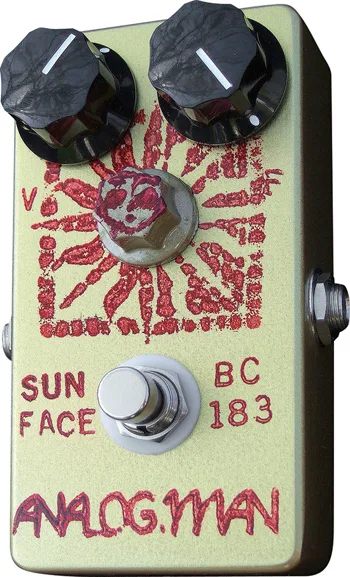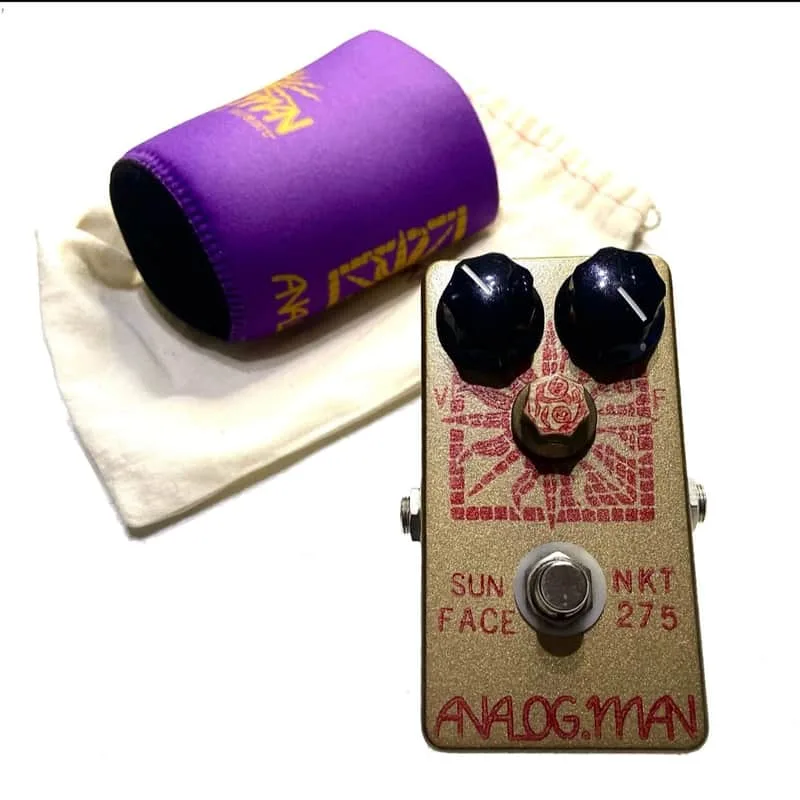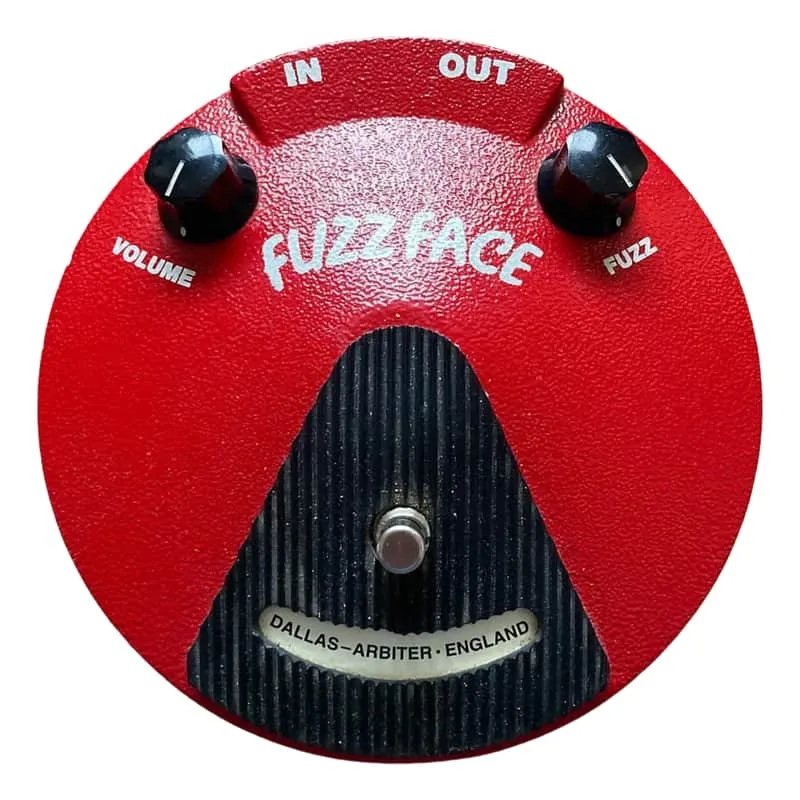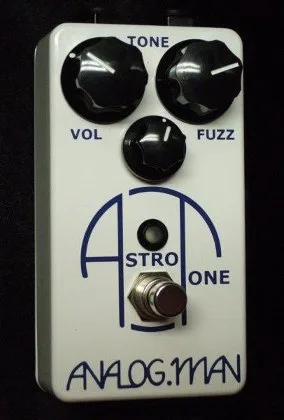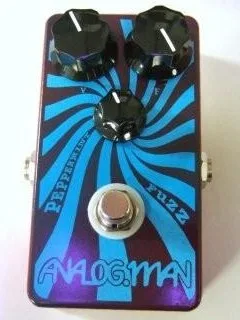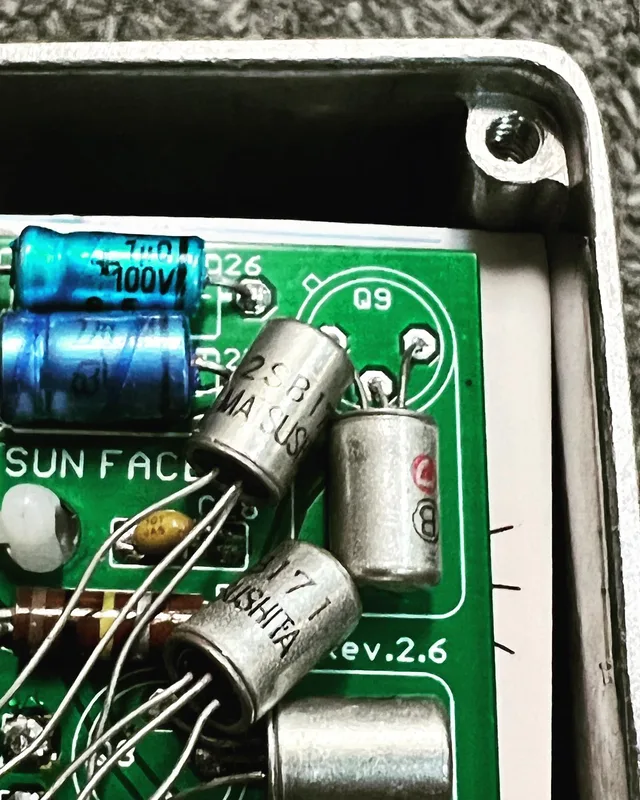


The Analog Man Sun Face is a hand-built fuzz pedal based on the Dallas Arbiter Fuzz Face circuit, made in the USA in small gold boxes and built to order. Analog Man describes it as the standard 1960s germanium circuit, or the 1969-and-later silicon circuit, each with a few tweaks to make it easier to use and sound better12. The company had been modifying Fuzz Faces to early germanium specs for a long time before it started selling the Sun Face as its own pedal3.
Analog Man describes the sound as nice and smooth, a singing bluesy tone rather than harsh noisy fuzz, and says the germanium versions are very sensitive to guitar volume: with a Strat, volume around 7 gives very little distortion, around 9 a smooth bluesy tone, and at 10 quite a lot of fuzz1.
The controls and internal trimmers
The two standard knobs are Volume and Fuzz, on the left of the face. Inside, there is a CLEAN trimmer, a white knob on the circuit board that can be turned with your fingers. Its normal setting is full counterclockwise for full fuzz availability. It works the same way as the volume control on your guitar, cleaning up the fuzz interactively, and turned all the way down it is completely out of the circuit, identical to an original 1969-and-later silicon Fuzz Face2. Analog Man adds that this trim pot can also kill radio frequency interference and helps the pedal work after a vintage-style wah pedal1.
| Control | What it does |
|---|---|
| Volume | Output volume2 |
| Fuzz | Gain, from cleanup to full saturation1 |
| CLEAN trimmer (internal) | Acts like turning down the guitar volume to clean up the fuzz; full CCW is completely out of the circuit2 |
| BIAS trim pot (internal) | Keeps the fuzz happy at different temperatures and with different or worn batteries1 |
| SUN DIAL (3-knob model) | Same function and circuit as the internal BIAS trim pot, brought to the outside; a $25 option1 |
| ON/OFF FUZZ POT (option) | Turning the fuzz knob all the way down clicks and disconnects the battery; a $15 option on the side-jacks model1 |
The SUN DIAL is the third knob on the 3-knob model, and the third knob on that model is the same as the standard internal input CLEAN trimmer1. On the silicon version, the BIAS adjustment allows the pedal to work well at any temperature, but since silicon is not affected by heat like germanium, Analog Man says there is normally no need to change it2.
Power: germanium and silicon versions differ
This is the biggest practical difference between the versions, and it matters to anyone with a pedalboard power supply162.
- Silicon versions: negative ground, standard polarity power jack, center negative. You can share power with normal pedals, though Analog Man recommends isolated power. Almost any power supply can be used without fear of melting it down12.
- Germanium versions: reverse polarity, positive ground. You cannot share power with normal pedals; isolated power is required. The power jack itself is normal polarity for ease of use16.
A germanium Sun Face must not share a non-isolated power source with a normal polarity pedal. This is inherited from the original Fuzz Face design: Jack Orman's technical analysis at AMZ notes the original circuit's polarity makes it incompatible with the usual pedalboard supply that has a negative ground and a positive supply voltage47.
The battery is disconnected when the input cord is removed, and the input is on the right2. The power jack and LED are optional; Analog Man notes an LED does not affect tone but drains the battery about four times faster, and that the green LED is very efficient and wired to use very little power1. Older manuals went further, shipping with no power jack or LED at all, on the grounds that these can be detrimental to the ultimate fuzz face386. On non-alkaline batteries, Analog Man says they sound better than an alkaline in this pedal2.
Transistor choices and versions
The Sun Face is made to order with a wide choice of transistors, and the transistor is effectively the version. In a guitar.com interview, Mike Piera of Analog Man said the Sun Face fuzz can be ordered in 2,800 different combinations, with over 20 transistor choices9. Delicious Audio describes it as hand made to order with a bevy of NOS transistor options, from germanium BARTs (Big Ass Russian Transistors) to the classic BC108 silicon10.
- NKT-275: offered starting July 2002, using New Old Stock British Newmarket 1960s NKT-275 transistors, with an additional internal BIAS trim pot1. A high-gain NKT275 set was offered as a +$75 option11.
- BC108 and BC183: old 1970 silicon types, which Analog Man calls the best of the old silicon era, as used in Eric Johnson's old red Fuzz Faces1.
- RCA germanium: introduced in 2018, also offered as a hybrid set with an NKT red dot or BART1.
- PATGOD: a version using transistors pulled from Farfisa organs, offered in 20021.
Vintage Guitar's review of the BC183 Sun Face describes it as a hand-built fuzz pedal offered with an a la carte selection of transistors, from white-dot high-gain NKT-275s to red-dot NKT-275s, BC108s, BC109s, and other germanium and silicon options12. On the NKT275 Sunface, the germanium circuit uses a 470R resistor where the silicon version uses 330R11. Analog Mike has said the BC183 transistors he got in 2011 are his favorite for a silicon fuzz face, a little warmer than the BC108 with plenty of fuzz13.
The enclosure has changed over the years: a 125B box measuring 2.5" wide, 4.75" tall and about 1.5" high was used until mid 2007, after which Analog Man moved to an MXR-sized B box, 2.25" wide, 4.25" tall and about 1.25" high. The larger box is still used for the large BART transistors, and top jacks without the on/off option became available in the smaller box starting in 20181.
Fuzz Face mods by Analog Man
Alongside the Sun Face itself, Analog Man modifies existing Fuzz Faces, either Dunlop reissues or Arbiter UK reissues1. JHS Pedals' history article credits the company as a genius at faithfully and accurately recreating Fuzz Face circuits from the '60s and '70s14.
- Classic germanium mod, changing all transistors, resistors and caps if needed: $60 plus shipping and handling (2000)1
- Installing a Sun Face board in a new Dunlop pedal, using the customer's switch, pots and case: $100 basic price (2002)1
- Arbiter England gray reissues, modified: $215 (2001)1
- Jimi Hendrix JH2 mods: the power jack is disconnected because it has the wrong polarity for a germanium fuzz (2002)1
A custom 4-knob Sun Face was made for Guns n' Roses, with Volume, Fuzz, a C knob for Clean, and a TONE knob with a mini-toggle: up for guitar-style tone, down for a tone circuit after the fuzz, middle for tone bypass1.
Where it goes in your chain, and what reviewers said
Analog Man's germanium manual is direct about placement: no non-true-bypass effects should go in front of it, otherwise the cleanup function will not work well and the tone will be bright and harsh6. Pedal of the Day's reviewer agreed from experience, finding the Sun Face plays best at the top of the chain because the circuitry is affected dynamically by the signal it receives15.
That reviewer's BC183-based pedal stayed warm and creamy through most of the fuzz spectrum, becoming fully saturated and buzzy when dimed, where it gave a rich, familiar and satisfying lead tone with notes that sustain infinitely. For rhythm it was fat and full, and rolling the volume down kept chords broken up but audible. The reviewer was so pleased they were tempted to try other transistor flavors15.
Vintage Guitar tested the BC183 Sun Face at $185 (2013), describing it as brighter, fuzzier and more stable than its germanium counterpart, with a tad more gain, and as a top-of-the-line pedal with true bypass, solid construction and artsy graphics12. Premier Guitar's reviewer called it simply:
"The Sun Face is a top-quality build from a top-quality builder."
Analog Man describes the Sun Face as the standard 1960s germanium Fuzz Face circuit with a few tweaks to make it easier to use and sound better452. Because the circuitry is affected dynamically by the signal it receives, the pedal plays best with other effects when it sits at the top of the chain, and Analog Man advises against putting any non-true bypass effects in front of it, as the cleanup function will not work well and the tone will be bright and harsh6.
Videos
Reverb
gearmanndude
Michael W. Westbrook
Questions
Is the Analog Man Sun Face true bypass?
Yes. Analog Man's manuals describe a true bypass on/off switch with no loss of tone when the pedal is off, the same as the original Fuzz Face. Vintage Guitar's review of the BC183 version also notes true bypass among its features.
Can I power a germanium Sun Face from my pedalboard supply?
Not from a shared, non-isolated output. Germanium versions are reverse polarity, positive ground, so Analog Man states they cannot share a non-isolated power source with a normal polarity pedal. Isolated power is required. The silicon versions are negative ground and can share power, though isolated power is still recommended.
Does the Sun Face have an LED?
The power jack and LED are optional. Analog Man notes an LED does not affect tone but drains the battery about four times faster, and that the green LED option is very efficient. Older manuals advised against both, saying they can be detrimental to the ultimate fuzz face.
Where should a Sun Face go in my signal chain?
First in the chain, straight after the guitar. Analog Man's germanium manual says no non-true-bypass effects should go in front of it, or the volume-knob cleanup will not work well and the tone will be bright and harsh. Pedal of the Day's reviewer found it plays best at the top of the chain because the circuit responds dynamically to the signal it receives.
How long does Analog Man take to build a Sun Face?
Each pedal is hand tweaked and built to order, so Analog Man says they usually take a week or so to build. The Sun Face can be ordered in 2,800 different combinations with over 20 transistor choices, according to Mike Piera in a guitar.com interview.
Is there a Sun Face option for bass?
Yes. Analog Man says bass players can order a Sun Face or Fuzz Face mod with more low end, and recommends a silicon version such as the BC183 for bass. Guy Pratt used a BC108 silicon Sun Face on bass on the 2006 On An Island tour.
Sources (16)
- Analog Man Sun Face and Fuzz Face Page, Analog Man (www.analogman.com), 2026
- SFManual-Silicon, Analog Man, 2026-08
- Microsoft Word, Analog Man, 2015
- SFNPNManual-Germ, analogman.com, 2026-08
- SFManual-Silicon, Analog Man, 2021-07
- SFManual-Germ, Analog Man, 2021-07
- Positive Power for the PNP Fuzzface, AMZ Guitar Effects Blog (muzique.com), 2002-03
- Microsoft Word/sunface.pdf), Analog Man, 2015
- "We don’t have our pedals on shelves ready to ship": Analog Man's Mike Piera on his customer-driven approach, guitar.com, 2019-08-13
- The 3 Best Fuzz Pedals Per Type, In 2023, Delicious Audio, 2022-09-15
- Guitar FX Layouts: Analogman Sunface NKT275, tagboardeffects.blogspot.com (Guitar FX Layouts), 2013-03-01
- Analog Man BC183 Sun Face, Vintage Guitar magazine, 2014-04-15
- Guitar FX Layouts: Analogman Sunface BC108, Guitar FX Layouts (tagboardeffects.blogspot.com), 2013-03-01
- ANALOG MAN'S BEST PEDALS, JHS Pedals
- Analogman Sun Face Fuzz, Pedal of the Day, 2014-06-07
- Modern Fuzz Pedals That Make Old-School Sounds, Premier Guitar, 2025-05-01