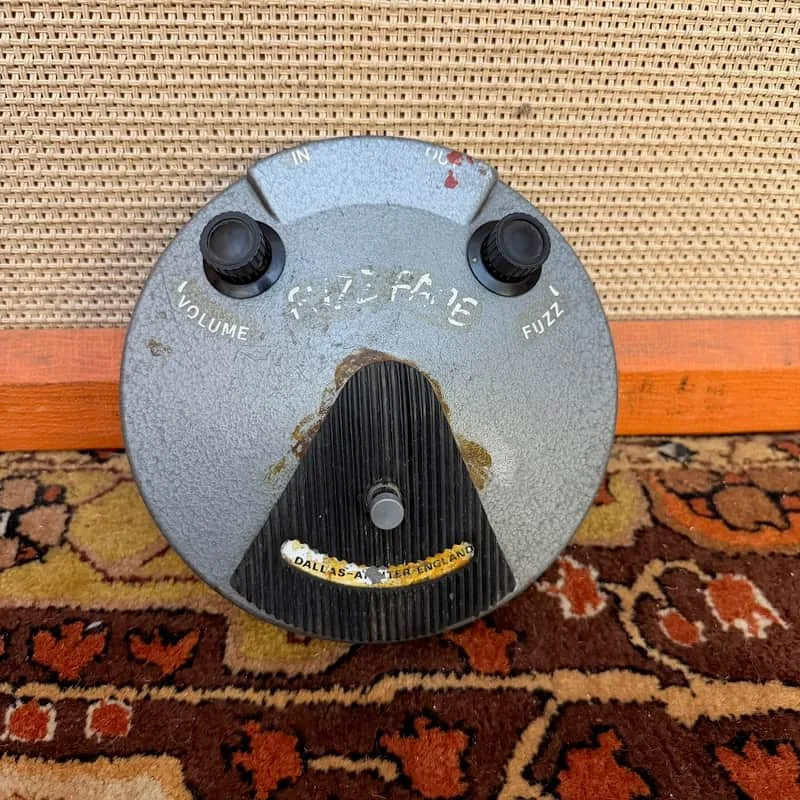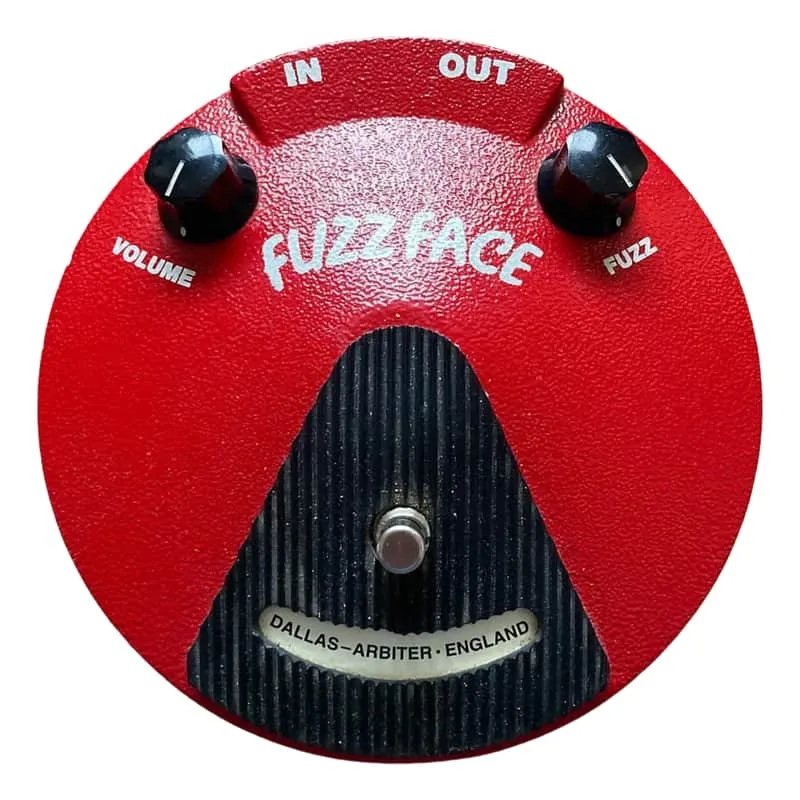


The Arbiter Fuzz Face Reissue is a fuzz pedal that re-creates the mid-'60s Fuzz Pedals original: a fuzz/distortion unit built with germanium PNP transistors from the same vendors' batch used to supply the originals, hand wired in England, in a die-cast casing molded from an original Arbiter case and hammer-finished in silver-gray. Vintage Guitar's reviewer, writing in the January 1997 issue, called it "the closest-sounding/looking pedal to the real deal."1
Background
The Fuzz Face name changed hands several times after the original Dallas Arbiter era. Analog Man's history of the pedal notes that even the unit many players took for an original could be a later build: "It turns out the FF that I was checking out was a reissue from 1976," Dave Fox wrote of a blue example, nearly two inches tall, marked Dallas Music Industries.2 The reissue covered here is the Arbiter-built version reviewed by Vintage Guitar in 1997, and Analog Man's fuzz pages list it among the Dunlop and Dallas Arbiter Fuzz Face reissues that followed the original circuit.1
Re-creating the pedal meant including Dennis Cornell, one of the original engineers, in the project.1
How it sounds
Vintage Guitar's reviewer describes the reissue's behavior across the knob's travel:
- At low settings: sweet, smooth overdrive-flavored sustain and distortion, closer to what you would expect from Overdrive Pedals than from full fuzz1
- At mid settings: a Hendrixy thick fuzz and distortion that re-creates the psychedelic guitar sounds of the '60s1
- At high gain and output settings: fuzzy tones that crackle and feedback, but controllable by rolling back the guitar's volume1
Across the range, the reviewer found "the Arbiter-design unit produces very rich, warm harmonic overtones and endless sustain."1
How it differs from the original
The reissue aims at the original in parts and construction: germanium PNP transistors from the same vendors' batch, and a case molded from an original Arbiter enclosure. The visible difference is on the top panel: the knobs look vintage but are numbered, unlike the originals.1
Videos
Gilberto Ávila
average.punter
Questions
Does the Arbiter Fuzz Face Reissue use germanium transistors?
Yes. Vintage Guitar's review reports that the reissue is built with germanium PNP transistors drawn from the same vendors' batch used to supply the originals, which is central to how closely it tracks the mid-'60s pedal. Germanium fuzz behaves differently from modern silicon designs, cleaning up with the guitar's volume knob and leaning toward warm, softer-edged tones.
Where is the Arbiter Fuzz Face Reissue made?
Each pedal is hand wired in England, according to Tom Lanik as quoted in Vintage Guitar's review of the reissue. The die-cast casing is molded from an original Arbiter case and finished in silver-grey hammer tone, so the pedal matches the original in construction as well as circuitry.
How much does the Arbiter Fuzz Face Reissue cost?
Vintage Guitar's January 1997 review lists the price at $185. That figure dates from the review period, so current street pricing may differ.
How is the reissue different from the original Arbiter Fuzz Face?
The circuit and parts aim at the original: germanium PNP transistors from the same vendors' batch, and a die-cast case molded from an original Arbiter enclosure. The visible difference is the knobs, which look vintage but are numbered, unlike the originals. One of the original engineers, Dennis Cornell, was included in re-creating the pedal.
Sources (2)
- Arbiter Fuzz Face Reissue, Vintage Guitar magazine, 2002-03-26
- Analog Man Fuzz Face Story, analogman.com, 2015