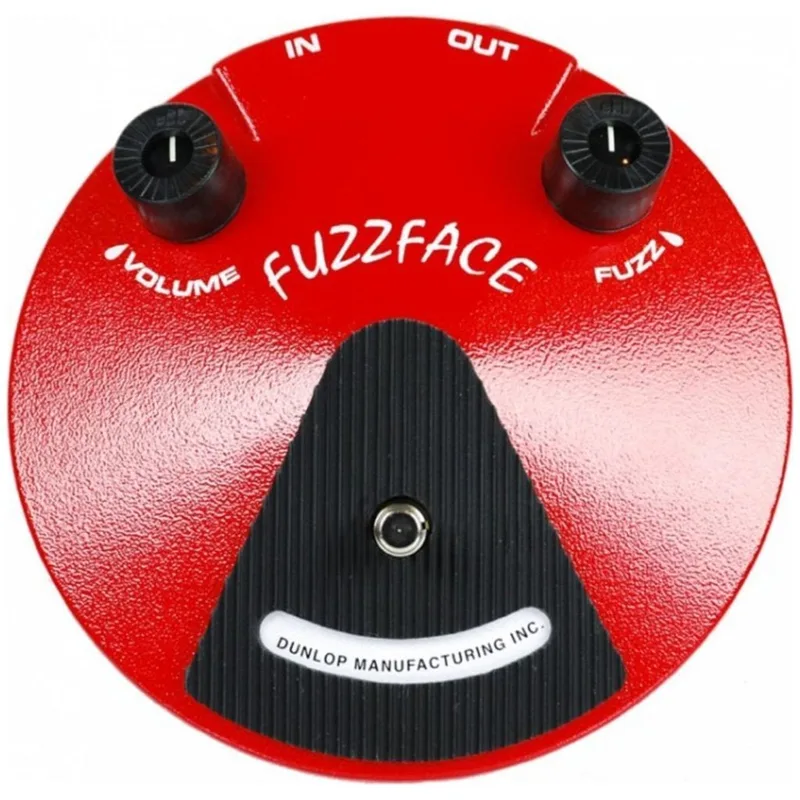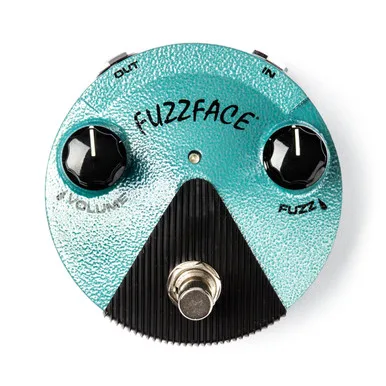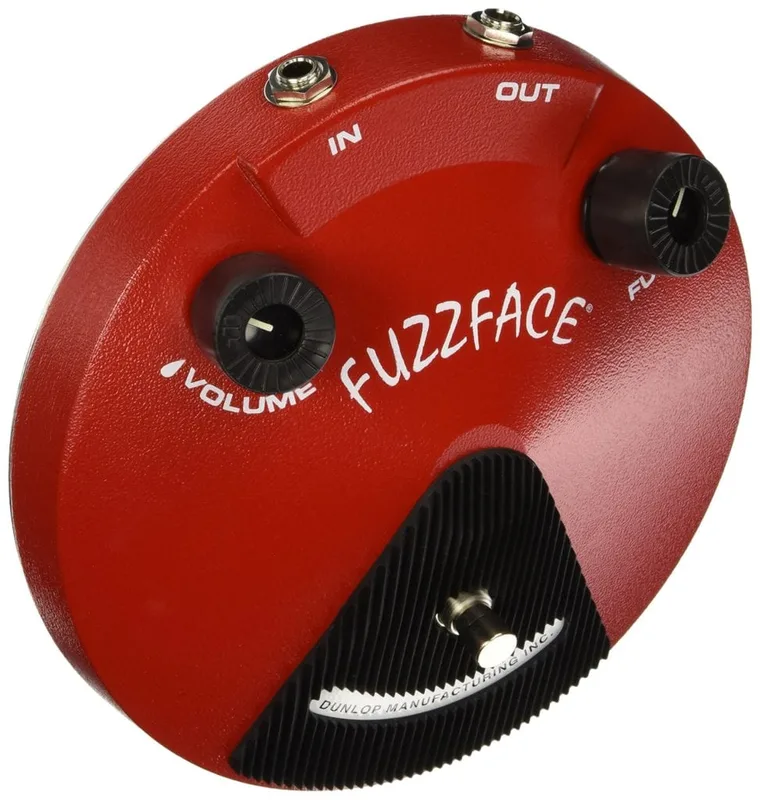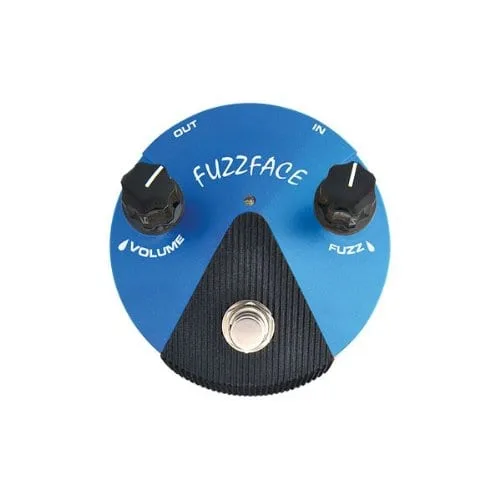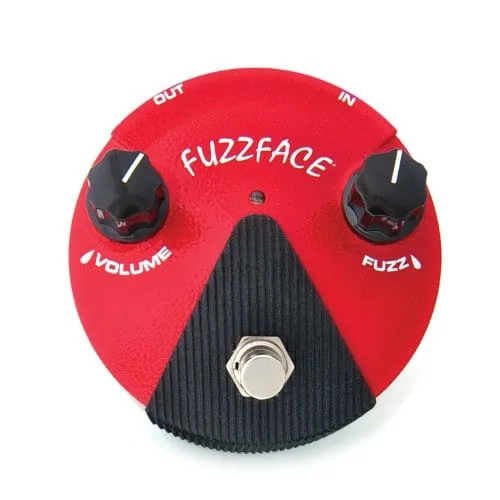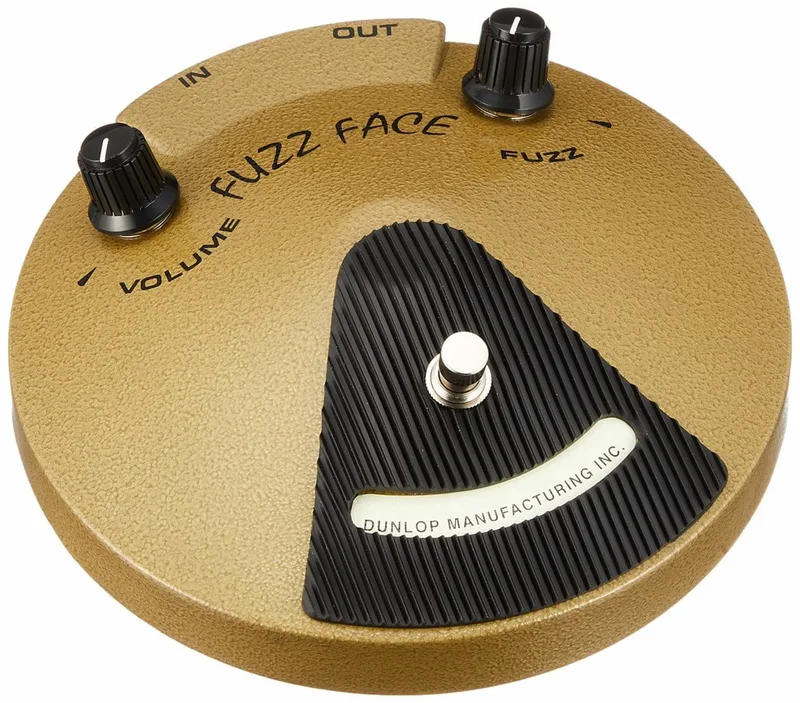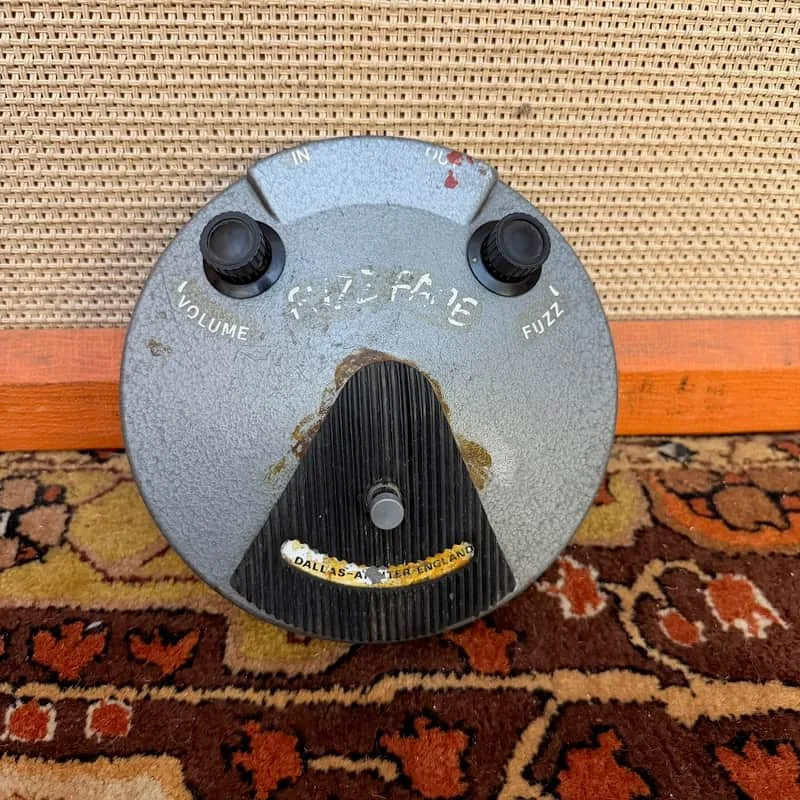


The Dallas-Arbiter Fuzz Face is a guitar fuzz pedal first made available in 1966, one of the first fuzz pedals of the mid to late 1960s123. It is an extremely simple circuit: two transistors, four resistors, three capacitors, and two potentiometers1. Despite that simplicity, it became one of the most copied fuzz designs ever built, popularized by Jimi Hendrix and scores of other 60s guitarists4, and it is still produced today by Dunlop in many versions5.
What sets the Fuzz Face apart for players is its touch sensitivity. William E. Overton's technical analysis for the Georgia Institute of Technology describes it as a quality "based on how hard the transistor is driven," and calls it "an important musical quality of the Fuzz Face"1. Back off your guitar's volume and the fuzz cleans up; dig in and it saturates. The circuit also clips asymmetrically, soft on one polarity and earlier on the opposite polarity when biased correctly, which contributes to its musical character1.
The controls: volume and fuzz
The original pedal keeps it to two knobs. Guitar World's Alex Lynham lists the controls simply as "Volume, Fuzz"2. The pots control the volume and the amount of distortion1.
That minimal control set is part of the design's character. With only a Fuzz knob to set the drive, players shape the distortion largely from the guitar itself: Animals Pedal's manual for its own Fuzz Face-based pedal suggests starting with the fuzz at maximum and adjusting the distortion with the guitar's volume knob, a working method the original circuit encourages3.
Inside the circuit: germanium and silicon
The Fuzz Face was originally available in two versions, using germanium or silicon transistors10. The two transistors form a voltage feedback biasing circuit, as described by R. G. Keen1. PNP transistors are used in the germanium models, whereas NPN transistors are used in the silicon models1.
| Version | Transistor type | Original parts | Character |
|---|---|---|---|
| Germanium (early) | PNP germanium | NKT275, AC128, or SFT363E, depending on manufacture date11 | Warm and smooth7 |
| Silicon (later) | NPN silicon | BC109C in the 1976 reissue12 | More stable, brighter and more aggressive75 |
Tru-Fi's history of the pedal describes the early 1966 to 1969 units as germanium and the 1970 version as moving to "temperature tolerant silicon"13. Coda Effects notes the same shift: germanium at first, later replaced with silicon transistors, which are more stable5. None of the original germanium part numbers are readily available today14.
For collectors, there is a practical way to tell the versions apart without opening the box. On the second and third version enclosures, determining whether a pedal has thinner "dial" knobs or Bulgin "top hat" knobs is a relatively safe way to differentiate germanium from silicon Fuzz Faces without examining the electronics8. A later photo of the Arbiter Fuzz Face with dial knobs appeared in Arbiter's advertising in 1967, and pedals with the same knobs are visible at the BMII trade fair booth in August of that year8.
One thing every Fuzz Face player should know: the circuit is very sensitive to the impedance of the input signal, and really only accepts the impedance coming straight from a guitar15. Placing a buffer or another pedal in front of it changes how it behaves.
Fuzz Face style pedals are very sensitive to input impedance and work best first in the chain, plugged directly into the guitar15.
From Arbiter to Dallas Arbiter to Dunlop
The Fuzz Face was designed by engineer David Cockerell7. Its design was inspired by other contemporary fuzz pedals, including the Maestro Fuzz Tone (designed by Glen Snotty) and the Sola Sound Tone Bender (designed by Gary Hurst)9, rather than being a direct copy of either.
The corporate history is tangled. Arbiter Electronics manufactured the pedal from 1966 to 19759, and Guitar World notes the pedal was issued by a number of companies: Arbiter initially, then Dallas Arbiter, Dallas, CBS/Arbiter, and Dunlop2. Production in the UK ceased around 19768. Today, both the Dallas Arbiter and Fuzz Face trademarks are owned by Dunlop Manufacturing Inc.9
Jimi Hendrix and the Fuzz Face
The Fuzz Face's fame rests largely on Jimi Hendrix. Dunlop states plainly that "The Fuzz Face Distortion, in all of its incarnations, was the fuzz pedal that he used more than any other"16. Dunlop's current Dunlop Fuzz Face Distortion is described as a meticulously faithful reproduction of the 1969 to 1970 Dallas Arbiter Fuzz Face that Jimi used on classic albums1718. Hendrix used germanium-based fuzz in the early years and silicon-based crunch in the latter part of his career16, which is why both versions of the circuit carry his name.
The 1976 reissue and later reissues
After UK production ceased, the Fuzz Face returned in a short-lived 1976 reissue. Dave Fox of Foxrox Electronics, who later oversaw the 1980s reissue program, examined one and found it was the NPN silicon version with BC109C transistors, about a half inch taller than the original Fuzz Faces1912. On the analogman.com history page he recalls it as blue, nearly two inches tall, with "Dallas Music Industries" on the mouth12. He also found that changing the 8.2K resistor to 6.2K gave it a decent sound12.
The pedal was re-issued from 1986 to 20009, and Dunlop reissued it in the early 1990s under the Dunlop Guitar Accessories name in the USA1. Dave Fox designed the 1980s reissue, with slight variations in the style of the aluminum casting across the run12.
Dunlop still produces the Fuzz Face in many versions: mini formats, germanium and silicon versions5, including the Dunlop Fuzz Face Mini Silicon and Dunlop Fuzz Face Mini Germanium, the FFM1 mini spec'd from Dunlop's own prized 1970 Fuzz Face pedal18, and signature editions such as the Dunlop Eric Johnson Signature Fuzz Face and Dunlop JBF-3 Joe Bonamassa Signature Fuzz Face. The design also lives on in a wide family of tributes and descendants, from the Analog Man Sun Face to the Tru-Fi Two Face Fuzz, which puts switchable germanium and silicon Fuzz Face circuits in one pedal.
Videos
Jezzaworld
The Riff w Nik Sevigny
Eric Merrow
Questions
Did Jimi Hendrix use a Fuzz Face?
Yes. Dunlop states that the Fuzz Face Distortion, in all of its incarnations, was the fuzz pedal Hendrix used more than any other. He used germanium-based fuzz in the early years of his career and silicon-based crunch in the latter part, which is why both versions carry his association.
What transistors are in a Fuzz Face?
Original Arbiter Fuzz Face pedals were equipped with NKT275, AC128, or SFT363E germanium transistors, depending on the manufacture date, and none of those parts are readily available today. Later silicon versions used NPN transistors, including BC109C in the 1976 reissue.
Who designed the Fuzz Face?
The Fuzz Face was designed by engineer David Cockerell, according to Tru-Fi's history of the pedal. The design drew inspiration from other contemporary fuzz pedals, including the Maestro Fuzz Tone designed by Glen Snotty and the Sola Sound Tone Bender designed by Gary Hurst.
What is the difference between germanium and silicon Fuzz Face?
Germanium models use PNP transistors and are described as warm and smooth; silicon models use NPN transistors, are more stable with temperature, and give a brighter, more aggressive fuzz. On vintage units, thinner 'dial' knobs usually indicate germanium while Bulgin 'top hat' knobs usually indicate silicon.
Was the Fuzz Face based on the Tone Bender?
Not a copy, but it was influenced by it. GuitarPCB's analysis says the Fuzz Face design was inspired by contemporary fuzz pedals like the Maestro Fuzz Tone (designed by Glen Snotty) and the Sola Sound Tone Bender (designed by Gary Hurst), rather than being a direct derivative of either.
Who makes the Fuzz Face now?
Dunlop Manufacturing owns both the Dallas Arbiter and Fuzz Face trademarks and still produces the pedal in many versions, including mini formats and both germanium and silicon variants. Dunlop reissued it in the early 1990s, and the pedal was also re-issued from 1986 to 2000.
Sources (19)
- Microsoft Word, Georgia Institute of Technology (hosted at guitarpcb.com), 2006-05
- Big Muff vs Fuzz Face: what's the difference?, Guitar World, 2023-08-22
- 【10/26(月)16:00まで10%OFF】Animals Pedal ANGEL BEAR FACE FUZZ, Animals Pedal (animalspedal.jp)
- FUZZCYCLOPEDIA : A Side-by-Side Comparison of EQD Fuzz Boxes, EarthQuaker Devices, 2021-08-10
- Coda Effects, Coda Effects, 2015-08
- MINI FUZZ FACES, JHS Pedals
- The guitar pedal that changed the world the Fuzz Face, Tru-Fi (tru-fi.com)
- Arbiter Fuzz Face • Fuzzboxes, fuzzboxes.org, 2021-05-12
- Fuzz Face Analysis, GuitarPCB
- CC Hybrid 2 by Foxrox Electronics, RockBoard PedalPedia, 2026
- PUFF_v5-2021.pdf, GuitarPCB.com, 2021
- Analog Man Fuzz Face Story, analogman.com, 2015
- Two Face Fuzz, tru-fi.com
- PUFF_v4.pdf, GuitarPCB.com, 2018-10
- Learn how to chain your effects pedals, Anasounds, 2020-09-18
- JIMI HENDRIX™ '69 PSYCH SERIES FUZZ FACE® DISTORTION, Dunlop (www.jimdunlop.com)
- JIMI HENDRIX® FUZZ FACE® DISTORTION, Dunlop (jimdunlop.com)
- FFM1.pdf, Dunlop Manufacturing, Inc., 2019
- Fuzz Face Reissue Story, Foxrox Electronics, 2014-09-12
 Eric Johnson
 David Gilmour
 Pete Townshend