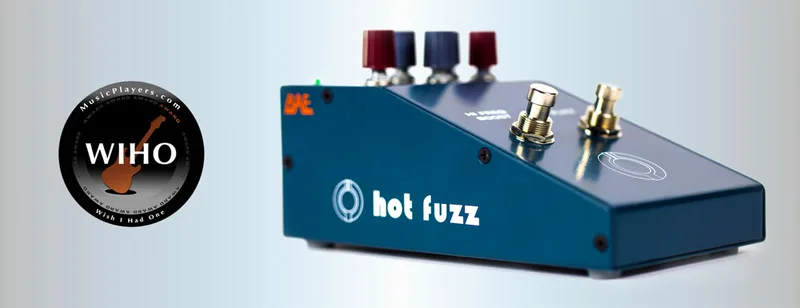


The BAE Hot Fuzz is a two-in-one fuzz and boost pedal from BAE Audio, a pro audio manufacturer better known for studio gear. One side is a high-frequency boost in the Rangemaster vein of treble boosters; the other is a four-transistor fuzz with Tone Bender DNA that BAE describes as an "English 1970s style fuzz box"12. Each section has its own true bypass footswitch and its own gain control, and the two can be used independently or together in series3.
It was BAE's first guitar stompbox, and it is built the way the company builds its rack gear: an all solid state design with four bipolar low-noise transistors, hand built with a handpicked selection of components34.
What each side does
The high-frequency boost side is a single-stage treble boost3. On its own it adds subtle-to-robust volume and treble, which Premier Guitar's reviewer found works well with tube amps verging on breakup2. MusicRadar's Trevor Curwen described its main thrust as a snarky presence, noting it rolls off some low end and has plenty in the tank to drive an amp harder1.
The fuzz side is a triple-stage circuit3 with controls for Juice (fuzz amount), Gain (output volume), Bass, and Treble13. MusicRadar found the Juice and Gain knobs together offer quite a range, from gritty drive to full-range fuzz1, and Premier Guitar credited a responsive tone stack with a gain range that moves from mellow to mean2.
| Control | Section | What it does |
|---|---|---|
| Gain | Boost | Boost's own gain control, foot switchable5 |
| Juice | Fuzz | Fuzz amount1 |
| Gain | Fuzz | Output volume1 |
| Bass | Fuzz | Shapes low end, works in tandem with Treble1 |
| Treble | Fuzz | Shapes high end, works in tandem with Bass1 |
The two footswitches are deliberately placed close enough that you can engage both sections with one clout of your boot, yet far enough apart for individual operation1. Performer Magazine's Chris Devine found them a little too close together for his taste5, and Premier Guitar listed the switch spacing among its cons as well2.
How it compares with a standard fuzz
Performer Magazine's reviewer found it a lot more controllable than a standard fuzz, thanks to the on-board bass and treble EQ settings5. Premier Guitar's reviewer described the sound as crackling hot, singing at high gain settings, with tones running from scooped and nasal to stinging depending on the guitar and volume and tone settings2.
"BAE's Hot Fuzz strikes a crafty balance between authentically wild and musically manageable."
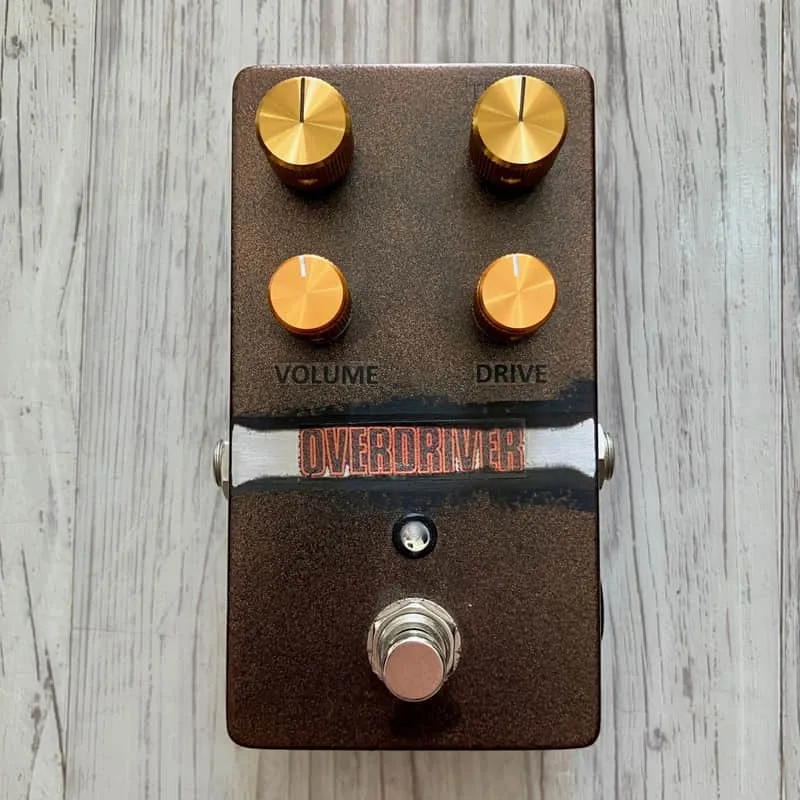
On circuit lineage, BAE says the design has Colorsound Overdriver origins2, and Premier Guitar notes its basic voice bears many sonic similarities to the Tone Bender family2. The Overdriver itself was a 1974-era Colorsound fuzz box made for the American market6, a follow-up to Colorsound's Power Boost7. The treble boost side, meanwhile, follows the Dallas Rangemaster tradition of treble boosters1.
The input and output jacks sit on the opposite sides of the box from what is the norm on pedals these days5, so check the layout before you cable it up on an existing board.
Power and battery
The Hot Fuzz runs off a single 9V battery or a standard center-negative power supply through a 2.5mm jack35. The battery does not need to be removed when using external power3. Total maximum current draw is under 6 mA3, low enough that a battery lasts a long time and a daisy chain is not heavily loaded.
History and build
The Hot Fuzz began with a personal quest for a long-lost tone by BAE Audio CEO Mark Loughman4. It debuted at NAMM in 20178 and was announced as available in November 20168. It is entirely handbuilt in the USA3, with all discrete components hand-wired in California4 and a handpicked selection of components including four low-noise transistors5. BAE claims a transistor noise figure under 2 dB across the entire audio band3.
What reviewers said
Reviews were positive on sound and build, with the footswitch spacing the main complaint21.
- Premier Guitar (2026): "Super-solid build quality" and "beautifully balanced between vintage character and modern malleability" among the pros; "footswitches are situated too close together" among the cons. Street price $2252.
- MusicRadar (Trevor Curwen): "Sound-wise, we can't fault this," calling it a sublime combination of fuzz and treble boost for the money1.
- Performer Magazine (Chris Devine, 2019): praised the controllable classic fuzz tone and low noise, though noted that at a $225 street price "it's not cheap"5.
Videos
Pete Thorn
BAE AUDIO
BAE AUDIO
Questions
Can you run the BAE Hot Fuzz boost and fuzz at the same time?
Yes. The Hot Fuzz has two true bypass footswitches, one for the boost and one for the fuzz, and the sections run in series. MusicRadar noted the switches are close enough to hit both with one stomp of your boot, yet far enough apart to operate each one individually.
Is the BAE Hot Fuzz true bypass?
Yes. Each of the two footswitches is true bypass, so both the high-frequency boost section and the fuzz section drop out of the signal chain completely when switched off.
Does the BAE Hot Fuzz take a battery?
Yes. It runs on a single 9V battery, or on a standard center-negative power supply through a 2.5mm jack. The battery does not need to be removed when using external power, and total current draw is under 6 mA.
Why are the input and output jacks reversed on the BAE Hot Fuzz?
Performer Magazine's reviewer observed that the input and output jacks are the opposite of what is the norm on pedals these days, but the review does not give a reason for the layout. It is simply how BAE built the box.
Is the BAE Hot Fuzz based on the Colorsound Overdriver?
BAE says the Hot Fuzz's design has Colorsound Overdriver origins, and Premier Guitar notes its basic voice bears many sonic similarities to the Tone Bender family. The Overdriver itself was a 1974-era Colorsound fuzz box made for the American market.
Sources (8)
- BAE Audio Hot Fuzz review, MusicRadar, 2018-02-11
- Quick Hit: BAE Hot Fuzz, Premier Guitar, 2017-02-23
- BAE Audio Hot Fuzz, Delicious Audio, 2020-09-29
- BAE Audio Releases New Hot Fuzz Boost/Fuzz Pedal, Premier Guitar, 2016-11-23
- REVIEW BAE Hot Fuzz, Performer Magazine, 2019-12-17
- Colorsound vintage reissue effects pedals, Analog Man Vintage guitar effects (analogman.com), 2015
- The Dallas Rangemaster, Vintage Guitar magazine, 2015-01-26
- BAE Audio to Showcase New Tonestack Fuzz and EQ at NAMM 2018, MusicPlayers.com, 2018-01-25