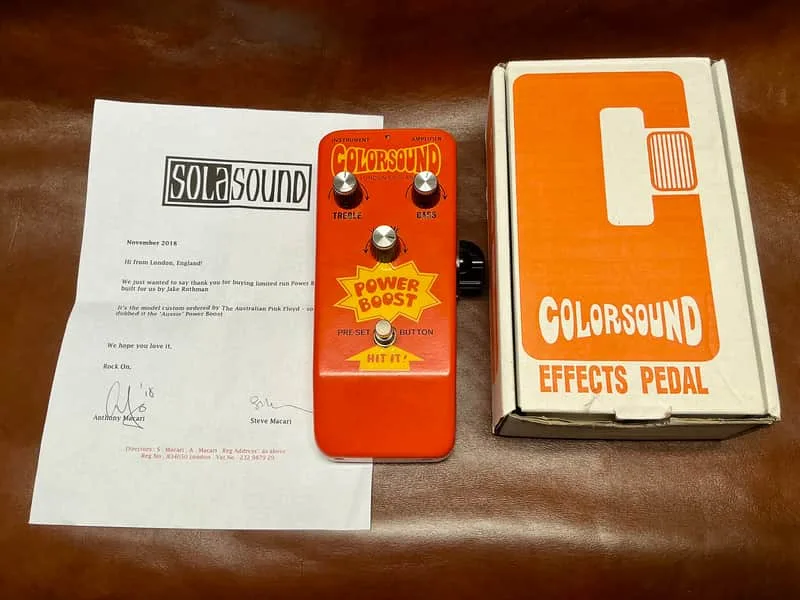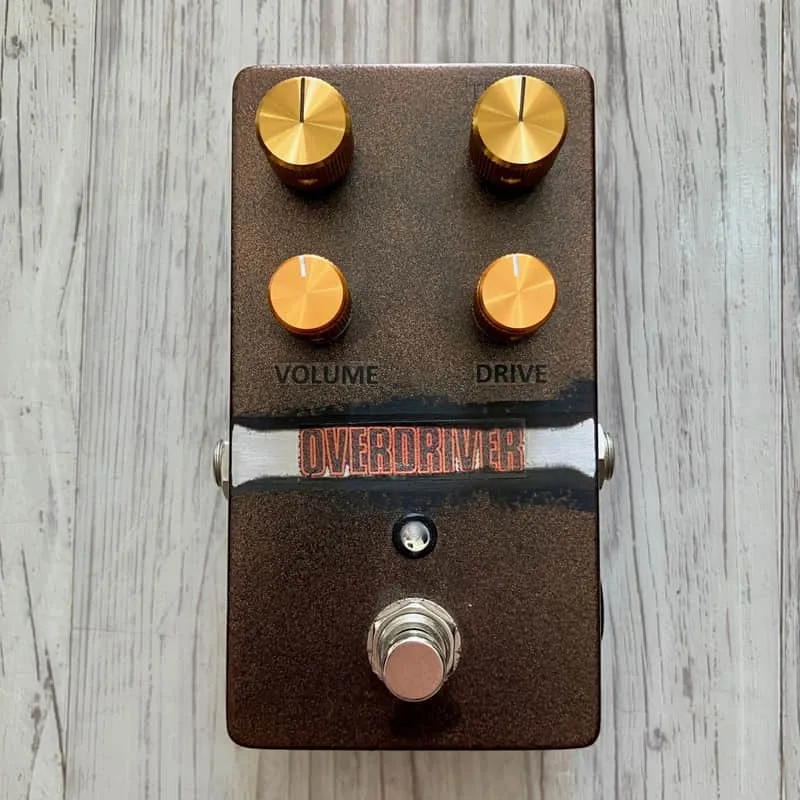


The Colorsound Overdriver is a British boost and overdrive pedal made by Sola Sound around 1971, designed by Gary Stewart, who later founded Colorsound1. It began life as a revision of the earlier Power Boost circuit, and its place in the family tree of early British fuzz and boost boxes is unusual: the same three-transistor circuit gives you a Power Boost at 18V and an Overdriver at 9V2. Guitar.com calls it "a forgotten giant of early British fuzz"3.
For a player, what it does depends on your pickups. TONEHOME describes it as an overdrive pedal with a distinctive bass and treble boost: with single coils it gives a very transparent, super clean boost that sounds dynamic and open, while humbuckers will always result in a slightly overdriven signal4. Tru-Fi adds that it was known both for its powerful overdrive and its incredible boost factor, usable for pushing fuzz pedals or simply boosting the signal5.
A boost that tips into overdrive
The Overdriver's core idea is that it bridges the gap between a clean boost and an overdrive. GuitarPCB, whose ColorTone board recreates the circuit, describes it as "bridged the gap between Boost & Overdrive recreating many of those popular, but hard to get tones of the 70's"6. The bass and treble controls allow a wide range of tonal options, including a full-on treble boost4.
The original units had no master volume control, and that was the pedal's defining quirk. Because of the remarkable volume jump when the pedal was engaged, very few vintage Overdrivers are left unmodded: many owners added a master volume pot themselves, and the reissue pedals carry one as well4. Analog Man's version of the pedal lists four knobs: Treble, Bass, Overdrive, and Master Volume, with the master volume added "to allow overdrive at useable volumes"7. Analog Man's unit came in a thin stamped gray metal case, narrower than a typical pedal, with a list price of $259 in 20157.
Very few vintage Overdriver pedals are left unmodded. Due to the remarkable volume boost when engaged, many users added a master volume pot, which the reissue pedal sports as well4.
The circuit itself is a three-transistor design with Drive, Volume, Treble and Bass controls, documented in vero (stripboard) and tagboard layouts by the Guitar FX Layouts community2. The original transistors were BC169C in the Q1 and Q2 positions and a BC184C in Q3; the layout notes specify the pinout orientation for each, BCE for the BC169Cs and EBC for the BC184C2. GuitarPCB's ColorTone Overdrive v3 build document instead lists BC109 transistors for Q1, Q2 and Q3, a common substitution for builders8.
One builder who made the vero layout reported a split verdict on the circuit's character2:
"Made this, beautifull clean boost, but overdrive seems too harsh."
Guitar FX Layouts commenter, on the Overdriver vero layout2
Versions and the 1996 reissue's minimum volume
The Overdriver's history is a story of small revisions. Aion FX traces it as an updated version of the Power Boost circuit, a third revision from 1972, and notes the name change came after Sola Sound took the Power Boost to a trade show in the United States and drew a lot of interest9. Tru-Fi dates the change more simply: in 1971, Colorsound changed the Power Boost into the 9V Overdriver, dropping the power requirement down to a single battery109. Over the years there have been different variations and reissues, some with slight modifications to the circuit or enclosure design1.
The relationship between the two circuits is direct enough that builders treat them as one layout with two settings: run the layout at 18V and you get the Power Boost; omit the level pot and you get the Overdriver2.
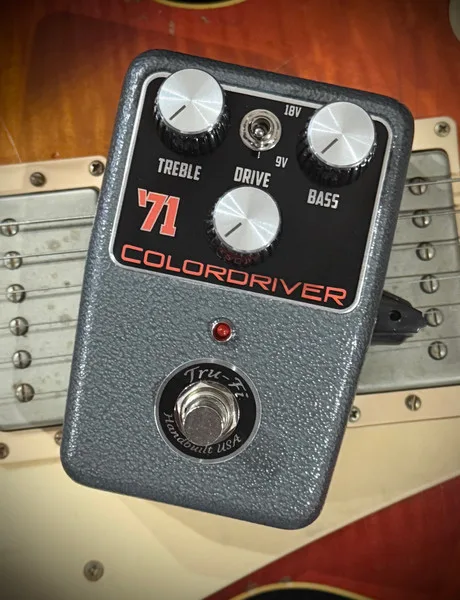
The 1996 reissue is the version most players will encounter today, and it has one well-known catch. It incorporated a volume pot on the output, finally answering the original's no-volume-control problem, but it also included a minimum volume resistor that prevents the output from going to zero11. The practical result is that the reissue cannot reach unity gain at higher gain settings, so the pedal is always adding some level. Aion FX reports that, as far as they know, this minimum volume resistor is still in current reissues11. Guitar.com's review of the Tru-Fi Mini '71 Colordriver, a modern tribute pedal, notes both the Power Boost and Overdriver tributes come with master volume, courtesy of legendary London dealer Macari's12.
| Version | Key difference |
|---|---|
| Power Boost (1969) | The same circuit running on 18V instead of 9V3 |
| Original Overdriver (around 1971) | 9V battery, no master volume; most were later modded1 |
| 1996 reissue | Output volume pot added, but a minimum volume resistor stops it reaching zero11 |
| Current reissues | Minimum volume resistor still present, per Aion FX11 |
Who played it
The Overdriver gained popularity in the 1970s and was used by various guitarists of that era1. Tru-Fi names David Gilmour of Pink Floyd, Jeff Beck, and T. Rex's Marc Bolan as users of the 9V version5, and GuitarPCB calls it "a favorite of Mr. Gilmour and Jan Akkerman of Focus among many"6. Vintage units are now sought after by guitar enthusiasts and collectors1.
Building one today
The circuit is well served in the DIY world. GuitarPCB sells the ColorTone Overdriver v3, a PCB for building a similar circuit to the classic Overdriver6, with a build document listing the BC109 transistor option8. Aion FX offers the circuit as a project called the Plasma, a vintage drive build9. The Guitar FX Layouts vero and tagboard layouts remain the reference for stripboard builders, with the transistor pinouts and the 18V Power Boost variant both documented2.
The Overdriver's influence also shows up in the DIY community. Tagboard Effects publishes vero (stripboard) and tagboard layouts for the three-transistor circuit, with Drive, Volume, Treble and Bass controls, and notes the original transistors were BC169C in the Q1 and Q2 positions and BC184C at Q32. The lineage runs both ways: running the layout at 18V gives the Power Boost, and omitting the level pot gives the Overdriver2. One builder who made the layout reported it "works as a beautiful clean boost but the overdrive seems too harsh"2.
Videos
musictoyznetwork rasch
gearmanndude
blondegraemey
Questions
Does the Colorsound Overdriver run on a battery?
Yes. The Overdriver ran on a single 9V battery, which was the change that set it apart from the earlier Power Boost circuit. The Power Boost ran on 18V, and builders who recreate the circuit note that running the same layout at 18V gives you the Power Boost instead.
Who designed the Colorsound Overdriver?
The Overdriver was designed by Gary Stewart, who later founded Colorsound. The pedal itself was created by Sola Sound, a British company, around 1971, and was made in England.
What transistors are in the Colorsound Overdriver?
The original units used BC169C transistors in the Q1 and Q2 positions and a BC184C in the Q3 position, in a three-transistor circuit. DIY layouts for the circuit also list BC109s as an option for all three positions.
Why won't the Overdriver reissue go to unity gain?
The 1996 reissue added an output volume pot, but it also included a minimum volume resistor that stops the output from reaching zero. Aion FX reports that this resistor prevents the reissue from reaching unity gain at higher gain settings, and that as far as they know it is still in current reissues.
Is the Colorsound Overdriver a fuzz or an overdrive?
It sits between the two. It is best described as an overdrive pedal with a distinctive bass and treble boost, and GuitarPCB describes it as bridging the gap between boost and overdrive. Guitar.com calls it a forgotten giant of early British fuzz, and with humbuckers it always produces a slightly overdriven signal.
Did David Gilmour use a Colorsound Overdriver?
Yes. Tru-Fi lists David Gilmour of Pink Floyd, Jeff Beck, and T. Rex's Marc Bolan as users of the 9V Overdriver, and GuitarPCB names Gilmour and Jan Akkerman of Focus among its fans. It was widely used by guitarists of the 1970s.
Sources (12)
- The Colordriver Overdriver, Tru-Fi (tru-fi.com)
- Guitar FX Layouts: ColorSound Overdriver, Guitar FX Layouts (tagboardeffects.blogspot.com), 2026-05-15
- Alternative rockers: 10 cool new dirt pedals you need in 2026, Guitar.com, 2026-04-22
- TONEHOME, TONEHOME - the World of Vintage Guitar Effect Pedals
- Tru-Fi Colordriver 9V version, loved by guitar pedal fuzz lovers worldwide, used by Jeff Beck and David Gilmour in the 70s, Tru-Fi
- ColorTone Overdriver v3, GuitarPCB
- Colorsound vintage reissue effects pedals, Analog Man Vintage guitar effects (analogman.com), 2015
- CTO-v3-2021.pdf, GuitarPCB.com, 2021-01
- Nucleus Vintage Boost / Colorsound Power Booster, Aion FX, 2020-07-03
- Tru-Fi Colordriver 18 Volt Guitar Pedal like the original Colorsound Power Booster, Tru-Fi, 1971
- Plasma Vintage Drive / Colorsound Overdriver, Aion FX, 2020-07-03
- Tru-Fi Mini ’71 Colordriver review, Guitar.com, 2026-02-23
 David Gilmour