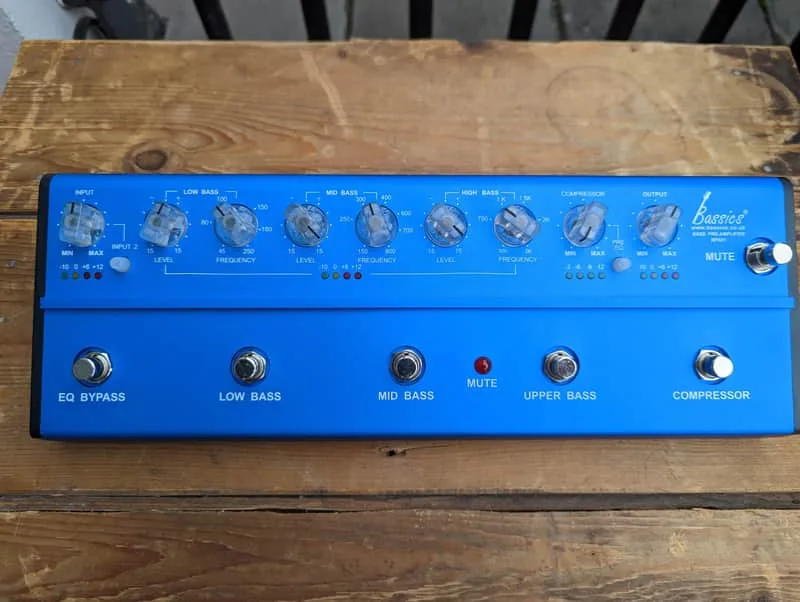


The Bassics BPA-1 is a floor bass preamp from Bassics, the company's first product, designed by Malcolm Toft, the veteran studio console designer1. It is built in the UK and takes the form of a chunky, two-kilo floor unit with footswitches, aimed directly at bass players who want studio-style tone shaping at their feet1. Bass Musician Magazine described it as "something that I have never seen before and offers so much control over tone and frequency"2.
At its core the BPA-1 combines a preamp, a compressor and an EQ in one box. The compressor is a high-grade VCA type made specifically for bass, and it can be run post or pre EQ2. MusicRadar calls it "a studio-quality VCA compressor"1. The EQ is a bypassable three-band design with up to 15dB boost or cut, centrally detented for off1. For players coming from simpler preamp pedals, the BPA-1 is closer to a channel strip than a tone-shaping boost.
The controls
The front panel is organized into input, EQ and compressor sections, each with its own footswitch and illuminated controls. When you step on a footswitch to engage the compressor or EQ, the corresponding knob lights up; when mute is engaged, all the knobs go dark3. The input and output controls glow red, low bass green, mid bass orange, upper bass yellow, and the compressor blue2.
| Control | What it does |
|---|---|
| Input 1 level | Set next to the EQ on top of the unit2 |
| Input 2 level | Set on the rear panel next to input 22 |
| Input selector | Small illuminated switch choosing between input 1 and 22 |
| Input 1 impedance toggle | Choice between high and normal, for piezo pickups2 |
| EQ level controls | -15dB to +15dB for bass, mids and highs2 |
| EQ bypass | Switches a section off silently; the lights go off1 |
| Compressor LED | Shows compression amount, ranging from -3dB to -12dB2 |
| Output level | Overall output level control1 |
| Mute | Overall mute1 |
Each of the two inputs has its own level control, so two basses can be plugged in simultaneously and balanced against each other1. One point Bass Musician Magazine raised in its 2018 review: switching between the two channels is done by a button on the top of the unit next to the input volume rather than a footswitch, and the reviewer would have preferred a footswitch there3.
The EQ itself is a three-band design, and Bass Musician Magazine's 2016 review breaks it into low bass, mid bass and upper bass sections, each with its own level control offering -15dB to +15dB2. MusicRadar found the controls quick and assertive in use, writing of "the quick, assertive response of the controls and the easy mastery which they give you over your sound"1.
The compressor can be placed before or after the EQ, and its LED meter shows how much gain reduction is being applied, from -3dB to -12dB2. MusicRadar's verdict on it was direct: "The compressor was especially effective, as it should be given the designer's studio history"1.
Inputs, outputs and power
The rear panel carries the connections, and the BPA-1 is generous with them23:
- Two standard jack inputs, both on the rear panel, with individual level controls12
- Input 1 impedance switch (high or normal) for piezo pickups, such as the one on an upright bass12
- 1/4-inch connections for output, FX send or tuner, and FX return, giving an effects loop12
- Two fully balanced DI outputs on both jack and XLR, described as balanced low-impedance direct outputs selectable for pre or post EQ12
- An overall output level and overall mute1
The balanced outputs mean the BPA-1 can feed a mixing desk or audio interface directly, with the pre or post EQ choice deciding whether the desk receives the shaped or unshaped signal2. Bass Musician Magazine's 2016 review framed the unit's studio appeal broadly, noting it "gives you the option to change the EQ in the studio to your preference while also being able to add Compression"2.
Power comes from a standard power cord, like an amplifier, rather than a pedalboard adapter3. The internal supply adapts to AC voltages from 85 to 265 volts1.
Because the BPA-1 runs on an internal power supply rather than a pedalboard power brick, it cannot share a pedalboard power supply or daisy chain. Plan for a wall outlet at your feet.
What reviewers found
Both Bass Musician Magazine reviews and MusicRadar's review were positive about how the unit treats the instrument. The 2018 Bass Musician review found that "even when the controls were dimed, the unit still retained the individual sound and nuance of each of the basses"3. MusicRadar likewise highlighted the responsive controls and the effective compressor, while noting the price reflects the UK build and Toft's studio heritage1. The 2018 review's one criticism was the lack of a footswitch for channel switching3.
Videos
Bassics Amps
Bassics Amps
Bassics Amps
Questions
Who designed the Bassics BPA-1?
The BPA-1 was designed by Malcolm Toft, the veteran studio console designer. It is the first product from his company Bassics, and MusicRadar notes that the compressor in particular reflects his studio background. The unit is built in the UK.
Where is the Bassics BPA-1 made?
The BPA-1 is built in the UK. MusicRadar's review points to the UK build as part of what the price pays for, alongside designer Malcolm Toft's studio heritage.
Does the Bassics BPA-1 have an effects loop?
Yes. The rear panel carries 1/4-inch connections for output, FX send or tuner, and FX return, so time-based effects such as delay can be placed after the preamp and EQ in the chain.
Does the Bassics BPA-1 have an XLR output?
Yes. It has two fully balanced DI outputs on both jack and XLR, described by Bass Musician Magazine as balanced low-impedance direct outputs selectable for pre or post EQ, which lets you feed a mixing desk or interface directly.
Can the Bassics BPA-1 be used with a piezo pickup?
Yes. Input 1 has an impedance toggle switch with a choice between high and normal. MusicRadar notes this is intended for piezo pickups, such as the one on an upright bass, where the higher setting suits the pickup's output.
Does the Bassics BPA-1 use a power cord instead of a power adapter?
Yes. The BPA-1 uses a standard power cord, like an amplifier, rather than a 9V pedal adapter. Its internal power supply adapts to AC voltages from 85 to 265 volts, so it can run on mains power in different regions.
Sources (3)
- Bassics BPA-1 Preamp review, MusicRadar, 2016-09-10
- Bassics BPA-1 Bass Pre-Amp Review, Bass Musician Magazine, 2016-11-01
- Review: Bassics BPA-1 Bass Preamp, Bass Musician Magazine, 2018-05-01