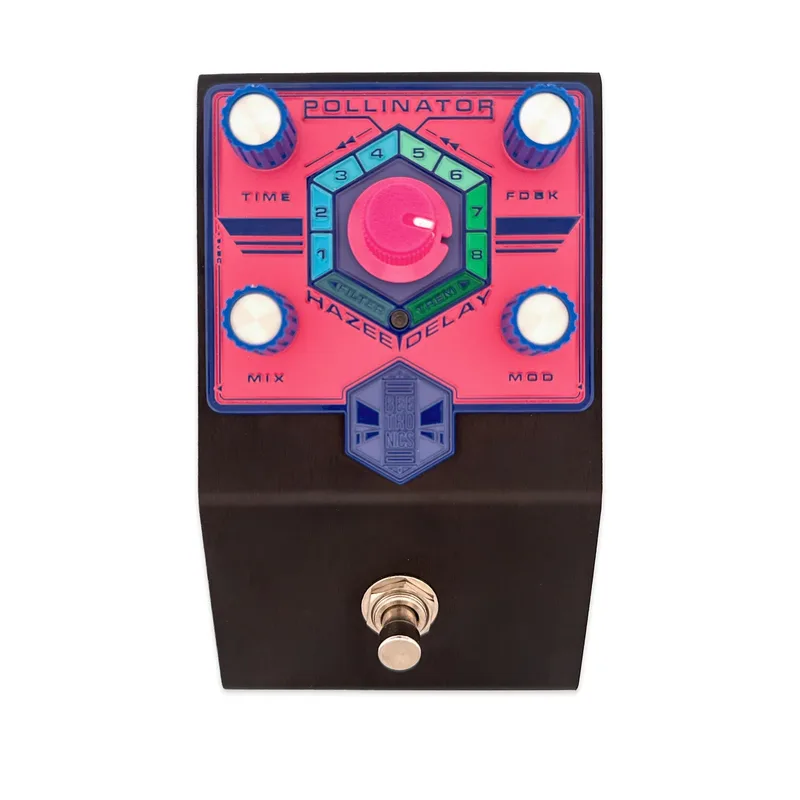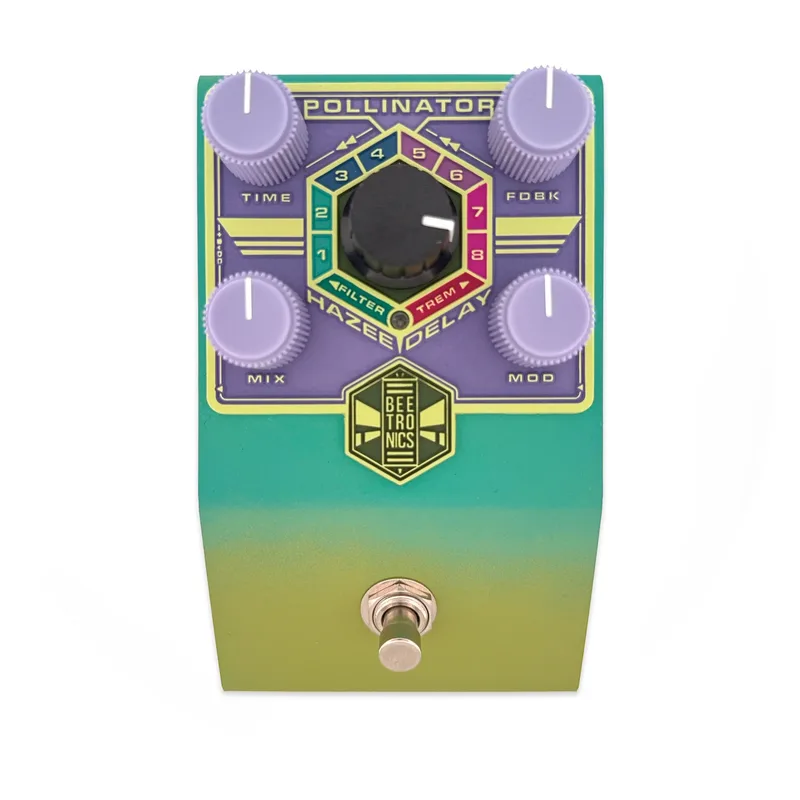


The Beetronics Pollinator Hazee is a modulated delay pedal that blurs the line between delay, modulation and sound design. Beetronics describes it as "a hive full of evolving delay textures," where each repeat blooms, shifts and evolves beyond what a traditional delay does, from subtle motion to dense, hazy textures1. It is the company's first fully digital pedal: earlier Beetronics pedals used digital control, but the Hazee processes the signal digitally1.
What makes it unusual is the order of things. The signal is modulated first, by a filter or a tremolo, and then delayed, so the repeats are copies of a moving, modulated sound rather than echoes with vibrato added on top1. Delicious Audio's reviewer put it plainly: "The Hazee modulates the signal first, filter or tremolo, then sends that moving, breathing sound into the delay line"2.
Modulation first, then delay
Most modulated delays add wobble to the repeats after they are created. The Hazee flips that: the filter or tremolo acts on your dry signal, and the delay line records that already-moving sound. Every repeat is a snapshot of a different moment of the modulation, which is why Beetronics says the repeats "bloom, shift, and evolve" rather than simply fading1.
The Modulation knob sets how much of the filter or tremolo movement is applied, and the Mode selector chooses which of the eight modulation-and-direction combinations shapes the signal5. Feedback and Mix work as on any delay, setting how many repeats stack up and how loud they sit against your dry signal5.
Eight modes: filter, tremolo and the Queen Bee octave modes
The eight modes sit on a central rotary selector, four filter-based and four tremolo-based2. Gearnews lists them as follows5:
| Modes | Family | Modes available |
|---|---|---|
| 1 to 4 | Filter | Forward, Forward Octave Up, Reverse, Reverse Octave Up |
| 5 to 8 | Tremolo | Reverse Octave Up, Reverse, Forward Octave Up, Forward |
Modes 2 and 7 are the Queen Bee special modes. In these, the delay buffer is read twice as fast as it is recorded, creating octave-up repeats with strange, musical rhythms678. Gearnews describes the result as "musical, rhythmic artifacts"5. In the Queen Bee modes, turning the Delay Time knob past halfway blends between the original signal and the octave layer, so the knob doubles as a mix control between the two1.
Guitar World's reviewer found the tremolo side of the pedal particularly characterful, noting that "the tremolo offers a nicely rounded pulse"3.
Controls, power and connections
The control surface is five knobs and a footswitch3:
| Control | What it does |
|---|---|
| Time | Delay time; in Queen Bee modes, past halfway it blends original signal and octave layer1 |
| Feedback | Number of repeats32 |
| Mix | Balance of dry signal and repeats5 |
| Modulation | Depth of the filter or tremolo shaping5 |
| Mode | 8-way selector for the eight modes5 |
| Bypass | Footswitch, buffered bypass3 |
Power comes from a 9V DC adapter, not supplied, drawing 80 mA3. There is a standard input and a standard output, so the pedal is mono only3. Delicious Audio's reviewer addressed the mono question directly: "Mono only, because stereo would've doubled the price and the point"2.
The Hazee has no tap tempo, and that is deliberate. Beetronics says "Hazee isn't trying to be a 'perfectly in time' delay," positioning it as a texture and sound design tool rather than a time-locked delay1. If you need repeats locked to a tempo, this is not that pedal.
Analog or digital, and how it differs from the BeeBeeDee
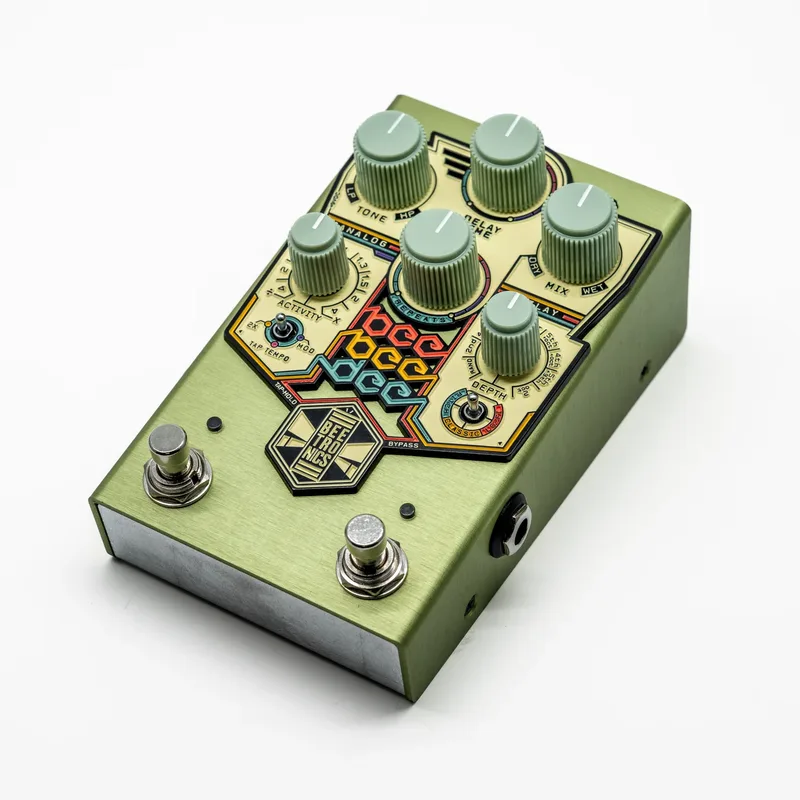
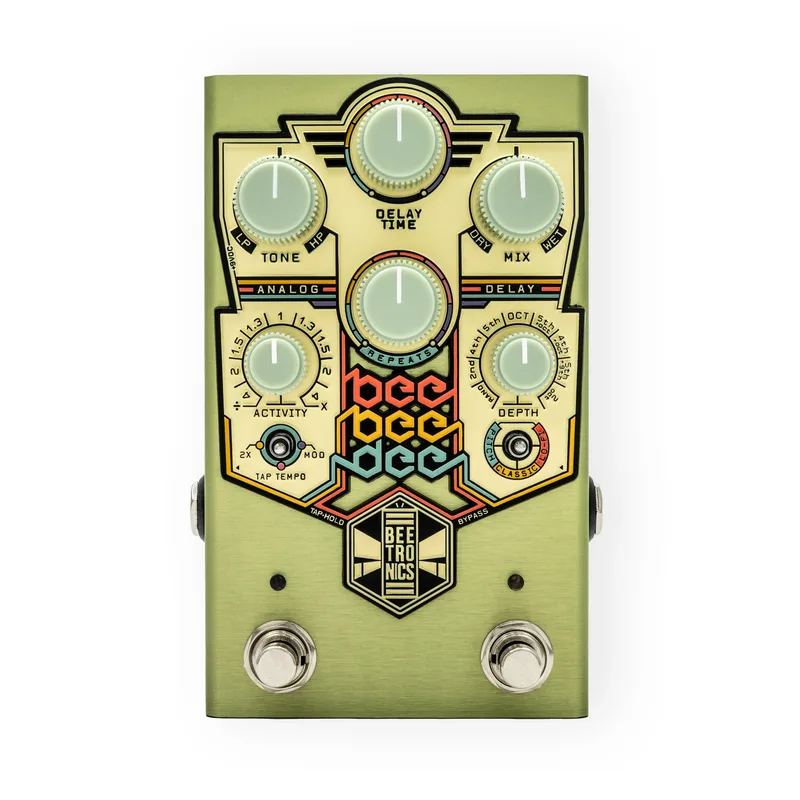
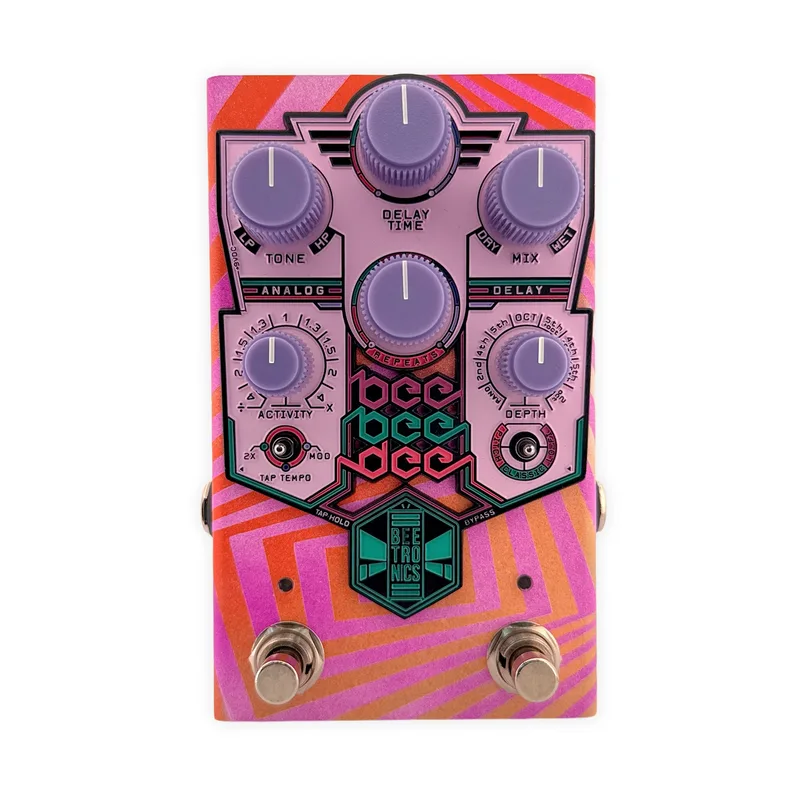
The Hazee follows the Beetronics BeeBeeDee, an analog BBD delay, and the contrast is the point4. The BeeBeeDee is an analog modulated delay; the Hazee is fully digital, built around the Spin Semiconductor FV-1 chip, which MusicRadar's review identifies at the core of the pedal4. That digital engine is what allows the reverse modes, the octave-up processing and the read-the-buffer-twice-as-fast trick of the Queen Bee modes.
The enclosures are hand-painted, the same as the analog ones2, and Guitar World's review credits the pedal with a rugged build3.
The first Pollinator Series pedal and its editions
The Hazee Delay heads up the new Pollinator Series, reported by Guitar Pedal X in January 2026 as an eight-mode digital delay priced at $24992. Delicious Audio's May 2026 review confirmed it as the first of the series, with "more bees coming"2. Beetronics itself says more Pollinator Series products are on the way1.
The pedal has appeared in several editions on the Beetronics webstore:
- A standard version, listed as a pre-order shipping mid November, in Gray8
- A Green colorway, with a Gray option also shown7
- A Custom Shop version at £269.00, sold out10
- A Limited Edition Neon Fade at £192.00 regular price, sold out1
Guitar World lists the price as $249 in the US and £229 in the UK3, and Delicious Audio's review gives the same $249 figure2. Beetronics offers a 14-day money back guarantee on the pedal8.
What reviewers said
Guitar World's review highlights the rugged build and the rounded tremolo pulse, against the mono-only limitation3. MusicRadar's Alex Lynham frames the pedal as a natural step for the company: "Following on from their Bee Bee Dee analogue delay pedal, it has developed the Hazee Delay," with the FV-1 chip at its core4. Delicious Audio's Brent P. Gladless calls it a multi-modulated delay and sums up the design philosophy: "No tap tempo, because that's not what this is for"2.
Videos
Beetronics FX
Beetronics FX
Julien Bitoun - Guitare Obsession
Questions
Does the Beetronics Hazee have tap tempo?
No. Beetronics says the Hazee is not trying to be a perfectly in-time delay, and positions it as a texture and sound design tool rather than a time-locked one. Delicious Audio's reviewer made the same point: no tap tempo, because that is not what this pedal is for12.
Is the Pollinator Hazee analog or digital?
It is fully digital, and it is the first fully digital pedal Beetronics has made. Earlier pedals used digital control only, while the Hazee processes the signal digitally. MusicRadar's review identifies a Spin Semiconductor FV-1 chip at its core14.
Is the Beetronics Hazee stereo?
No, it is mono only, with a standard input and a standard output. Delicious Audio's reviewer noted that stereo would have doubled the price and the point, and Guitar World's review also lists it as mono only23.
What chip is in the Beetronics Hazee?
MusicRadar's review identifies the Spin Semiconductor FV-1 chip at the core of the pedal. That chip handles the delay, filter, tremolo and octave processing in the eight modes4.
How is the Hazee different from the BeeBeeDee?
The BeeBeeDee is an analog delay, while the Hazee is Beetronics' first fully digital pedal. The Hazee adds eight modes including reverse and octave-up repeats and two Queen Bee modes, and it modulates the signal before the delay line rather than adding modulation to the echoes14.
Sources (10)
- Pollinator Hazee Delay • Limited Edition • Neon Fade, Beetronics
- Beetronics Pollinator Hazee Multi-Modulated Delay, Delicious Audio, 2026-05-28
- Beetronics Pollinator Hazee Delay review, Guitar World, 2026-08-02
- Beetronics Pollinator Hazee Delay, MusicRadar, 2026-04-05
- Beetronics Pollinator Hazee Delay: Available to order now!, gearnews.com, 2026-03-04
- Pollinator Hazee Delay • Limited Edition • Pink Venom, Beetronics (www.beetronicsfx.com)
- Pollinator Hazee Delay • Green, Beetronics
- Pollinator Hazee Delay (Pre-order, Beetronics
- Guitar Pedal X, Guitar Pedal X, 2026-01-22
- POLLINATOR HAZEE DELAY, Beetronics