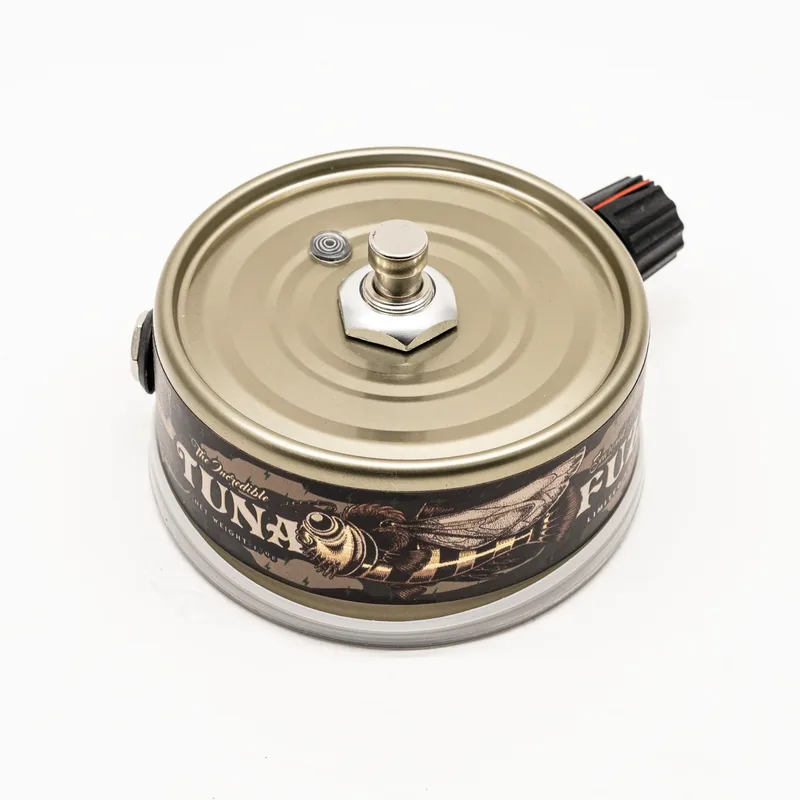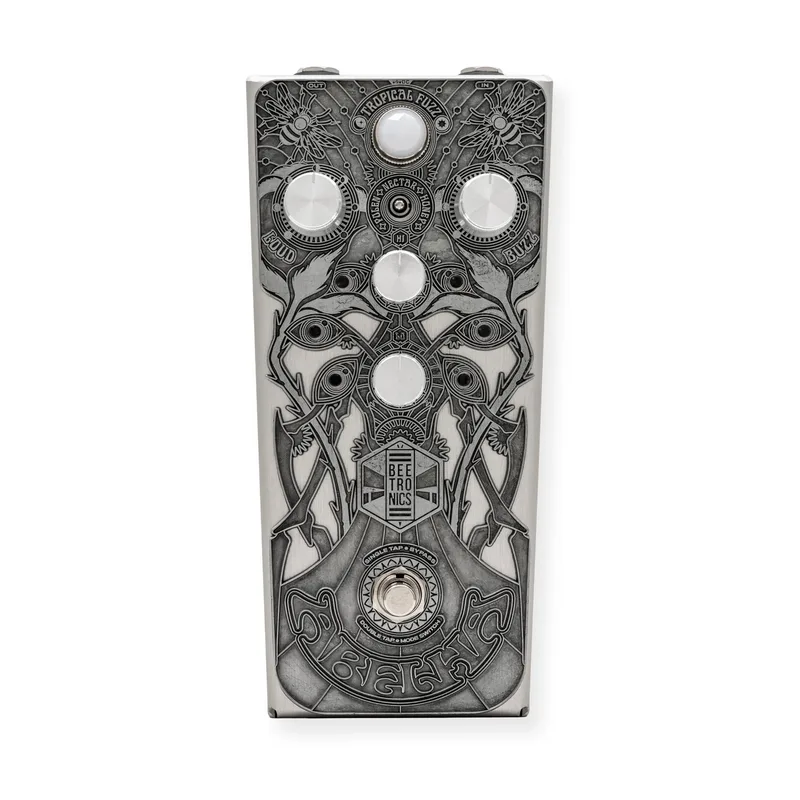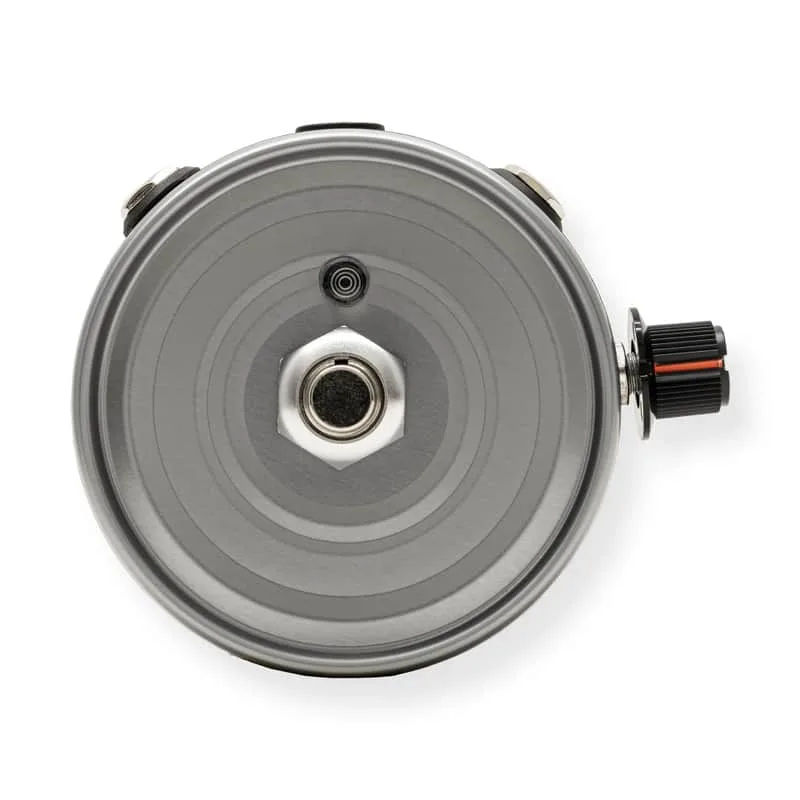


The Beetronics Tuna Fuzz is a three-transistor fuzz pedal built inside a real tuna can. Every can is hand-drilled at Beetronics' workshop, and a transparent back cover shows a Tunabee-shaped PCB inside1. Released in September 2024, it was the maker's first budget pedal and its most affordable release to date, sold direct for $9923. The circuit shares some similarities with the Beetronics OctaHive, but Beetronics says the tone can be quite different1.
Beetronics describes the sound as having a lot of volume and being very dynamic, "delivering a sound that's impressively close to vintage fuzzes"1. On Guitar Pedal X, Stefan Karlsson heard it as fairly Fuzz Face adjacent, with a rich and warm tone2.
One knob: master volume, gain from the guitar
The Tuna Fuzz has a single control, the STINKER knob, which dials in the master volume1. There is no gain knob. Instead, the pedal "cleans up real nice by using your guitar's volume knob as a gain control," in the maker's words1. Guitar World's reviewer measured unity gain before the halfway point of the knob's travel and found good volume-knob clean-up9.
This is the classic vintage-fuzz approach: crank the pedal and ride the guitar's volume for level and texture. Guitar.com's reviewer, Cillian Breathnach, found the clean-up "isn't quite full Fuzz Face glassiness, but drop down to 3 and 4 on your guitar and you do get a nice, mildly ragged low-gain sound"10.
Because it is an impedance-sensitive fuzz, pickup choice goes a long way toward determining the sound. In Guitar.com's review, humbuckers emphasized a gurgly low end, while single-coils were bright but not shrill10.
Beetronics does not recommend using a buffer before the Tuna Fuzz, even though many of its other circuits have no issue with buffers. The volume-knob gain control works best with nothing between your pickups and the pedal10. There is also no room for a battery inside the can, so it needs a 9V DC center-negative supply7.
History: Filipe Pampuri's tuna can pedals
The enclosure is a tribute to Beetronics founder Filipe Pampuri's early days as a builder. When he was starting out, Pampuri repurposed tuna cans as pedal enclosures to save money on materials, and he shared that approach with young students in Brazil interested in guitar pedals3. Guitar.com's 60 Seconds video on the pedal describes it as inspired by the beginner pedals Pampuri would teach school kids to build back home in Brazil11.
After throwback photos of those tuna can pedals circulated on social media and people asked whether the company would make them a real product, Beetronics decided to do it5. Guitar Pedal X reports the circuit is based on one of Filipe's very original fuzzes2.
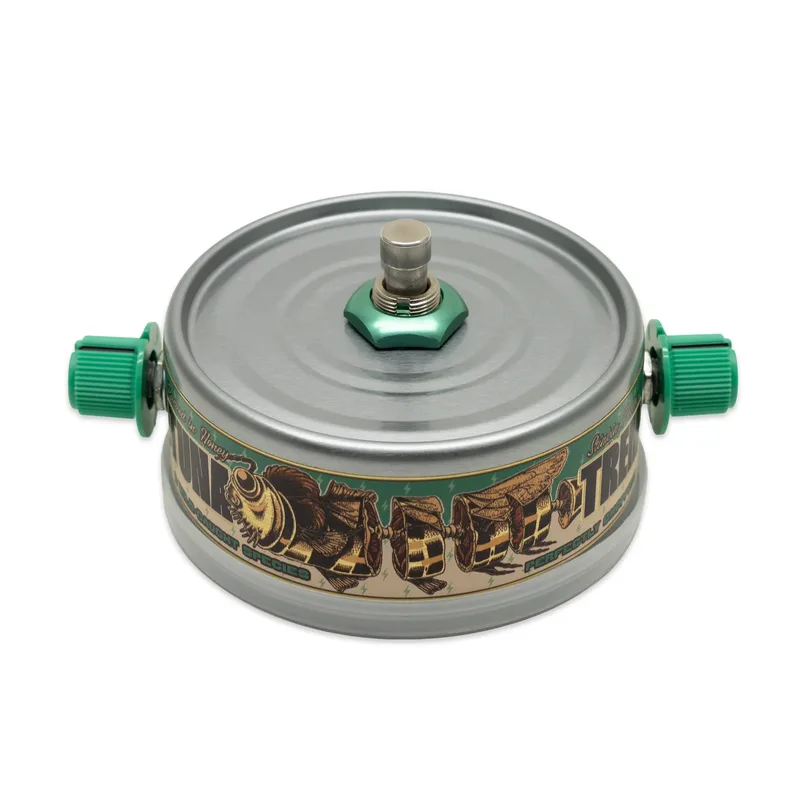
The format has since grown into a family. Beetronics followed the Tuna Fuzz with the Tuna Trem, a nine-mode pattern tremolo in the same tuna can and blisterpack packaging12. Limited editions of the Tuna Fuzz itself include the BEECON Limited Edition, now sold out13.
What reviewers said
Reviews across the press were positive, with the usual caveats about a tin can enclosure.
| Reviewer | Publication | Verdict |
|---|---|---|
| Trevor Curwen | Guitar World | "By far the most affordable pedal that Beetronics has made, and with no skimping on sound quality"9 |
| Jonathan Horsley | MusicRadar | "Super-simple, affordable and a lot of fun... a compelling introduction to the unhinged world of Beetronics"7 |
| Cillian Breathnach | Guitar.com | Found the clean-up and build have limits, but the tone impresses for the price10 |
| Stefan Karlsson | Guitar Pedal X | "A fantastic 3-Transistor Silicon Fuzz... straddles both Tone Bender and Fuzz Face flavours"6 |
Guitar World's reviewer called the concept "a cute concept that's well executed," praised the nicely balanced fuzz tone, and called the pedal a no-brainer for players who like their fuzz "wild and wooly with plenty of teeth"97. MusicRadar's Jonathan Horsley agreed it is a compelling introduction to Beetronics' sound7.
On durability, reviewers were candid. Guitar.com noted the lid that forms the back of the pedal is just a friction fit, and that a zip-tie or two might be necessary to keep it from wandering, and that being a tin can it is not built for endless stomping aggression10. Guitar World found the plastic base fits firmly but may be an issue over time if the pedal is Velcro'd to a board9. At 80mm across and 0.20lbs, it is a compact addition to a pedalboard9.
Buying and versions
Beetronics sells the Tuna Fuzz directly through its own website, bypassing dealers and distributors, at $9938. The maker offers a 14-day money back guarantee14. Alongside the standard silver version, there have been a Gold BEE STOCK version, the sold-out BEECON Limited Edition, and a Jingle Buzz Limited Edition13.
The Tuna Fuzz sells for $99, and Beetronics is bypassing dealers and distributors to sell it directly38. UK retailers listed it at a launch price of £859, and the Beetronics webstore's regular price is £77.001. One UK-based writer reported paying £120 for theirs, which included taxes and shipping to the UK2. A limited edition version, the Tuna Fuzz BEECON, has sold out13.
Videos
Beetronics FX
60 Cycle Hum
Demos In The Dark
Questions
Does the Tuna Fuzz take a battery?
No. There is no room for a battery inside the tuna can enclosure, so the pedal runs only on external power. It takes a 9V DC center-negative supply and draws about 10mA, so it is easy on a typical isolated or daisy-chain power brick.
Can you put a buffer before the Beetronics Tuna Fuzz?
Beetronics does not recommend it. While many of the maker's circuits have no issues with buffers, the Tuna Fuzz is an impedance-sensitive fuzz whose gain is controlled by the guitar's volume knob, and a buffer between the pickups and the pedal interferes with that interaction. Put it first in the chain.
How do you control the gain on the Tuna Fuzz?
There is no gain knob. The single STINKER control sets master volume, and you ride your guitar's volume knob for gain and output level, the way players do with vintage fuzzes. Rolling down to 3 or 4 on the guitar gives a mildly ragged low-gain sound.
Where can you buy the Beetronics Tuna Fuzz?
Beetronics sells it directly through its own website, bypassing dealers and distributors, at a list price of $99. Limited editions such as the BEECON version have sold out. The pedal carries a 14-day money back guarantee from the maker.
Is the Tuna Fuzz tin can durable on a pedalboard?
It is a real tin can, so reviewers advise some care. The back lid is a friction fit that may need a zip-tie, and the plastic base could work loose over time if Velcro'd to a board. It is compact at 80mm diameter and about 0.20lbs, but not built for endless aggressive stomping.
Sources (14)
- Tuna Fuzz • Silver (BACK IN STOCK), Beetronics
- Guitar Pedal X, Guitar Pedal X, 2024-09-18
- Beetronics introduces Tuna Fuzz, Guitar World, 2024-09-17
- Tuna Fuzz by Beetronics, RockBoard PedalPedia, 2026
- This unconventional fuzz pedal is literally a tuna can with a footswitch, guitar.com, 2024-09-18
- Guitar Pedal X, Guitar Pedal X, 2024-12-18
- Beetronics Tuna Can Fuzz Pedal review, MusicRadar, 2024-11-01
- Beetronics Tuna Fuzz, Delicious Audio, 2024-10-16
- Beetronics Tuna Fuzz pedal review, Guitar World, 2024-11-14
- Beetronics Tuna Fuzz review, Guitar.com, 2024-09-23
- 60 Seconds S1E36: Beetronics Tuna Fuzz, Guitar.com, 2024-09-20
- Guitar Pedal X, Guitar Pedal X, 2026-10-01
- Tuna Fuzz • BEECON Limited Edition, Beetronics
- Tuna Fuzz • Gold • BEE STOCK, Beetronics