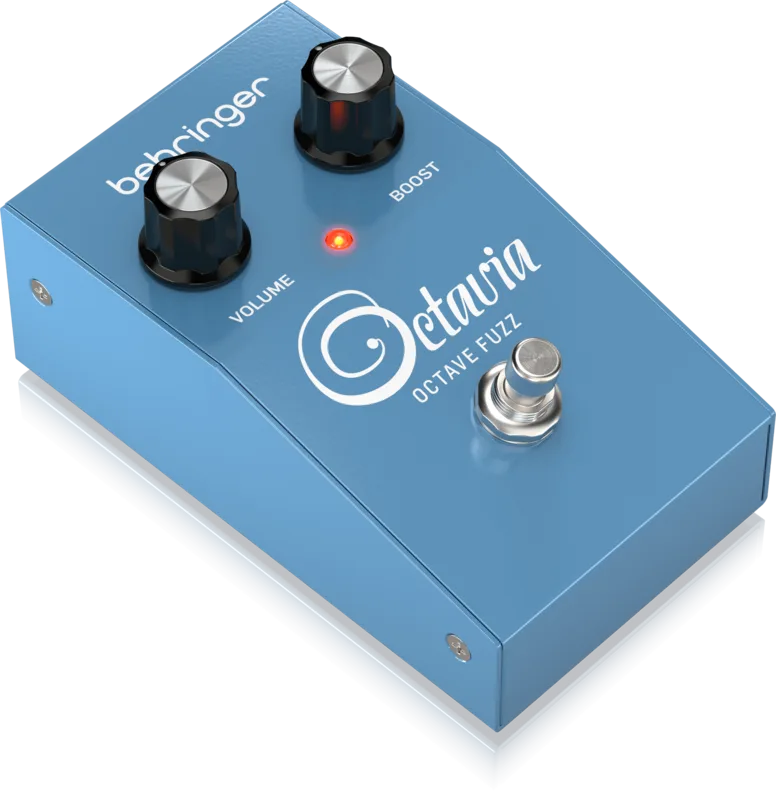


The Behringer OCTAVIA OCTAVE FUZZ is an octave fuzz pedal: a fuzz circuit that adds a distinct and sometimes unpredictable octave-up sound on top of the distortion, which Behringer says lets a guitar stand out in a mix. It is an all-analog, silicone-based circuit, and the company points to the original octave fuzz used by Jimi Hendrix in the 60s as its lineage1. gearnews.com reported at its release that it is modeled after the Tychobrahe Octavia, the circuit behind the octave fuzz sounds of Hendrix, Jeff Beck, Stevie Ray Vaughan and Kenny Wayne Shepherd2.
Controls
The layout is deliberately minimal: two knobs and nothing else.
| Control | What it does |
|---|---|
| Volume | Sets the output volume1 |
| Boost | Dials in the amount and intensity of the fuzz12 |
Behringer calls this a super-simple control layout that lets you set the output volume and the amount of fuzz1. gearnews.com put it the same way: "You just get controls for volume and boost, which allows you to dial in the intensity of the fuzz."2
Sound and how to get the octave effect
Behringer describes the pedal as a vintage octave fuzz with an aggressive voice and octave-up effect, and says it responds really well to your picking dynamics and sounds amazing on single-coils or humbuckers1. Octave fuzzes of this type are famously touch-sensitive: the octave-up note appears strongest when you play single notes in a limited range with the fuzz backed down, which is where the maker's suggested starting point comes in.
Behringer's own recipe for chirpy octaves with distortion underneath1:
- Set the fuzz knob to about 10 o'clock.
- Switch to your neck pickup.
- Play up around the 12th fret.
Where it sits in Behringer's fuzz line
The circuit it follows
The Tychobrahe Octavia design has been rebuilt by many builders over the years. Madbean Pedals sells its own version, the Retrograde, described on the company's site as "the classic Hendrix style oct-up fuzz"3. Roger Mayer, whose effects company has long been associated with the Octavia design, notes on his product page that his Octavia is now power supply friendly4, something worth keeping in mind when placing any Octavia-style pedal on a shared power supply.
Videos
Behringer
Budget Pedal Chap
Pedalboards of Doom
Questions
What does the Behringer Octavia Octave Fuzz sound like?
Behringer describes it as a vintage-style octave fuzz with an aggressive voice and a distinct, sometimes unpredictable octave-up effect that helps a guitar cut through a mix. The company says it responds well to picking dynamics and works with both single-coil and humbucker pickups. It is aimed at the octave fuzz sounds of the 1960s, the style associated with Jimi Hendrix.
Is the Behringer Octavia based on the Tychobrahe Octavia?
Yes. gearnews.com reported at the pedal's February 2025 release that it is modeled after the Tychobrahe Octavia, the octave-up fuzz circuit associated with Hendrix, Jeff Beck, Stevie Ray Vaughan and Kenny Wayne Shepherd. Behringer's own page points to the original octave fuzz used by Jimi Hendrix in the 1960s.
How much does the Behringer Octavia Octave Fuzz cost?
gearnews.com reported on 20 February 2025 that the pedal was available for $60.00 in the United States, with UK and European prices of £56.00 and 69.00 euros at the same date.
Is the Behringer Octavia fully analog?
Yes. Behringer describes the OCTAVIA OCTAVE FUZZ as an all-analog, silicone-based circuit, which the company says keeps the tone pure and authentic.
Does the Octavia work with humbucker pickups?
Behringer says the pedal responds really well to your picking dynamics and sounds amazing on single-coils or humbuckers, so both pickup types are covered according to the maker.
What settings give the octave-up effect on the Octavia?
Behringer suggests setting the fuzz knob to about 10 o'clock, switching to the neck pickup and playing up around the 12th fret to get chirpy octaves with distortion underneath.
Sources (4)
- OCTAVIA OCTAVE FUZZ, Behringer
- Behringer Octavia Octave Fuzz: The Sixties' Legend Revived, gearnews.com, 2025-02-20
- Wolfshirt.pdf, madbeanpedals.com, 2024-04-25
- Guitar Effects Pedals by Roger Mayer, Roger Mayer (roger-mayer.co.uk)