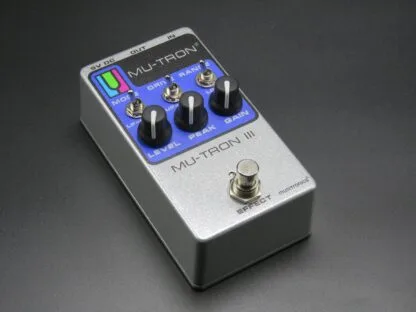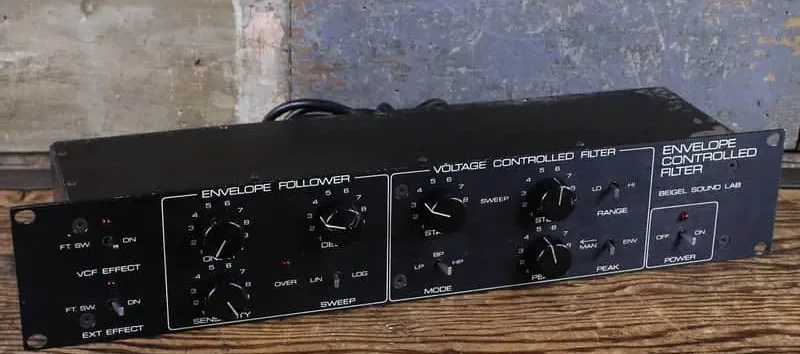


The Beigel Sound Lab Envelope Controlled Filter is an envelope filter effect unit from the 1980s, designed by Mike Beigel, the inventor of the envelope controlled filter effect and the developer of the original Mu-Tron III. Where a wah pedal moves its filter with your foot, an envelope filter moves it automatically with the level of your signal: play harder and the filter opens up, play softly and it closes down1.
According to the original Beigel Sound Lab advertisement, from which the maker's current product page draws its description, the unit combines three building blocks: a parametric envelope follower, a versatile voltage controlled filter, and an external effects loop1. That makes it more of a studio or rack-style processor than a simple stompbox, and its power requirement reflects that.
Where it came from
The Beigel Sound Lab Envelope Controlled Filter was designed by Mike Beigel, described in the company's own material as the inventor of the envelope controlled filter effect and the developer of the Mu-Tron product line1. The pedal was advertised circa the 1980s, placing it after the original Musitronics era of Mu-Tron envelope filters1.
The controls
The front panel is built around a set of controls that set where the filter starts, where it stops, and how it responds to your playing. The maker's product page describes each control as follows1:
| Control | What it does |
|---|---|
| RANGE | Allows the filter to sweep over two overlapping ranges |
| SENSITIVITY | Adjusts the envelope follower response to the input signal level |
| PEAK Control Switch | Allows control of the filter "peak" by either the Peak control or the signal envelope |
| MODE switch | Selects the filter characteristics desired for the musical effect |
| LIN-LOG Sweep Switch | Changes the way the envelope follower responds to your playing dynamics |
| EXT EFFECT | Electronically switches an external signal processor into the audio path between the input preamp and the voltage controlled filter |
| POWER | Turns the unit ON or OFF |
The RANGE switch selects between two sweep ranges. LO sweeps from 150Hz to 5KHz with the START and STOP controls set at 1 and 10, while HI covers 350Hz to 12KHz resonance frequency1.
The PEAK Control Switch has two positions. In MAN, the filter peak is set manually by the Peak knob. In ENV, the peak is controlled by the signal envelope: the louder the audio signal, the higher the envelope and the greater the peak1.
The MODE switch includes a BP (Band Pass) mode, which passes signals in the region of the filter's cutoff frequency1.
START, STOP and sweep direction
The START and STOP controls set the endpoints of the filter sweep, and their relationship determines the direction of the effect1:
- If STOP is set higher than START, the filter sweeps upward as you play.
- If STOP is set lower than START, the filter sweeps downward.
- If START and STOP are both set to the same value, the filter frequency does not change at all, and the unit performs similar to a one-channel parametric equalizer.
That last point is worth noting for players who want a controllable, resonant EQ rather than an auto-sweep: set the two controls equal and the unit becomes a static peak filter1.
The LIN-LOG switch
The LIN-LOG Sweep Switch changes how the envelope follower tracks your dynamics. In the LOG position, the effect is to compress the envelope response, making the unit much less sensitive to your playing dynamics. This gives you a way to tame the filter's reaction on dynamic playing styles, or to get a more even sweep from uneven picking1.
The external effects loop
One feature that sets this unit apart from simpler envelope filter pedals is the EXT EFFECT switch, which electronically switches an external audio signal processor into the audio path between the input preamp and the voltage controlled filter. In practice this means you can insert another effect, such as an overdrive or fuzz, ahead of the filter section inside the same unit, so the filtered signal is shaped by whatever you place in the loop1.
Specifications
The maker's product page lists the following measured specifications1:
| Specification | Value |
|---|---|
| Frequency response (bypass position) | 20Hz to 20KHz ± 0.5dB |
| Maximum input signal level (bypass position) | 6.3 v RMS (+18dBV) |
| Maximum signal gain (Peak Control = 10) | 24dB |
| Minimum signal gain (Peak Control = 1) | 0dB |
| Sensitivity for full envelope sweep | 75mv RMS (maximum) to 1.8 v RMS (minimum) |
| Dynamic range (measured at output) | 105dB worst case |
| Residual noise level | -93dBV worst case |
| Maximum undistorted output | +12dBV worst case |
| Envelope attack time | 5 milliseconds to 2.5 seconds |
| Envelope decay time | 10 milliseconds to 5.0 seconds |
| Envelope voltage output | 0 to 10 volts |
The wide attack and decay time ranges, from milliseconds to seconds, mean the filter can be set to snap open on each note or to swell slowly behind a sustained chord. The envelope voltage output of 0 to 10 volts is the control signal generated by the envelope follower, and it is what drives the voltage controlled filter: the louder the input signal, the higher the voltage, and the further the filter peak moves1.
This unit runs on AC mains power, specified at 115 VAC ± 15% with a 3AG 1/4 amp 125 volt fuse1. It is not a battery or pedalboard power supply product, and it is built for US mains voltage rather than 230V supplies.
Videos
gearmanndude
Pedals & Friends
David Hegland
Questions
Is the Beigel Sound Lab filter the same as a Mu-Tron III?
No, but it comes from the same designer. Mike Beigel invented the Mu-Tron III envelope filter in 1972, and the Beigel Sound Lab Envelope Controlled Filter is his later design, advertised in the 1980s. It combines a parametric envelope follower, a voltage controlled filter and an external effects loop in one unit.
What does the LIN-LOG switch do on the Beigel filter?
It changes how the envelope follower responds to your playing dynamics. In LIN the response is linear, tracking your attack more directly. In LOG the envelope response is compressed, making the filter much less sensitive to how hard or softly you play.
Can the Beigel Envelope Controlled Filter run on 230V power?
No. The maker specifies an AC supply voltage of 115 VAC, plus or minus 15 percent, with a 3AG 1/4 amp 125 volt fuse. It is built for US mains power, so players on 230V supplies would need appropriate voltage conversion.
What is the envelope voltage output used for?
The envelope follower puts out a control voltage of 0 to 10 volts that tracks the level of your input signal. This is the voltage that drives the voltage controlled filter, so the louder you play, the further the filter peak moves. It can also drive other voltage controlled gear.
Sources (1)
- Beigel Sound Lab, Musitronics Mu-Tron (mu-tron.com)