

The Mu-Tron III is an envelope-controlled filter pedal that Musitronics Corp. first released in 19721. It reads the envelope, or "volume picture," of every note you play and translates it automatically into a filter sweep, producing what Mu-Tron describes as "an easily-controlled, articulated, vowel-like sound, as fast or slow as you play"2. In plain terms: play harder and the filter opens further; pick faster and the sweep moves faster. It is one of the earliest filter pedals of its kind, and it works on guitar, bass, keys and more.
The pedal is an analog design built around photo-couplers (also called optocouplers or vactrols), which dynamically control a series of frequency filters based on the level of the input signal3. That opto-based circuit is a big part of why the pedal sounds the way it does, and why later copies have chased it for decades.
What it does: an envelope filter with vowel-like sweeps
An envelope filter, sometimes called an auto wah, is not the same as a wah pedal you rock with your foot. A wah sweeps on a fixed curve; the Mu-Tron III sweeps in response to your playing dynamics. Its patent description puts it precisely: "The filter peak response frequency is thus varied in accordance with the varying envelope of the sound generating signal"7.
Guitar World's Nick Wells described the range of textures it can produce:
"The wah sounds go well beyond those of a typical wah pedal, producing a wide variety of textures that include duck-like quacks, vowel-like vocal tones, piercing synth squeals and bowel-shaking bow wows"8
Aion FX notes that the vocal-like effect was quickly embraced by musicians and became a characteristic effect of entire genres, particularly funk3. Notable users include Bootsy Collins on bass, Jerry Garcia on guitar, and Stevie Wonder3. Premier Guitar reports that it became one of Jerry Garcia's signature sounds9.
The controls
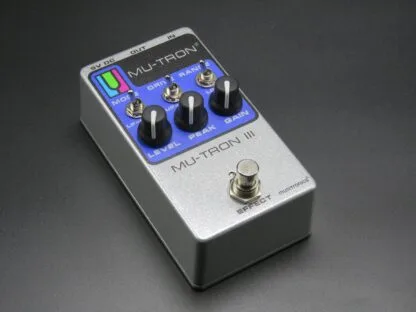
The Mu-Tron III has six controls: three knobs and three switches10. The controls and what they do:
| Control | What it does |
|---|---|
| GAIN | Controls the envelope and filter audio drive; sensitivity at the input for optimum operation from any musical source211 |
| PEAK (Frequency) | Controls the range of frequency manipulation4 |
| LEVEL | Controls the output volume of the effected signal (on later versions)12 |
| Mode switch (LP/BP/HP) | Selects the filter type: Lowpass, Bandpass or Highpass2 |
| Drive switch | Shifts the filter up or down for two totally different effects13 |
| Range switch | Adds the filter sweep to the low or high end of your signal10 |
A few points worth knowing as a player. The Low-High switch does not create distortion; it just focuses the envelope detector on bass or treble tones7. The drive switch's up and down settings behave very differently: one builder on the Guitar FX Layouts blog reported that "with the down sweep I can get some cool phaser like sounds controlled with picking velocity"7. Your guitar's volume knob is also part of the instrument here, since the pedal is reading your signal level the whole time7.
Power: ±9V from two batteries
The original Mu-Tron III runs on ±9 volts from 2 NEDA 1604 batteries, or from the Musitronics Model PS-1 Battery Eliminator2. Guitar World describes the early versions as running on either two 9-volt batteries or an 18-volt power supply8. Designer Mike Beigel explained the reasoning:
"We used a dual supply instead of a single supply so the effect could have a wide dynamic range"8
Late-'70s versions, made when Musitronics was owned by ARP, have a built-in power supply, so units from that era differ from the battery-powered originals8.
History and versions
The Mu-Tron III came out in 1972 from Musitronics Corp.1. Premier Guitar's builder profile tells the origin story: the circuit was derived from a Guild synthesizer, using the side of the instrument Beigel called the "timbre generator" and one of its four voltage-controlled filters9. The pedal was at first called the Auto-Wah9. The first units were sold at E.U. Wurlitzer in Boston; as Beigel put it, "They sold well, so we made more"9. A patent for the Mu-tron III was filed in 19759.
The timeline of the original and its descendants:
- The Mu-tron III was originally called the Auto-Wah9
- Its circuit was derived from the Guild synthesizer's "timbre generator" and one of its four voltage-controlled filters9
- Early units were sold at E.U. Wurlitzer in Boston, and they sold well, so more were made9
- Late-'70s versions, from when Musitronics was owned by Arp, have a built-in power supply8
- For many years, the performance of any given Mu-Tron III was based on the electrical performance of the photo-couplers, which did not all behave the same146
The original pedal went through revisions: Mu-Tron's own documentation for the Mu-Tron III+ lists two versions of the manual, one for serial numbers up to and including 2791 and another for serial number 2792 and above13. The original Mode selection was a rotary switch with three positions7.
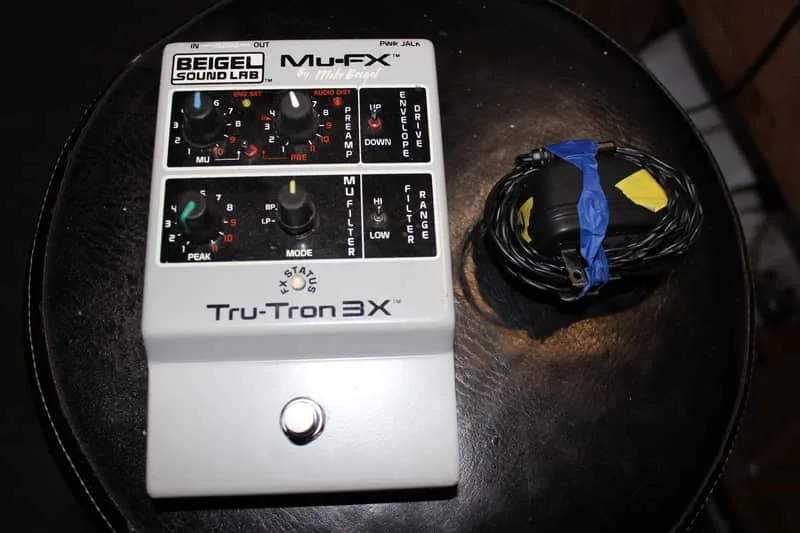
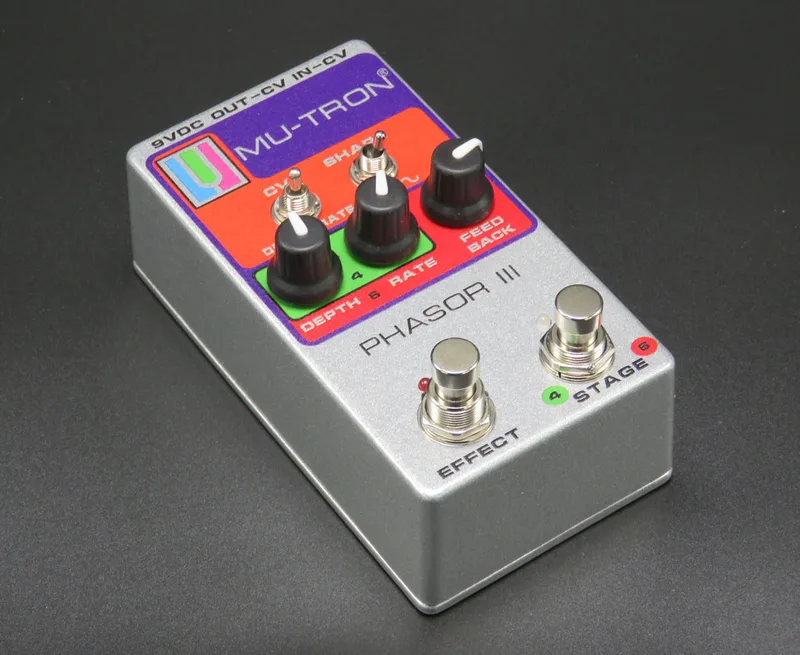
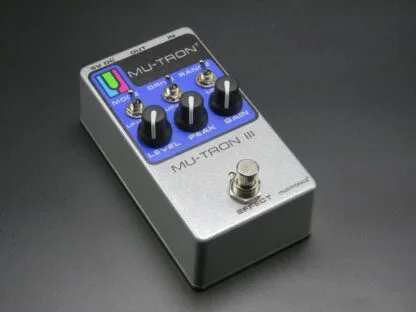
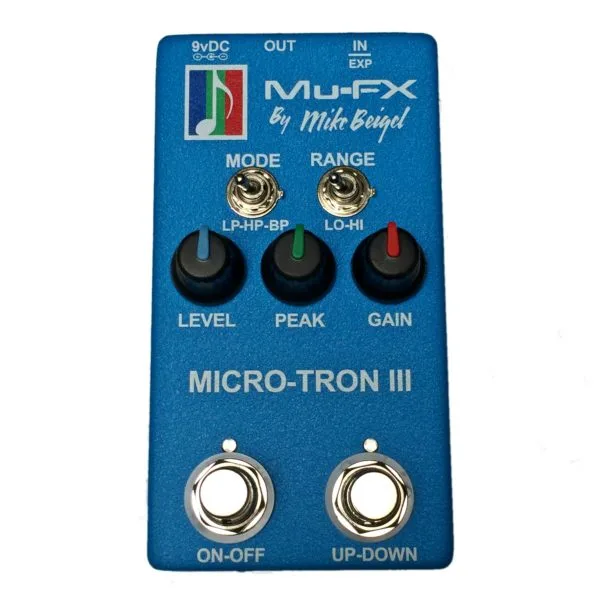
Later products carry the design forward. The Mu-Tron Phasor III is described as a compact, modernized and affordable version of the classic Mu-Tron Phasor II15. The Mu-Tron III Vintage Silver offers Low pass, Band pass and High pass modes4. The Mu-FX Micro-Tron III has its own owner's manual, covering its operation1216.
One quirk of the originals: for many years the performance of any given Mu-Tron III depended on the electrical behavior of its photo-couplers, which did not all behave the same, so two vintage units could respond differently6. The vintage units used a Hamamatsu 0805a photo-coupler6.
The Behringer B-Tron III
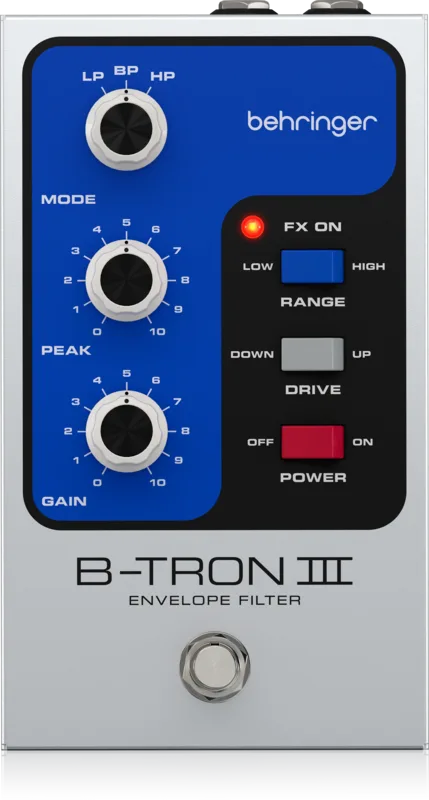
The Behringer B-Tron III is Behringer's envelope filter pedal, and the press has covered it in connection with the Mu-Tron III171819. Worth noting for comparison: the character of the original came from its photo-couplers, the vintage Hamamatsu 0805a part found in the vintage Mu-Tron III pedals, and for many years the performance of any given unit was based on the electrical performance of those photo-couplers, which did not all behave the same6.
What reviewers and builders said
Guitar World's assessment of the original's standing is blunt:
"This is probably one of the most copied pedals ever, though it seems few have come close to fully replicating its sound."10
DIY builders have their own take. The Guitar FX Layouts blog, which published a modified layout for the circuit, collected builder reports ranging from "this thing is amazing! There are so many tonal variations!" to complaints that the build is "not easy to wire but it's very fun to play with"7. One builder found the LP mode amazing but the BP and HP modes warbly and distorted in the high end, while another heard no discernible difference between the three modes7. Build notes from the same page: the 15uF cap should be non-polarized, and the TL072 can be substituted with most dual opamps but not the single NE55347.
Videos
BassTheWorld.com
Soultron
Bassklasse
News
Questions
What made the Mu-Tron III sound unique?
It used photo-couplers to control a voltage-controlled filter from the envelope of the input signal, so the filter sweep follows how hard and how fast you play. The result is an articulated, vowel-like sound rather than the fixed sweep of a typical wah pedal. Because the photo-couplers did not all behave the same, individual units could sound slightly different from one another.
Where should an envelope filter go in the signal chain?
Guitar World advises placing the Mu-Tron III at the front of the signal chain, with effects like compression and distortion plugged in after it. The reason is practical: the pedal reads the volume profile of your picking, so a compressor or distortion in front of it would reshape that envelope before the filter can respond to it.
When was the Mu-Tron III discontinued?
The original Mu-Tron III was discontinued around 1979 to 1980. Musitronics was sold to ARP in 1979, and ARP produced the pedals until 1980. The Mu-Tron name was later reacquired by designer Mike Beigel, and the circuit has been reissued in modern versions such as the Mu-Tron III Vintage Silver and the Mu-FX Micro-Tron III.
Did Jerry Garcia use a Mu-Tron III?
Yes. Premier Guitar reports that the Mu-Tron III became one of Jerry Garcia's signature sounds, and Aion FX lists Garcia on guitar among notable users, alongside Bootsy Collins on bass and Stevie Wonder. Mu-Tron's own marketing for later versions references the classic Jerry tone and Bootsy funk.
What is the Behringer B-Tron III?
The Behringer B-Tron III is an envelope filter that Behringer describes as creating a wah or vowel sound every time you play a note. MusicRadar called it an homage to the Mu-Tron III, and Guitar World described it as a $69 replica of the Mu-Tron III. It launched in February 2025.
Who designed the Mu-Tron III?
Mike Beigel designed the Mu-Tron III at Musitronics, and a patent for the pedal was filed in 1975. The circuit grew out of work on a Guild synthesizer, drawing on its timbre generator and one of its four voltage-controlled filters. Beigel reacquired the Mu-Tron name in 2018.
Sources (19)
- Mike Beigel, Musitronics Mu-Tron (mu-tron.com)
- Mu-Tron III, Musitronics Mu-Tron
- Lumitron Resonant Filter / Mu-tron® III, Aion FX, 2023-09-08
- Mu-Tron III Vintage Silver, Musitronics Mu-Tron (mu-tron.com)
- Mu-FX Tru-Tron 3X, Vintage Guitar magazine, 2015-09-04
- Mu-Tron Opto-Mod Modules for Micro-Tron IV, Musitronics Mu-Tron
- Guitar FX Layouts: Mutron III, Guitar FX Layouts (tagboardeffects.blogspot.com), 2014-06-19
- How the Mu-Tron III became a vintage pedalboard icon, Guitar World, 2026-02-09
- Builder Profile: The Mu-tron Story, www.premierguitar.com, 2013-09-12
- The Mu-Tron III: “Without it, there ain't no Bootsy”, Guitar World, 2023-03-17
- That Pedal Show, That Pedal Show, 2017-11-17
- Mu-FX Micro-Tron III, Musitronics Mu-Tron
- Mu-Tron III+ Envelope Controlled Filter, Musitronics Mu-Tron
- Mu-Tron Opto-Mod Modules for Micro-Tron IV, Musitronics Mu-Tron
- Phasor III, Musitronics Mu-Tron
- Micro-tron III by Mu-Tron, RockBoard PedalPedia, 2026
- B-TRON III ENVELOPE FILTER, Behringer
- “This thing is your one-way ticket to funky town”: Behringer's long-awaited Mu-Tron III clone arrives and promises a rabbit-hole of retro-funk tones for just $69, MusicRadar, 2025-02-06
- Behringer blasted by Mu-Tron III maker over $69 replica, Guitar World, 2025-02-17
 Tim Mahoney