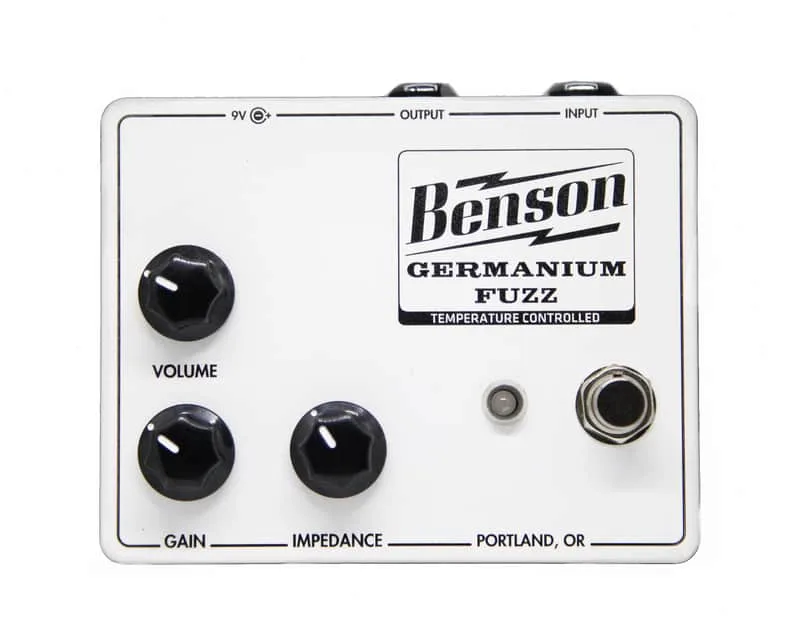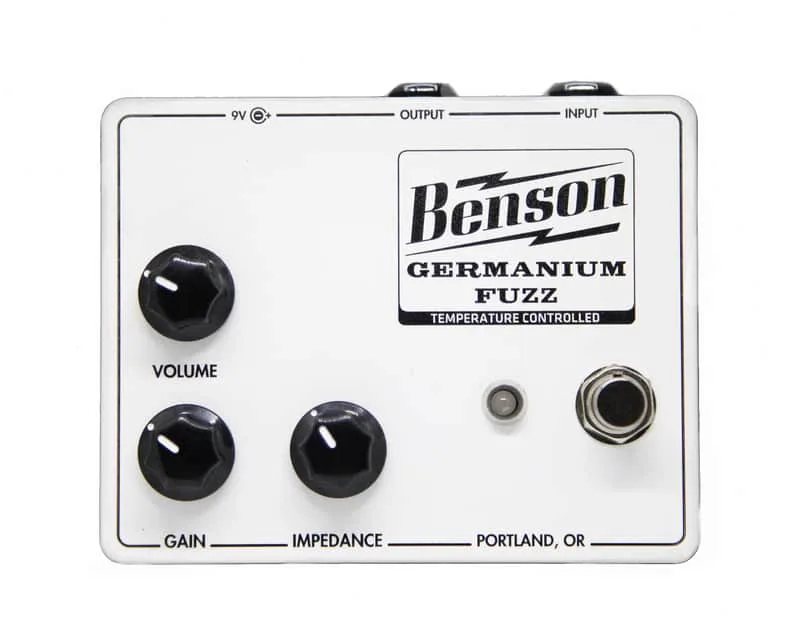


The Benson Germanium Fuzz is a fuzz pedal from Portland's Benson Amps, the makers of the sought-after Preamp pedal, built around two germanium transistors in the ubiquitous 60's circular fuzz topology, a Fuzz Face variant123. What sets it apart from most germanium fuzzes is its automatic thermal bias technology: a circuit that gently warms the transistors to a preset operating point, so the sound stays consistent regardless of the temperature around it12.
Germanium fuzz circuits have always been finicky. Their sensitivity to temperature changes affects gain, bias and tone consistency, and they are known to fight with buffered pedals and humbuckers. This pedal was designed to solve those problems2. It is voiced as a "pretty" fuzz in the 60's and 70's classic rock and psychedelic rock vein, not a spitty, harsh experimental fuzz: it often sounds like an overdrive or distortion until the gain is all the way up and the impedance is turned down24.
A germanium fuzz that heats its own transistors
The core idea is the heater. The bias of the transistors is automatically regulated by a circuit that warms them to a fixed operating point, a patent-applied-for design178. When the LED is orange, the transistors are warming up to increase their hFE (transistor gain) and to shift the bias point to the correct voltage; when it turns green, the correct bias and hFE are set and the warmer switches off, toggling back and forth as needed while the pedal is on24.
On That Pedal Show, Chris Benson explained the indicator and the wait in plain terms9:
"when heater's on it's Amber and when it's off it's green"
"it takes three three or four minutes for it to fully heat up depending on the ambient temperature"
Other reports put the warm-up at 2 to 3 minutes on average after plugging into power before the pedal sounds correct25. The pedal is designed to operate between freezing and 100 degrees Fahrenheit, though it might still sound fine outside that range25.
Because the heater fights the temperature problem at the source, the finish matters outdoors. Benson offers two colors chosen with temperatures in mind: Studio Black, which is not meant for direct sunlight, and Solar White, which is fine with it. Benson says there is a 20 degree Fahrenheit difference between a black pedal and a white pedal in direct sunlight25.
The controls
The pedal keeps it to three knobs, and they are interactive rather than independent27.
| Control | What it does |
|---|---|
| Volume | Sets output level7 |
| Gain | Adjusts gain, from a rich clean boost through overdrive up to an aggressive fuzz with some octave overtones27 |
| Impedance | Bypassable control that simulates rolling down the guitar volume for a tight, sparkly sound, without touching the guitar's volume knob24 |
The impedance and gain controls are very interactive, offering many colors of tone24. The circuit has been tuned so the pedal works as a rich sounding clean boost, an overdrive, or an aggressive fuzz with some octave overtones, depending on where the gain sits2.
There is also an internal trimmer, precisely set at the factory. Turning it voids the warranty2.
Do not turn the internal trimmer. It is precisely set at the Benson factory, and turning it voids the 2 year warranty2.
Buffers and placement
A Class A buffer is installed at the very input of the pedal4. Reviewing for guitar.com, Michael Watts noted that Benson also added a class A buffer feeding a passive guitar pickup simulator6. From serial number 2501 onward, that extra buffer and pickup simulator drastically improve compatibility with other pedals in a chain2. Benson has also said he put a buffer in the front end so the pedal presents a high input impedance9. For players used to germanium fuzzes misbehaving after a buffer or with humbuckers, this is the practical fix2.
Power: 9V, under 100mA
The Germanium Fuzz runs on a 9V DC Boss style center negative power supply only, and there is no battery2. guitar.com's review likewise lists a 9V center negative power input only6. It draws less than 100mA when the heater is engaged, and far less when the heater is off2.
More than 9V DC could destroy the pedal or the power supply, and there is no battery option, so plan a dedicated 9V outlet on the pedalboard2.
History and versions
The Germanium Fuzz came out of work by Chris and the Benson Amps crew4. Premier Guitar's press release tells the origin story: Chris set up a remote workspace in an eighties RV and got to work designing a pedal, and because the correct germanium transistors are difficult to source, the Germanium Fuzz will only be built when there are parts available, sold until supplies run out8. On the release date, sources disagree: a JHS Pedals video with Chris Benson says the Germanium Fuzz pedal started in 202010, while Guitar World reports the Germanium Fuzz and Germanium Boost were launched in 2021103.
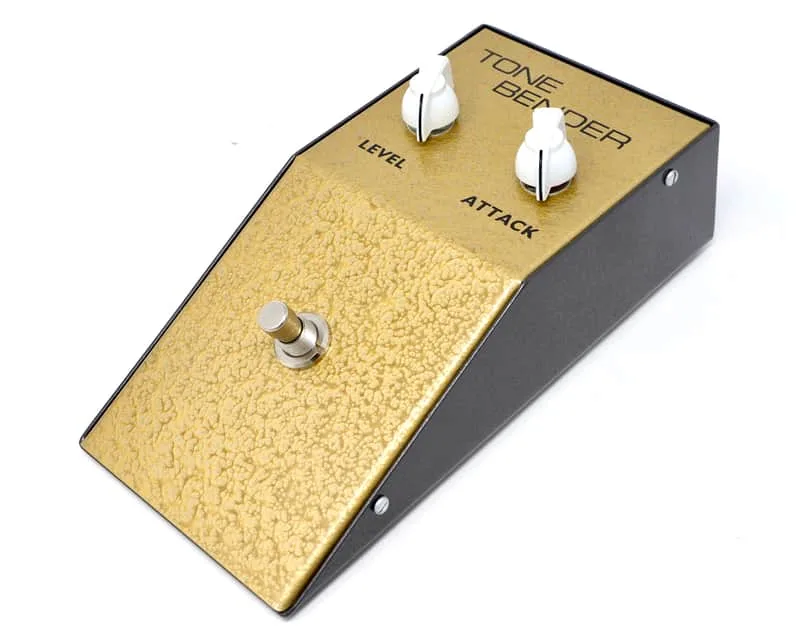
The circuit is a Fuzz Face variant set up in the 60's circular fuzz topology and tuned for good sound13. In the JHS video, Josh described it in circuit terms:
"this is a more tame fuzzace tomb bender mark 1.5 circuit"
Benson later applied the same thermal bias idea to another circuit: the Benson Germanium Boost grew out of a voltage controlled error correction circuit that was rejected during the Germanium Fuzz's development, when the temperature control approach was chosen instead111213.
The Germanium Boost
A sibling pedal came out of the same development. While designing the temperature controlled fuzz, Benson tried a voltage controlled error correction circuit to bias a single germanium transistor; it ultimately did not work for the fuzz, which is comically sensitive to transistor gain attributes, but it became the Germanium Boost, a one-knob germanium clean boost pedal123. The maker describes the result as a germanium clean boost that can use a germanium transistor without the weird artifacts that were previously unavoidable, with a bias correcting circuit13. It lists at $199.00, runs on 9V DC center negative only with space for a battery, and carries a 2 year warranty13.
Reviewing it for guitar.com, Richard Purvis found the Level control cuts output on the left side of the dial with unity gain around the number five, and rated it 9 out of 10 overall11:
"High-priced and high-class, this is a really nice booster and an equally nice always-on tone improver."
What reviewers said
Pedal of the Day called it a gorgeous fuzz pedal, one that pairs perfectly with Benson's Preamp pedal, and noted the fuzz tone is not spitty or harsh, more often sounding like an overdrive or distortion until the gain is all the way up and the impedance is turned down4. gearnews.com framed the patent-applied-for tech as potentially making a huge difference for players seeking vintage germanium fuzz tone without the usual hassle7, and MusicRadar asked whether the temperature controlled design was about to set a new benchmark for pedals47.
Videos
Benson Amps
AndyDemos
Mike Hermans
News
Sources (13)
- Germanium Fuzz by Benson Amps, RockBoard PedalPedia, 2026
- Benson Germanium Fuzz, Delicious Audio, 2023-04-20
- Benson expands its temperate-controlled fuzz pedal range with the vintage '60s flavors of the Stonk Box, Guitar World, 2023-05-18
- Benson Amps Germanium Fuzz, Pedal of the Day, 2021-11-01
- Central heating in a fuzz pedal? Benson's new Germanium Fuzz sounds interesting!, MusicRadar, 2021-02-03
- Benson Germanium Fuzz Review: Benson’s new fuzz pedal is a temperature-controlled game-changer, guitar.com, 2021-04-19
- Benson Amps' Germanium Fuzz uses thermal biassing for consistent '60s fuzz tones, gearnews.com, 2021-02-03
- Benson Amps Releases New Germanium Fuzz, Premier Guitar, 2021-02-02
- Chris Benson Of Benson Amps & Pedals At TPS! Preamps, Fuzzes, Delay, Surf's Up & Florist, That Pedal Show (YouTube), 2024-05-16
- Temperature Controlled Fuzz!? (Benson Stonk Box Germanium Tonenbender MK1 Zonk Machine Fuzz), JHS Pedals (YouTube), 2023-06-14
- The Big Review: Benson Germanium Boost, Guitar.com, 2022-02-03
- Benson Amps Germanium Boost, Pedal of the Day, 2022-04-06
- Germanium Boost, Benson Amps